Our Rabbit Neighbors

6%

Review and Herald Publishing Company · Battle Creek, Michigan · March 19, 1903

FromThe Youth's Instructor, Vol. LI, No. 11

Read the full edition

Our Rabbit Neighbors

(Concluded)
It seemed like a hard day for poor Bunny when men settled up the country, brought in fences of all kinds, cut down the trees, mowed off the hazel brush, and plowed the fields; but she has learned just how to make the best of circumstances as she finds them. If her blackberry briers have all been mown down, she will sleep in the brush pile; and when that is gone, she very wisely sleeps in the hedge fence that man has so carefully set out and tended. Here she is usually safe, and that is the reason almost all the rabbits in the neighborhood are to be found along the hedge fences. When a dog comes near, all Bunny has to do is to dodge through the fence, and run along on the other side; and if, after wasting a great deal of time, he happens to get over where she is, she simply jumps back again, and is safe.
If there are no hedge fences, she has carefully followed along every other fence in the neighborhood, and knows just where a dog can go, and where he can not come. Two years ago an old rabbit lived all winter long within twenty-five yards of my father's house, and the house dog chased her two or three times every day; but she always led him into the wire fence, and while he was hanging on the barbs, and whimpering, and trying to get through, and scratching himself, she would get safely away.
We may rest assured that there is not a hollow tree, nor a hole in the ground, nor a place where she can get under a hay-stack or under a barn, within a mile of her home, that Bunny does not know all about, and just how to reach it in the shortest possible time. No one knows any better than she that a dog can follow her track by the scent; so she never goes anywhere without running around in circles every little while, and so crossing her track that the dogs will have trouble in following it.
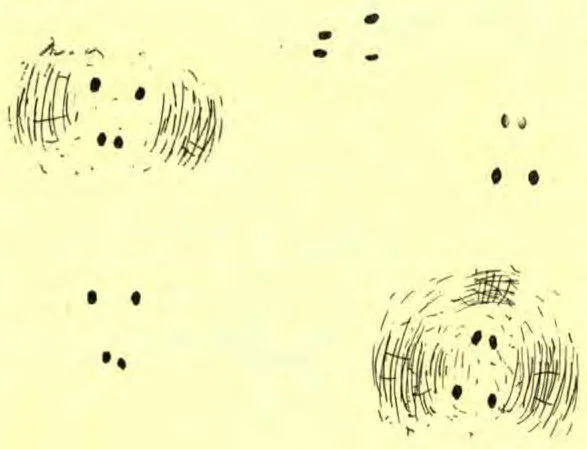
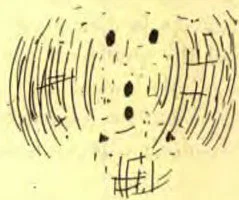
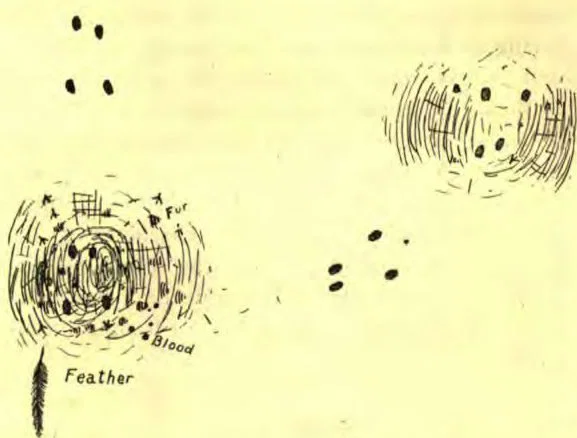
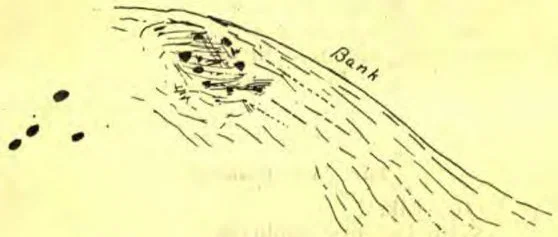
When you go into the woods, and see a rabbit track running right along in a straight line, without any break, you may know that the rabbit that made it was in danger, perhaps was being pursued by some enemy, and was escaping as fast as her little legs could carry her. If you do not see the tracks of a dog or some other animal after you have followed this track for a little distance, you are quite safe in concluding that she was fleeing from some bird. The accompanying illustration will tell you, better than I can describe it, a story that I found written in the snow about a year ago.
I was walking through a large cemetery when I noticed tracks that showed that a rabbit had been running for dear life; and I followed them, to see what it could mean; for there were no other tracks in sight. After I had gone about two hundred yards, the tracks suddenly changed direction, as if poor Bunny had made a wild leap to one side, and just where she had made this side leap, were marks in the snow, like the ones you see in the picture. Then I knew that some bird had been after her, but for the life of me I could not tell what; so I followed the tracks back and forth, in and out, for a few more rods. Every little while there were tail- and wing-marks in the snow, and at last I saw that the trail was beginning to be marked by drops of blood. Two rods farther on there was a place where the snow was all mashed down, and scattered over with tufts of fur and drops of blood; but Bunny had got away; for the track led on, showing more desperate leaps than ever. As I was turning to follow the track, I picked up the feather of a crow, and saw that what I had surmised was true; for a hawk would have borne the rabbit away at once.
Bunny ran about twenty-five yards farther, and there I saw evidences of another tussle. Carefully comparing the tracks in the snow, I saw that there had been more than one bird. Again Bunny escaped, and ran down a bank. I followed a little farther, and saw where the tracks ended, to go on again no more. Plainly, her pursuers had devoured most of the unfortunate rabbit where they had killed her, and then some other bird had come along, and borne the carcass away. Crows seldom do this.
I returned to my room to get my note-book and pen, so I could make a sketch of what I had seen. As I drew near the place, an hour later, I glanced up to the top of a tree that stood just over the spot where poor Bunny had been eaten, and there sat three black crows. To me they looked like three murderers, and they seemed to feel guilty; for as soon as they caught sight of me, they flitted away like evil shadows.
On the Western plains, where there are no good places to hide, the rabbits have grown larger, and have much longer legs. We call them jack-rabbits there, and they can run like the wind. It is very seldom that either a dog or a horse can catch a jack-rabbit as he bounds away across the prairies. This kind of rabbits could not run well among the brush of our Eastern States; for they would be constantly knocking themselves down. So, as civilization has gone westward, and the country has been planted with timber and brush, the jack-rabbits have gone before it. Now they are scarce in Iowa, and are not found at all east of the Mississippi River.
But the jack-rabbit is not left entirely without protection. On the Western prairies grows the soap-weed, or “Spanish bayonet.” Its spear-like leaves project in every direction, and form a bulwark which no wandering coyote is anxious to investigate. Under these the rabbits of the prairies sleep as confidently as their cousins under the gooseberry bush farther east. Where it is too dry for the soap-weed, the cactus thrives; and under the shelter of a clump of “prickly-pears,” he rests secure from danger.
High in the Rocky Mountains, where the soft, dry snows of perpetual winter lie deep, there is still another rabbit, which God has made to dwell there in safety. Were the ordinary rabbit to run over these loose snows, he would sink in so deeply that he would be an easy prey to his pursuer; but here we have the “snow-shoe rabbit,” whose feet are widened out, and padded with long, stiff hair, until he races over the fleecy snow without fear of sinking. Men have made them snow-shoes to travel in these regions; but the great Father of all, who knows the needs of every one of his creatures, has made these innocent creatures to live among the rocks, and has so equipped them that they may dwell there in safety.
I have given only a little sketch of this most common and interesting little “neighbor.” If the children will get out in the open air, and use their eyes, they will learn much more of interest that I have not even mentioned; and it will bring health to their bodies, joy to their hearts, and wisdom to their minds.