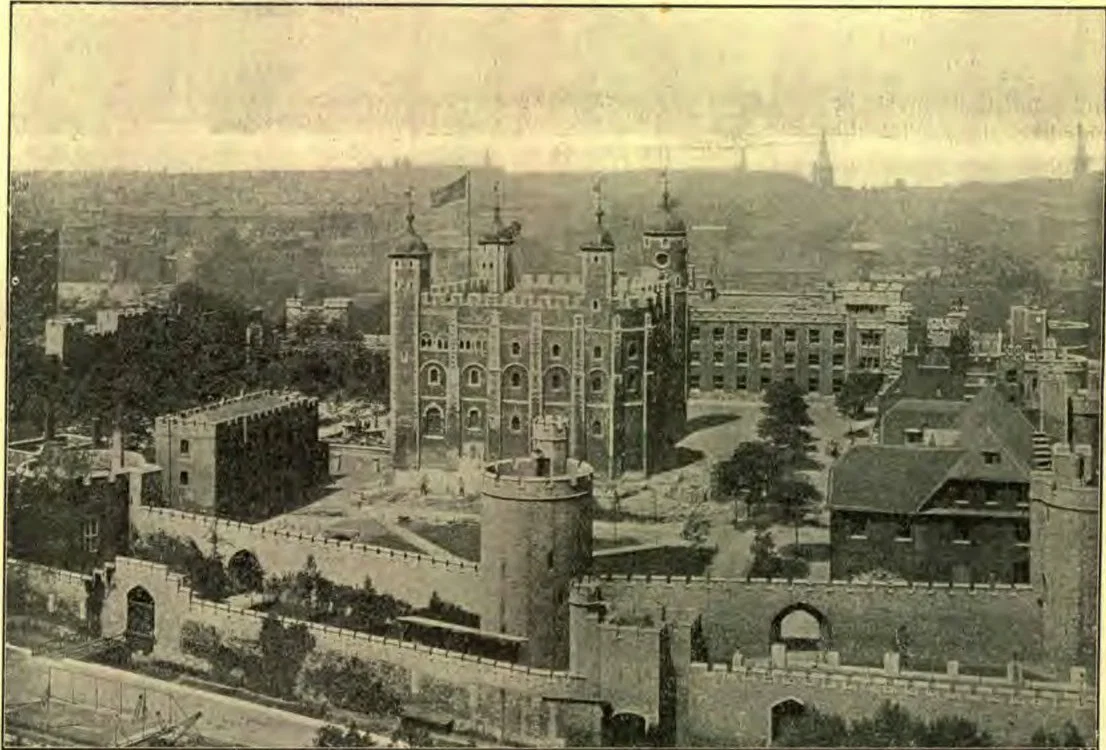
No other institution in England exceeds in historical interest the Tower of London. It is said to be of Roman origin. The accompanying illustration represents a portion of the Tower very accurately.
The buildings and courts cover about eighteen acres. In the center is the celebrated White Tower, built by William the Conqueror. At one time this was the royal residence of England. Beneath this Tower are the famous dungeons where Sir Walter Raleigh, Guy Fawkes, and many other celebrated prisoners were kept. Adjoining them is the Torture Chamber, where many such prisoners were tortured at midnight to force confessions and the revelation of plots. The walls of these dungeons are solid granite, sixteen feet in thickness. When the cells were used as prisons, there were no windows nor ventilators of any kind.
In the upper part of this building is the Armory, where many relics are preserved; such as armor-clad knights on horseback, the rack used for the torture of victims, the ax and block for executions, etc.
Beauchamp (pronounced Bē’cham) Tower, at the left of the White Tower, was the prison where many victims were imprisoned during the persecutions of the sixteenth century. Among these were Sir Thomas Moore, Bishop Fisher, Anna Boleyn, Catharine Howard, Lady Jane Grey and her husband, and many others. Several of these were executed on the block in the Tower Yard. The place is distinctly marked by a memorial plate in the pavement. In two places in Beauchamp Tower we find the name Jane cut in the solid rock. It was probably engraved by some prisoner who was confined here with the unfortunate Lady Jane Grey.
The Crown Jewels are exhibited in Wakefield Tower, among which is the crown of St. Edward, which has been used at the coronation of all the kings and queens of England since the time of Charles the Second.
The most interesting entrance to the Tower is the Traitor’s Gate, which opens from the River Thames. Royal and princely prisoners were always brought into the Tower by boat through this gate. The Tower is cared for by the Yeomen of the Guard, commonly known as “the king’s beef-eaters.”
The Tower Bridge
The Tower Bridge crosses the Thames just below the Tower of London, and is one of the finest pieces of architecture in the city. It was built in 1871 by Sir Horace Jones, who was the first to conceive the idea of opening the central span by lifting it in two parts, as shown in the picture on the next page. The mechanism is quite perfect. The great span of two hundred feet can be opened for the passage of vessels in two minutes. The total length of the bridge is nine hundred and forty feet; and the distance from high water to the upper span is one hundred and thirty-nine feet six inches; in other words, when the span is open, a ship having masts one hundred and thirty-nine feet six inches high above the water can pass beneath the bridge. Traffic is not hindered when the span is open; for the people are taken up to the higher bridge by elevators, and lowered in the same way on the other side.
London Bridge
Not far above the Tower Bridge is London Bridge. The traffic across this bridge is enormous. This is probably the busiest point in London, with the possible exception of the street in front of the Bank of England. London Bridge is built of granite, and was completed in 1831 at a cost of ten million dollars.
LONDON TOWER, WITH THE WHITE TOWER PROMINENT IN THE CENTER
Smithfield
Smithfield is a familiar name to our young people who have read the History of the Reformation in Great Britain. In ancient times it was a large open space in front of the ancient little church of St. Bartholomew, commonly known as St. Bartholomew the Grand. It was on this open space, and directly in front of St. Bartholomew’s Chapel, that over two hundred prisoners, among whom was John Rogers, were burned at the stake for their faith. These executions were largely during the reign of Queen Mary. It was here, also, that Walworth, mayor of London, slew Watt Tyler, the leader of a rebellion. The Scottish patriot, William Wallace, is also said to have been beheaded here. For many years this open space was used as a cattle market; but the Smithfield of then was not the Smithfield of to-day. Great markets of brick and stone, paved streets, and long rows of shops and residences have obliterated the Smithfield of history. All that is left is a small square paved with stone where the marketmen feed their horses. Even the churchyard and cemetery of St. Bartholomew have been trespassed upon; for within the quaint old entrance-gate of the churchyard are small shops, liquor saloons, and other public buildings, which seem cruelly desecrating to the visitor.
St. Bartholomew the Grand
St. Bartholomew’s Chapel is the oldest church in London. It was founded in 1102, nearly four hundred years before Columbus sailed across the Atlantic. Services are still held two or three times a week in this venerable old pile, the columns of which are more than half eaten in two by the action of time. We had the good fortune to visit the chapel when the Sunday morning service was about to begin, and one of the ush- ers kindly explained to us many items of interest. As we stood beneath the crumbling arches of one of the old cloisters, and listened to the quaint service and the deep tones of the organ echoing along the time-worn roof, a strange solemnity came over us; for it was in this very building, and before this altar, that scores of noble men deliberately and fearlessly made the decision to lay down their lives by the ordeal of fire rather than prove untrue to the God whose light had shone into their hearts.
Such men are needed to carry the cause of truth to the world to-day.
Bunhill Fields
On the city road in Finsburg is a little plat of four acres of ground which is interesting to every traveler. This was used as a burying-place during the “great plague” of 1665, when over a thousand cart-loads of human bodies were deposited here from the charnel-house of St. Paul’s.2It is said that over one hundred and thirty thousand persons were buried in this cemetery during the century preceding 1852. Here, in the midst of this great gathering of the bodies of the dead, rest the remains of John Bunyan, author of Pilgrim’s Progress; Daniel De Foe, author of Robinson Crusoe; George Fox, the founder of the sect of Quakers; Dr. Isaac Watt, the author of so many beautiful hymns; Susannah Wesley, the mother of John and Charles Wesley; three of the grandsons of Oliver Cromwell; and many other noted personages.
John Wesley’s Church
Across the street from Bunhill Fields is the little old church where John Wesley preached the grand and soul-stirring doctrine of sanctification and justification by faith. The caretaker permitted us to go through the church, and sit in the chair and in the pulpit once used by this devoted man. It seemed almost like sacrilege to sit in his pulpit simply from curiosity; for the memory of the great work accomplished under the blessing of God by this man leaves an atmosphere of awe and reverence about these historic relics.
In the yard behind the church are the graves of John Wesley and Dr. Adam Clarke. In front there is a fine statue of Wesley, on which are his memorable words, “The world is my parish.”