I PROMISED to tell my young friends something in regard to the prevailing religion of the Burmese people. They worship Buddha, “The Wise,” or “The Enlightened,” and after him they are called “Buddhists.” Their religion is very old, nearly twenty-five hundred years; and its monuments, temples, shrines, and monasteries are innumerable. Its festivals are carefully observed; and its monastic system is fully established in every part of the kingdom. The members of the monastic fraternity are known as pon-gyees, or “holy men.”
The pon-gyees are not exactly priests, but rather what we would call monks. Their religious ministrations are confined to sermons, and they do not interfere with the worship of the people. They are a very numerous class, and may at once be known by their yellow robes (the color of mourning), shaven heads, and bare feet. They subsist wholly by charity. The vows of the pon-gyees include celibacy, poverty, and the renunciation of the world; however, a pon-gyee may at any time be released and return to a secular life. Hence nearly every Burmese youth assumes the yellow robe for a time. The object of the brotherhood is the more perfect observance of the laws of Buddha.
While visiting the “Golden Pagoda,” a temple in Rangoon, we noticed a young Irishman who had joined the pon-gyees, and learned that he was very influential among the monks. The rosary is in general use among the followers of Buddha. The Burman is free from fanaticism in the exercise of his religion, and his most sacred temples may be freely entered by the stranger without offense.
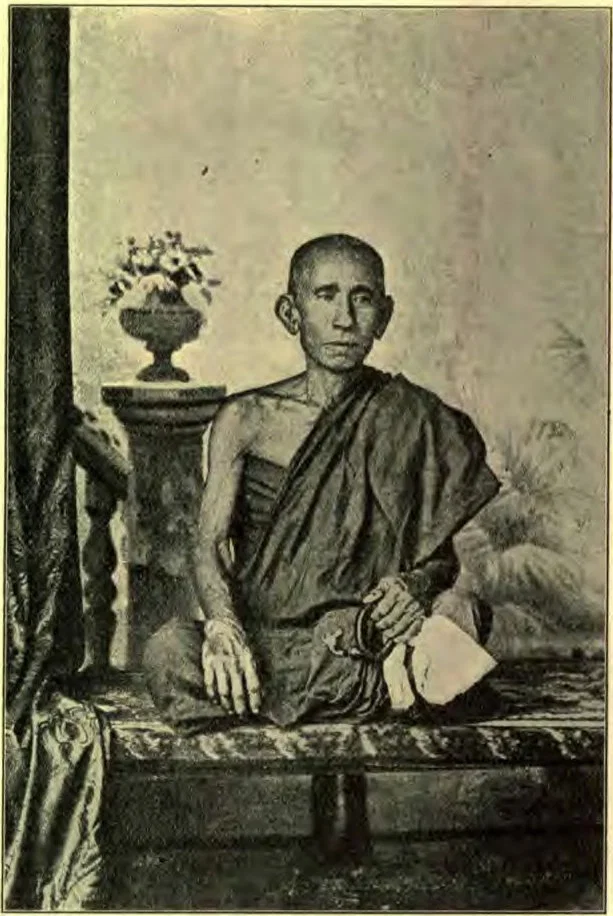
Buddhism teaches man to combat, control, and master the passions of his heart, to make reason predominate over sense, mind over matter, and to practise the virtues required for the attainment of these objects. Buddhism accepts without questioning, and in its most exaggerated form, the doctrine of the transmigration of souls, which lies at the root of so much that is strange in the Eastern character. According to Buddhist belief, when a man dies, he is immediately born again, or appears in a new shape, and that shape may, according to his merit or demerit, be any of the innumerable orders of being composing the Buddhist universe, from a clod to a divinity. It is believed that Buddha himself before his last birth as Sakyamuni (monk) had gone through every conceivable form of existence on the earth, in the air, and in the water, in hell (as they believe in it) and in heaven; and had filled every condition in human life. When he attained the perfect knowledge of the Buddha, he was able to recall all these existences.
This will be sufficient to show you the need of Christian workers among the Burmese. We find them much interested in our health principles, as they themselves are vegetarians. They are anxious to have “Shall We Slay to Eat?” translated into their language.
Sister Meyers and myself visited one of their temples one morning as they were preparing for a feast. When they learned from our Burmese sister, Mah May, that we were vegetarians, they were much pleased, and gave us a friendly invitation to have a meal with them. We enjoyed some luscious fruit in their company. They also gave us some of their tracts.
The largest temple they have is the “Golden Pagoda,” in Rangoon. I must not close without saying a word about this colossal building, which is about three hundred and fifty feet high, and is covered from the top one hundred and fifty feet downward with gold plates, each worth about sixty dollars. Any person furnishing a plate is considered to have done an actual act of merit, and is sure of a future reward. The picture shows the front entrance to the Pagoda. You will notice that it is guarded by two gigantic griffins, which are supposed to be imposing enough to scare away intruding spirits. On a feast-day the broad stairway is alive with throngs of gaily dressed worshipers coming and going; and here also the maimed and the halt congregate to solicit alms.
Among the beggars we saw many a loathsome sufferer from leprosy.
That our young people may be interested in the Burmese field, and that some of them may desire to work among the people, is my sincere prayer.
THEKLA BLACK.
Karmatar, India.