Thebes
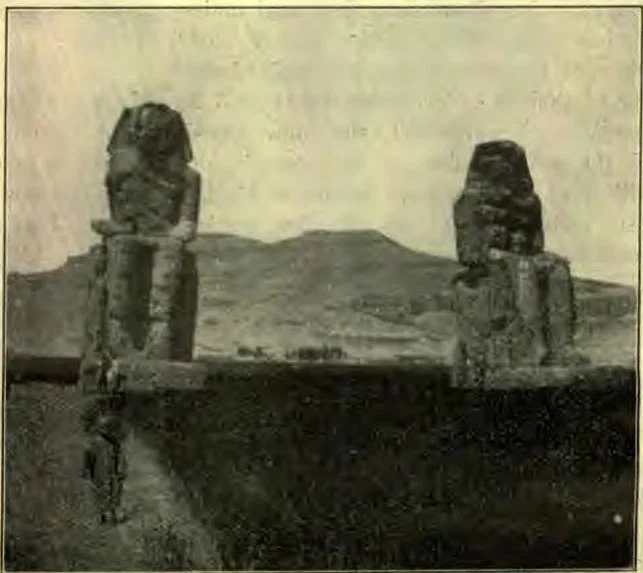
HAVING been told that we have seen the best of all at Karnak, we do not expect much of the ruins across the river, and are agreeably surprised to find so many things that are novel and interesting. Crossing the Nile at Luxor, we find first the Colossi of Memnon, two large sandstone statues. The northern one is celebrated for its long-lost vocal powers. It is related that after the mythological Grecian hero, Memnon, was killed at Troy, he appeared at Thebes in the form of this colossus, and when his mother Eos presented herself at sunrise, she was greeted with a plaintive musical note. The fact of the sound is established by many unimpeachable witnesses, and is variously described. Septimius Severus repaired the statue, and it has since remained silent. The sound is now thought to have been produced by the sudden heat of the rising sun expanding the stone, and causing numerous minute particles to be cracked off.
Near the colossi are the ruins of the Ramesseum, a large temple built by Rameses II. Some of the inscriptions recording his victories over the Hittites are very interesting. The large fallen colossus in the first court is a striking example of the sculptural and artistic skill of the ancient Egyptians.
Passing the large temple of Seti I at Kurna, we proceed along the winding valley road that leads through the desert hills to the tombs of the kings. It appears that the Theban monarchs preferred excavating tombs for themselves in the rock of the Biban el Mulak to erecting immense pyramids as did the kings of Lower Egypt. The long, broad passages, sometimes leading for hundreds of feet down into the solid rock, terminate in large subterranean chambers, often magnificently decorated. These tombs are now lighted by electricity, which makes them easy of access. The tomb of Seti I is perhaps the most interesting. The inscriptions on its walls form a complete and graphic exposition of the old Egyptian religion,—especially that part which relates to the future state, or “underworld.” The vaulted roof is decorated with an astronomical and astrological charts, containing all the signs of the zodiac. The tomb of Rameses III also presents inscriptions of great variety and excellent execution, and is peculiar for its ten-sided chambers. In the principal chamber of the elegant and recently discovered tomb of Amenophis II, the sarcophagus still contains the mummy of the dead monarch, giving the splendid sepulcher a realistic air that is almost ghastly.
Tourists usually return from the tombs of the kings over the mountain road which descends in full view of the large temple of Der el Bahri, built by Queen Makare. The queen's brother, Thothmis II, who succeeded her, conceived the gallant design of erasing all mention of his sister from the inscriptions of the temple, and supplying his own name in their place. He succeeded so well that the original inscriptions were never entirely restored. This splendid temple is built up against a massive cliff, which, towering hundreds of feet above, completely dwarfs the comparatively insignificant ruins. So always do the works of God stand out in comparison with human productions.
The ascent of the mountain west of Thebes is impracticable for women, and not without danger for men; but it affords a splendid view, including all the temples and tombs of Thebes, Luxor, and Karnak, the broad, fertile plain which extends from Armant to Kons, with the Arabian desert in the background; while on a clear day, and with the aid of a good glass, even the pylons of Edfu, sixty miles away, may be discerned. Descending from this mountain, we may visit the small but elegant Ptolemaic temple of Der el Medina, in one of the chapels of which is the celebrated judgment scene, representing Osiris, god of the “Underworld,” sitting in judgment, surrounded by Horus, the dog-headed Anubis, and all the genii and demons of Hades in full array. While Ptolemy Philopater is offering incense to Osiris and Isis, Horus is weighing his heart in the presence of goddesses of truth, as the ibis-headed scribe, Thoth, records the verdict.
Before leaving Thebes, we should visit the large temple of Medinet Habu. On the high wallsp. 2 around this temple are related in glowing terms, and illustrated by means of immense figures in relief, the exploits and victories of Rameses III over the Libyans. In another place is a very interesting calendar of all the Egyptian festivals. The pylons and courts of this temple are fairly intact, but the sanctuary and its chambers are hopelessly in ruins, yet some of the reliefs still retain traces of the brilliant coloring for which they were once so noted.
After completing the rounds at Thebes, we find ourselves thoroughly fatigued, so we spend several days in resting and digesting what we have seen before starting on for Assuan.
Assuan
The journey from Luxor to Assuan is very trying. The railroad is a narrow-gage line, and the accommodations, even in the first class, are poor. In many places above Luxor the Nile Valley is so narrow as barely to give the railway a foothold between the river and the desert rocks. Leaving Luxor, we pass through the desert for a few miles, and then come in sight of the smokestacks of the extensive sugar works at Arment, on the west bank of the river. The slender minarets of Esneh, and the pylons of the temple of Edfu are soon passed, both being also across the river. At Selwa we enter a broad tract of fertile land, which, however, is uncultivated, being above the inundation line. Two hours more bring us to Assuan in the evening, after the hottest and dustiest eight-hours' trip we have ever experienced.
Leaving the station, we take a stroll up the wide, beautiful avenue which extends over a mile along the bank of the river; and we agree at once that Assuan is the most charming spot in Upper Egypt. The first cataract of the Nile is here, and the river channel is deep and narrow, divided by rocky, picturesque islands, whose tops are crowned with groves of luxuriant date-palms. From the largest of these islands, the Elephantine, shine the lights over the Savoy Hotel, stealing silently over the water, and leaving a shimmering, golden pathway across the river. The last pink glow of the fading sky lights up the ripples with a golden tint until the river looks like a “sea of glass mingled with fire.” The soft, spicy breeze, bearing the perfume from the purple shadows of the distant mountain, brings on a delicious, dreamy languor as the traveler drops into a seat by the shore, lost in silent yet ecstatic admiration of the exquisite and almost unearthly beauty of the landscape spread out before him.
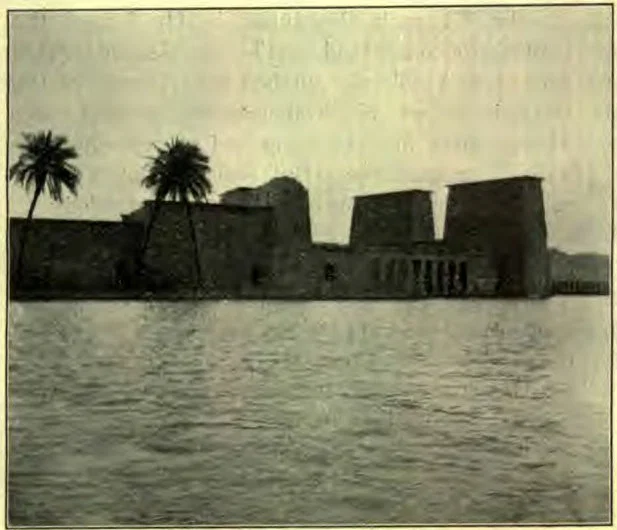
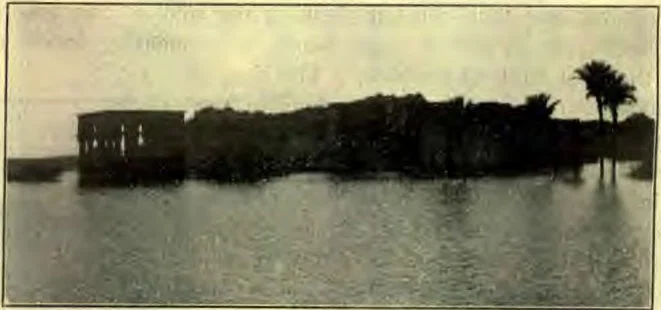
The next morning we take the train for Shelall, on our way to visit the beautiful island of Philae, once fondly called the “Pearl of Egypt,” but now entirely under water. Our boat is rowed right into the sanctuary of the temple of Isis, and among the slender columns of the graceful Kiosk. The huge barrage which dams up the river two miles below the island has caused the water to rise about sixty feet, and under the influence of the moisture, the soft sandstone of the monuments is rapidly decaying so that in a few years Philae will be only a memory. Nevertheless, the view from the top of the great pylon of the temple of Isis is still very interesting. Immense black boulders rise picturesquely out of the water of the great artificial lake created by the barrage, while in many places the tops of the beautiful palm-trees that were but recently numbered among the glories of Philae, still appear flourishing above the ripples.
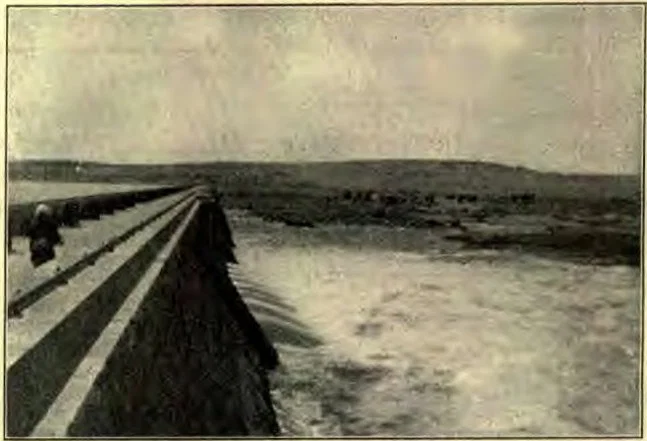
The cause of this state of affairs is worthy of attention. The object of the barrage is to enable the agricultural department of Egypt to control the annual inundation of the Nile, which has frequently caused serious loss to the whole country, so dependent on its rise, by its eccentric fluctuations. The barrage also provides for the irrigation of large, fertile districts hitherto useless because of a lack of water. It is simply an immense dam, the largest in the world, being about a mile and a half long, and eighty feet high. The top is twenty feet wide, and is traversed along its entire length by a narrow iron track, over which the visitor is pushed in little four-wheeled trucks, miscalled “trolleys,” operated by natives. The lower part of the dam is pierced by twenty-eight huge gates, opened and shut by hydraulic power, which control the flow of the river. The imprisoned water, dashing from these gates in a roaring smother of foam and spray, forms a magnificent spectacle. The barrage was begun about five years ago, the duke of Connaught laying the corner-stone. He was also present when the gates were first opened last winter. About ten thousand men were employed, and thirteen million dollars expended in its construction.
Traversing the ancient road on our way back to Assuan, we stop to notice a large prostrate obelisk of the finest Syene granite, entirely cut from the quarries, but never moved to its destined place.
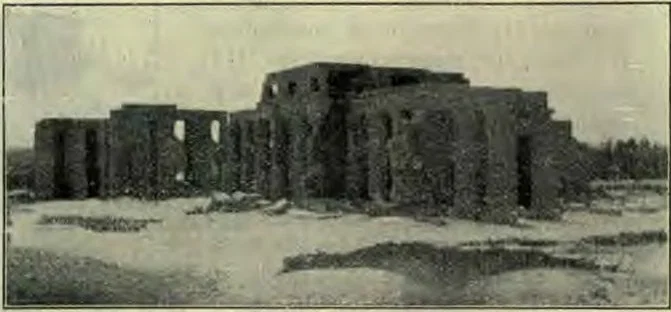
After visiting the Bisharin encampment, where about two thousand of the wildest Beduins live, we start back for Cairo, but with an impression of the magic beauty and mystic charm of Assuan in our minds that will never be forgotten.
GLEN WAKEHAM.