No doubt all the girls and boys who will read this story have been acquainted with rabbits most of their lives, but all of them may not have known what wonderful little animals they are; for they are wise little creatures, and well fitted for the life they live.
Bunny eats grass and clover; and if there is a picket off the garden fence, she likes very much to creep in and eat the young peas and cabbage stalks. Let me tell you how she knows whether this hole is just the right size,—for she is a wise Bunny, and will not crawl into a hole where she might stick fast. On the side of her face grow a number of long hairs. We call them “whiskers.” These stick out just as wide as her fat little body; and if, when she pokes her head into an opening, these whiskers brush on the sides, she knows she can not get through that entrance, and very wisely looks for another. I wonder how many little boys and girls who have noticed these whiskers on Bunny’s face knew what they were for?
Puss has whiskers, too, but hers are for an entirely different purpose. If you will notice, the whiskers on her face stick out in front of her nose. When she is creeping softly up to a mouse or a bird, she must go very quietly, so that she will not disturb it. She keeps her eyes fixed on it all the time, and could not see if something were in the way that would make a noise if she touched it. This is where her whiskers help her.
If there is anything in the way, her whiskers touch it, and she stops instantly, without making the least noise.
While Bunny is fond of grass, and thinks peanuts or beans a rare titbit in the winter, her chief diet is the inner bark of berry bushes and crab-apple-trees. She is equally fond of the bark of small apple-trees, and this is just the reason our fathers sometimes tie rags around the little trees in the orchard before winter begins.
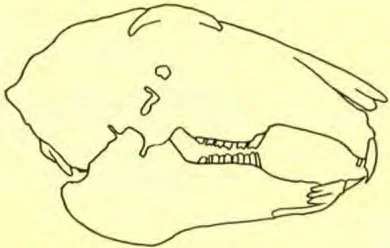
I want to tell you about Bunny’s teeth, and how it is that she can get into the bark so easily. Her front teeth are long and sharp, and the outside edge is covered with a hard coat of enamel, but the inside edge of the tooth is made up of soft dentine. This means that when she bites anything hard, the inside of the tooth wears away, and leaves it just like the edge of a chisel; and the more she gnaws the bark of trees, the sharper her teeth get. If she breaks a tooth, it soon grows out again. She can cut large sticks in two, if she wishes; and where she works, she leaves little chips almost like the chips that are left by a beaver. While it is still winter, if some of you will go out into the hazel brush, and use your eyes for a little while, you will find where she has been eating the bark of crab-apple bushes or little thorn sprouts.
I have known rabbits that were shut up in boxes to gnaw, in a very short time, a hole large enough to let them out.
Bunny is a harmless little creature, and as she seldom bites, and never eats other animals, there is not a wolf, nor dog, not a cat, nor mink, nor weasel, nor, in fact, any bird or beast of prey, that does not think that she was made especially for him to eat; so her poor, hunted little life is spent in constantly watching for an enemy. She usually has half a dozen or more homes, and does not stay in any of them very long at a time, lest some of her foes learn her whereabouts.
When she is found, she has only one method of escape, and that is by running; but God has especially prepared her for this. Her hind-legs are very powerful, and are made almost twice as long as her front ones; so that when she stands still, she stands on her front toes, while her hind-feet touch the ground clear up the heel,—the place that we usually call the knee. When she sleeps, she sleeps with her legs just ready to jump and run at a moment’s warning, and very often her eyes are open. Her ears are very long, so that she can hear the least noise; and her coat is colored like the dead grass in which she sits, so she is very hard to see. When she runs, her hind-legs are so long that they jump away past her front feet; and so it happens that her hind tracks are always in front of her front ones. She does not like to run down-hill; for she is liable to turn somersaults. For this reason she makes her home on the low ground, so she can always run up-hill if anything disturbs her.
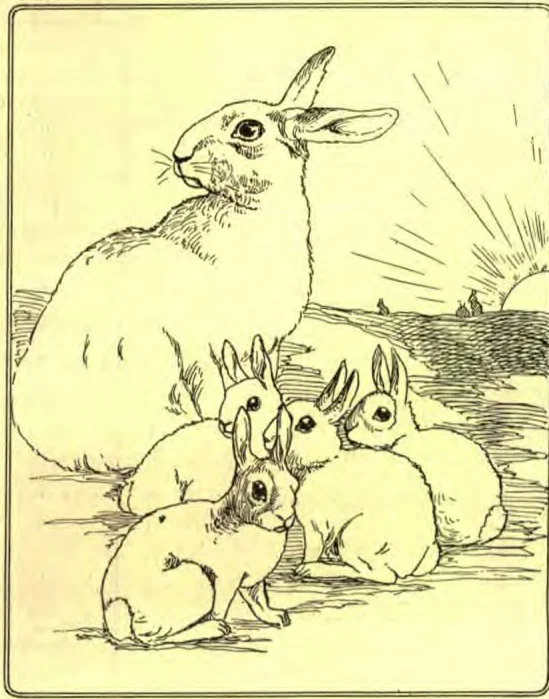
Before the country was settled, Bunny generally had her home among the blackberry briers or under some large gooseberry bush. I once knew an old rabbit that slept for a whole year under a very large gooseberry bush that stood by a fence. The gooseberry bush would keep a dog from pouncing on her without giving warning, and she could go through the fence at the first bound, and then she was safe; for no dog could catch her after he had taken the time to get over the fence. I passed her almost every day, and learned to know her very well. When she had a family of babies in the spring, it was interesting to see how she could talk to them, and not even make a sound. They might be playing about, having all the fun that little bunnies could wish; but if Mrs. Rabbit heard anything unusual, up would go her ears, and every little bunny of them would stop instantly, and put up its pretty ears to listen. If she thought she saw danger, she would lay her ears flat on her back, and every little baby would squat down to the ground, and do the same thing.
Rabbits also talk to each other by thumping on the ground with their hind-feet. They always know just what the signal means; but I must confess that I never could tell whether it was the mother calling for her children, a husband calling for his wife, or two enemies daring each other to come out and fight. I do know that they do all three, however, and that they can understand each other perfectly.
FLOYD BRALLIAR.
(Concluded next week)