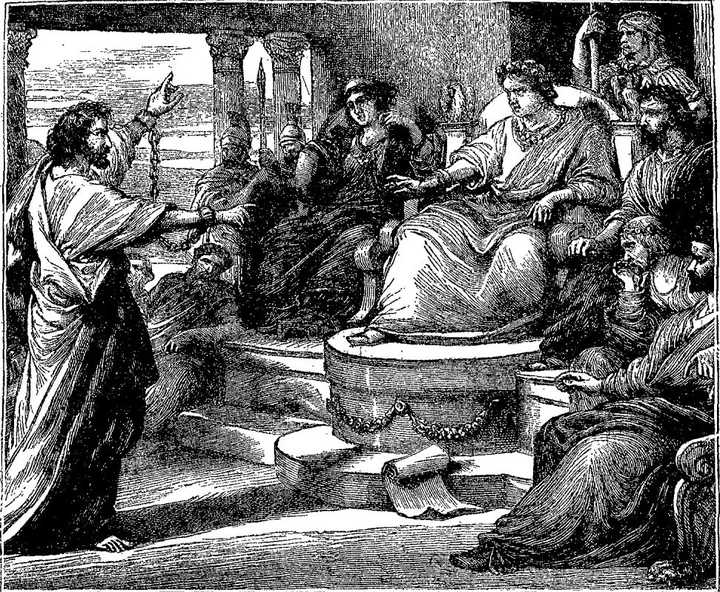
The term “Christian citizen” is one frequently used nowadays, but is, we fear, only imperfectly understood. This is not saying, however, that the designation is an improper one, or that it describes something that cannot exist. That a man can be at once a Christian and a citizen is evident from the fact that the Apostle Paul was such; he was both a citizen and a Christian. We name these things in their order; for the apostle was first a citizen in point of time, and subsequently became a Christian; but did not thereby either forfeit or renounce his citizenship, for we find him twenty-five years after his conversion declaring himself “a citizen of no mean city” (Acts 21:39), and claiming his legal rights as a Roman (Acts 22:25); and still later, by several days at least, we find him exercising the Roman citizen’s right of appeal to the emperor himself. Acts 25:10, 11. The Apostle Paul was, then, a Christian citizen of the Roman empire, and that at a time when Rome itself was wholly pagan.
Silas also a Roman Citizen.
Nor was this the first time that the apostle availed himself of the privileges of Roman citizenship; neither was he alone in it. From Acts 16 we learn that when arrested, whipped and imprisoned at Philippi, Paul and his companion, Silas, refused to be secretly released, but sent word to the magistrates, saying, “They have beaten us openly uncondemned, being Romans, and have cast us into prison; and now do they thrust us out privily? nay verily; but let them come themselves and fetch us out.”
Referring to this circumstance another has well said:—
Paul and Silas felt that to maintain the dignity of Christ’s Church they must not submit to the illegal course proposed by the Roman magistrates. The apostles were Roman citizens, and it was unlawful to scourge a Roman save for the most flagrant crime, or to deprive him of his liberty without fair trial and condemnation. They had been publicly thrust into prison, and now refused to be privately released without proper acknowledgments on the part of the magistrates.¹
It may be that when Paul described himself as “a citizen of no mean city,” he meant no more than that he was a native of Tarsus, and regarded that as his home; but no such explanation can avail to weaken the force of the apostle’s assertion that he was a Roman. In this he as clearly claimed citizenship in an earthly government as does the American, who, going abroad, carries with him a passport from the Secretary of State at Washington; and who, upon occasion, claims his rights as an American citizen. All of which, in the absence of evidence to the contrary, shows that citizenship in a civil government, and a legitimate exercise of the rights thereof, are not inconsistent with Christianity, nor with the fact that the Christian’s citizenship is in heaven (Phil. 3:20, R. V.), and that he is a stranger and pilgrim upon the earth seeking a city whose builder and maker is God.
The Sphere of Civil Authority.
Civil authority is ordained of God for the preservation of human rights. “We hold these truths to be self-evident,” declared our forefathers, “that all men are created equal; that they are endowed by their Creator with certain unalienable rights; that among these are life, liberty, and the pursuit of happiness; that to secure these rights governments are instituted among men.” The same sublime truths are taught in the sacred Scriptures. Civil government has, then, to do only with the relations of men as social beings, and in the very nature of the case can have nothing whatever to do with any man’s relations toward God. Nor does the individual, the citizen, the subject, or whatever else he may be called, owe to civil government any duty, or service, or obligation of any kind that does not pertain to the equal rights of his fellow-men.
As an intelligent, civil, social being he is amenable to the God-ordained authority which men have to safeguard their own rights; but as a moral being, endowed with a religious nature, capable of knowing good and evil as revealed in the word of God, the individual is responsible only to God. In these things civil government can have no legitimate jurisdiction over him.
A Dual Citizenship.
Such being the relations of men to eachp. 274 other and to their Creator, it follows that he who properly understands the obligations resting upon him may at the same time be loyal and obedient to a just, civil government, and to the moral government of God; he may thus have a dual citizenship being at the same time an American or other citizen and a citizen of the heavenly kingdom. To deny this is to assert that there is a necessary conflict between just civil government and the moral government of God, which is certainly not the case since both are ordained of God for the good of man, including Christians. 1 Tim. 1:1–4.
The Christian citizen, then, of an earthly government, is simply one, who, being a citizen, is also a Christian, and who having learned to do unto others as he would that they should do to him, having learned to love his neighbor as himself, is subject to just civil law “not only for wrath but also for conscience sake.”
But the fact that the man is a Christian entitles him to no special favors from the government. Every man who conducts himself as a good citizen, who discharges his obligations to his fellowmen and respects their equal rights, whatever may be his motive, is entitled to all the benefits of civil society. Government cannot know the heart and cannot inquire into the motive which impels the subject to obedience; it can take cognizance alone of his conduct in its relation to the government and to his fellow-citizens.
Just Government and the Conscience.
Just government will not trench upon the moral domain, it will not invade the sacred precincts of the conscience. Nor will the Christian citizen (the citizen who is truly a Christian) invoke the civil power in behalf of the supposed interests of his religion. To do so would be to violate the all-comprehensive rule of Christian life, namely, “Whether ye eat or drink, or whatsoever ye do, do all to the glory of God.” It is to the glory of God that his gifts and the things which he has ordained are used for the purposes for which he gave them; while to wrest his word, to change his ordinances and usurp power which he has reserved to himself is God-dishonoring, as it is also to despise his gifts by refusing to use for our preservation, improvement and comfort, the means which he has graciously given. The Christian will then, while thankfully availing himself of the benefits of civil society, while willingly contributing his quota of money and influence for its maintenance, for the benefit not only of himself but of his fellowmen, insist that the State confine itself to its God-ordained sphere, that it respect the right of conscience, which is indeed only the right of God to the untrammeled heart-service of every man. In short, the Christian citizen will exemplify in his own life and in every sphere of action and influence which he enters, the Golden Rule: “All things whatsoever ye would that men should do to you, do ye even so to them.”
The Ten Commandments and the Golden Rule.
As before remarked, the one all-comprehensive rule of the Christian’s life is, “Whether ye eat or drink, or whatsoever ye do, do all to the glory of God.”² The servant of God never gets beyond this rule; he cannot without forsaking Christ enter any sphere where this law of action is not of binding obligation. Whether in the home, in the church, or in the State, the claims of the divine law are equally upon him.
When a prominent senator declared several years since that the ten commandments and the Golden Rule had no place in politics, he doubtless spoke the truth so far as the practice of many politicians is concerned, but he did not announce a great principle nor a necessary rule of action. Politics primarily means, “The science or practice of government; the regulation and government of a nation or State for the preservation of its safety, peace and prosperity,”³ “The protection of citizens in their rights,”⁴ etc. To say that in these things men might not or ought not to be governed by the ten commandments and the Golden Rule is to declare that God has ordained something from which sin is inseparable, and that for the good of mankind; for that even a very poor government is better than none, all must admit.
Individual Accountability.
The trouble in regard to this question is that too many agree with the honorable senator, to whom reference has been made, so fully that in the political sphere they consider themselves outside the jurisdiction of the law of God, and act accordingly. They are governed by policy and that only; they know no other law. Theirs is a terrible mistake. Caucus, party, and State action is, in its last analysis, individual action, and for it individuals are accountable and must one day answer at the bar of the God whose law they have despised and ignored.
Man Cannot Enforce the Law of God.
This is not saying, however, that caucuses, parties, or States, have any warrant to enforce either the ten commandments or the Golden Rule. The Decalogue reaches to the thoughts and intents of the heart; the Golden Rule requires not only that a man shall be just, but that he shall be generous. Civil rulers have no jurisdiction over the mind; they have no authority to enforce more than equal and exact justice between man and man; and even this they are to do from the standpoint of natural right, not from that of the divine law.
In moral duty, in all things relating to the relations of the creature to the Creator, God has left men free to choose or to refuse His service. Touching all these things he has appointed a day in which he himself shall judge the world; and to all who would usurp his prerogative as Judge, he says: “Who art thou that judgest another man’s servant? to his own master he standeth or falleth. Yea, he shall be holden up; for God is able to make him stand.”⁵ Let the Christian, therefore, while he refuses to enter any sphere in which he cannot be loyal to God, or to engage in anything in which he cannot be governed by the ten commandments and the Golden Rule, beware on the one hand of despising an ordinance of God, and on the other hand of usurping the authority and functions of the Judge of all the earth.
The evils of civil government are not in its legitimate use but in its abuse. The man who attends a district school meeting and assists in determining the amount of school tax that shall be levied and the number of months that school shall be taught thereby exercises a right of civil citizenship, and engages to just that extent in politics and government; and it would be absurd to say that in so doing he could not act in harmony with the will of God as expressed in the ten commandments and the Golden Rule.
A Serious Question Considered.
But while it is not in itself contrary to the principles of Christianity for the Christian under certain circumstances to exercise the rights of civil citizenship, yet there are circumstances of time and place which, to say the least, render participation in civil affairs by the Christian very questionable. Politics, in the common acceptation of the term, are both corrupt and corrupting. The chances are a thousand to one that the Christian entering the political sphere, under prevailing conditions, would not only fail in doing any good but would be himself contaminated by the abounding corruption. Surely the servant of God can find a more fruitful field and promising sphere of usefulness than the role of political partizan.
The ever, overshadowing, all-absorbing theme of the truly Christian minister or layman is the salvation of sinners. It is to rescue those who are conformed to this world, that being transformed by divine grace, they may “prove what is that good and acceptable, and perfect will of God.”
In the pursuit of such work, Christians accomplish vastly more for the betterment of civil society by the reflex influence on the non-Christian world of their Christian words and deeds than they could possibly accomplish by attempting to reform civil government by devoting their time to the never-yet achieved and indeed impossible task of purifying politics, when any betterment of politics can come only as the result of the reformation of the individuals who compose the body politic.
Civil Government Only Temporary.
According to the Word of God, civil governments are only temporary. They are ordained among men for the purpose of preserving order among the selfish, oppressive masses of men, while the ambassadors of Christ plead with these masses to be translated not from civil society but from the kingdom of Satan into that of God’s dear Son.
By the same Word we learn that these same governments are to be destroyed by the hand of God. “The God of heaven shall set up a kingdom. . . . It shall break in pieces and consume all these kingdoms.” The same Word declares that “in the last days” “wicked men and seducers shall wax worse” up to the coming of our Lord Jesus Christ the second time; when every government of earth represented by the kings of the earth and their armies will be arrayed in open hostility to him and perish as a result. It must follow from this that the nearer we approach this destruction the greater the separation between these God-defying governments and the citizens of the kingdom of God.
The people who publish the AMERICAN SENTINEL believe that the world is fast nearing that solemn hour to which we have referred. They believe that now as never before it is the duty of the Christian minister and layman to labor to rescue men from the impending doom of all things earthly. They do not believe that the ship of State can be saved from the wreck which He who sees the end from the beginning has decreed to be the fate of worldly governments; and just as it would be a crime for the captain of a hopeless wreck to urge his crew and passengers to man the pumps when they should take to the life-boats, so to-day it is a sin against heaven and against perishing men for the followers of Christ to devote their energies, as so many are doing, to the attempted salvation of political government, to the regeneration of civil society, instead of the salvation of perishing men. The church is honeycombed with infidelity, her life is well-nigh crushed out by an insupportable load of worldliness, while her ministers who should be weeping between the porch and the altar crying, “Spare thy people, O Lord, and give not thine heritage to reproach”p. 210 are dabbling in the cesspool of politics in the vain effort to renovate civil society! But to all who will heed the call the Creator says, “Come out from among them, and be ye separate, saith the Lord, and touch not the unclean thing, and I will receive you.”