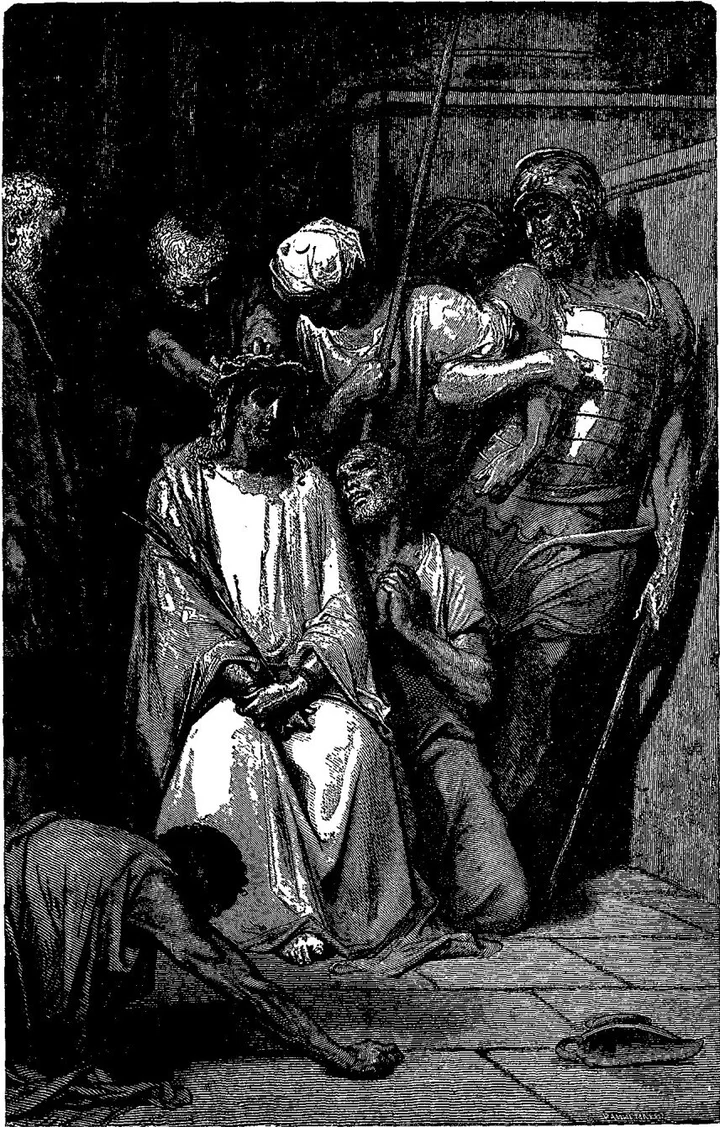
THERE was once an occasion upon which Jesus Christ, the Son of God, was literally crowned as a king by the representatives of this world. The event is narrated in the twenty-seventh chapter of Matthew. The account reads:—
“Then the soldiers of the governor took Jesus into the common hall, and gathered unto him the whole band of soldiers. And they stripped him, and put on him a scarlet robe. And when they had platted a crown of thorns, they put it upon his head, and a reed in his right hand: and they bowed the knee before him, and mocked him, saying, Hail, King of the Jews!” Verses 27–29.
What mockery, indeed! Yet there was no greater mockery in that scene than there is in the idea that Christ can be this world's king. It was the very mockery of this idea that was illustrated on that occasion.
The participants in that tragic mock ceremony were representatives of this world. They represented the people over whom Christ would reign as this world's king. He would reign over a people contrary to him; for those who are in harmony with him on this earth are vastly in the minority. His scepter of righteousness would be a reed, and his crown a crown of thorns. The homage he would receive would be hypocrisy.
There was no more mockery in that which the Roman soldiers actually did with Jesus Christ in Pilate's house, than in that which the people of this world have thought to do in their schemes to make him the world's King. In that memorable scene in Pilate's hall, the Saviour was crowned King of this world in the only way that he could and would be so crowned by this world's agencies.
There is a scheme in progress at the present time to make Christ the King of this world. It is a scheme conducted by those bearing his own name; yet its real character and meaning are not different from those of the scene when he was crowned with thorns. It is a mockery, as that was; though we are fain to think, not recognized as such by many of those engaged in it. We have listened to the pronouncements of powerful and eminent bodies of the people in its favor. The Woman's Christian Temperance Union, for example, have declared:—
The Woman's Christian Temperance Union, local, State, national, and world-wide, has one vital, organic thought, one all-absorbing purpose, one undying enthusiasm, and that is that Christ shall be this world's king;—yea, verily, this world's king in its realm of cause and effect—king of its courts, its camps, its commerce; king of its colleges and cloisters, king of its customs and constitutions. . . . The kingdom of Christ must enter the realm of law through the gateway of politics.
The National Reform Association, the American Sabbath Union, the societies of Christian Endeavor, and other organizations of more or less note, are all working with a practical unanimity for the accomplishment of this purpose.
They would have Jesus Christ made the king of this world by a vote of the people, or of their representatives. Let it be supposed that Christ would accept such a decision concerning his kingship; what would be the result? What would he do with those over whom he reigned? and what would they do with him? Is not the similarity apparent between his position as it would be in such a case, and what it actually was before the soldiers of Pilate?
The spirit of the Roman soldiers on that occasion was the spirit of the world toward Christ. The world has as much real love for Christ now as they had, and no more. They would be as ready to do his bidding as were the rabble; they would just as readily comprehend and espouse the principles of his government.
In short, one of two things would be inevitable. Either his subjects would treat him with mockery and derision, as Pilate's soldiers did, ignoring his will and making his kingdom onep. 258 whose fit scepter would be a flimsy reed, and whose fit emblem of kingly authority would be a crown of thorns; or he would put forth his divine power against his hypocritical subjects, and sweep them out of existence. The latter result would be the one that would follow, for Christ could not reign over unrighteous subjects. We read that the eternal Father has said to his Son, “Thy throne, O God, is forever and ever; a scepter of righteousness is the scepter of thy kingdom.” Heb. 1:8. Every subject of the King of kings will be righteous. There will be no flaws in his kingdom, no mockery connected with his reign.
This we know from the Scriptures. The time will come when Jesus Christ will receive the kingdoms of this world; and when he receives them, he will at once destroy them. That is the only thing he can do with them, tainted as they are with sin. All men have now a chance to repent and be saved from sin, and become by faith the subjects of the kingdom of grace, upon the throne of which Christ now sits. But we are told that the saved will be few, while the great majority will follow the broad road to perdition. The multitudes will prove incorrigible as concerns the purposes of God in the gospel. Sin must finally be removed from God's universe, and the incorrigible sinner must go with it. Then will come the final destruction of things earthly. As it is written in the second psalm: “I will declare the decree: the Lord hath said unto me, Thou art my Son; this day have I begotten thee. Ask of me, and I shall give thee the heathen for thine inheritance, and the uttermost parts of the earth for thy possession. Thou shalt break them with a rod of iron; thou shalt dash them in pieces like a potter's vessel.” Ps. 2:7–9.
Still more pointed is the language of Christ himself concerning the ultimate fate of those who reject his authority, as set forth in the parable of the nobleman and the talents. Christ is the nobleman, who has gone into a far country, having entrusted to all a certain amount of talents. Some trade with these talents and gain other talents, but some view him as an austere man, for whom they have no love. Finally comes the day of reckoning, when the nobleman returns from the far country, and rewards every one according to their works. And then he says concerning such as have refused to accept him: “But those mine enemies, which would not that I should reign over them, bring thither and slay them before me.” Luke 19:27. Christ will reign over his saints; not over sinners.
There is an hour which the eternal purpose of God has set over against that hour of mocking in Pilate's hall,—an hour when Christ will be crowned in glorious reality,—not King of this world, for this world will have passed away—but King of that new earth which is to be in this world's place; when, instead of the mocking worship of the rabble, there will be the adoration of saints and angels. And that will be when all the righteous ones of every age shall have been gathered out from all nations, the work of salvation completed, and the redeemed ones forever freed from the power of sin and death. Then in the presence of his redeemed, of the host of heaven, and of the wicked, the crown that far outshines all crowns will be placed upon the head of the Son of God, but not by a human hand. The men who crowned him with thorns in Pilate's hall, will see him crowned upon the Father's throne. The misguided ones who have thought to make him this world's king by their own vain methods, will see him crowned King, in God's own appointed time and way, of that new earth which is to be the eternal inheritance of the saints.
Let us not join in the vain effort to usher in the kingdom of God through the “gateway of politics.” Let us not be participants in any mock coronation of Jesus Christ.
S.