[From our Calcutta Correspondent.]
In March, 1885, one year before the AMERICAN SENTINEL began its career, it was decided to hold a conference of representatives from all parts of India at Poona during the Christmas holidays. The object of this conference was “to enable earnest laborers in the cause of national progress to become personally known to each other, and for discussing and deciding upon the political operations to be undertaken during the ensuing year.” Certain Indian gentlemen consented to act as a reception committee. Near the time for the conference to meet the cholera broke out at Poona and the place of meeting was transferred to Bombay. The actual number of representatives present was seventy-two.
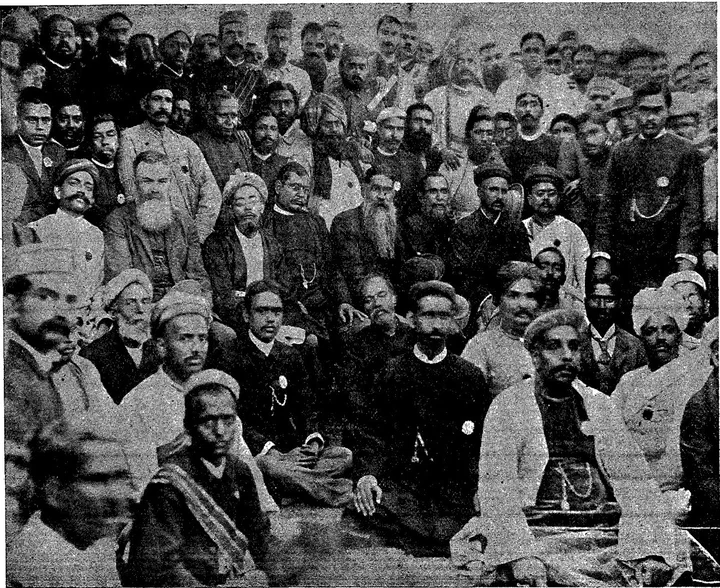
Of that meeting an Indian writer said: “In the history of a nation there is always a day which is marked above all the rest, which sows the first seeds of progress, and which lays the foundation of all future greatness. Such was the day when the patriotic barons of England assembled on the little island of Runnymede to induce their king to sign their great charter of freedom. Such was the day when the American patriots sat in the assembly of delegates, and vowed to die for the independence of their country; and such was the day when seventy-two Indian patriots first assembled in Gowalia Tank House to promote the good of their common country. This union of Indian people after ages of separation and ill-feeling was a great historical event.”
At a preliminary meeting of the reception committee the name of the conference was changed to congress.p. 220
The gathering this year, which I was privileged to attend, was the twelfth annual session, and was held in Calcutta. The actual number of representatives from all parts of India holding certificates was 703. Besides these, hundreds from the country were daily in attendance. An immense pavilion over two hundred feet long by one hundred wide was erected in Beadon square, in which the meetings were held. This pavilion was packed full, and to show something of the enthusiasm among the people, I may say that after the first day when tickets of admission were one rupee each, they were sold to all who could get in at five rupees (about $1.50) each.
The congress has already secured considerable warm sympathy and support from Englishmen of influence. A glance at the resolutions gives an idea of the object of the congress, and I refer to them here not to discuss the political situation in India, but to show the agencies which are in training and the danger that this vigorous body of intelligent and educated Indians stand in of being captured by the religio-political movement already at work in this country.
The congress appeals to the Indian government and also to the Imperial government through a British committee which it has in the House of Commons for, (a) Separation of Judicial and Executive Functions. They say as matters now stand the chief magistrate is often the judge as well as the head of other governmental departments. (b) Provincial Finance. This is designed to prevent extraordinary expenses being thrown onto the country in the creation of which it had no voice. (c) Public Service Examinations. They demand that these shall be held, not in England alone as at present, but in this country at the same time. (d) A recasting of the Educational Service. (e) Extension of Trial by Jury, (f) Abatement of the Salt Tax. Many of the speeches made on these questions were decidedly eloquent.
At the close of the congress, the Indian Social Reform Congress, which is really an adjunct of the one already mentioned, held a meeting. The gathering was not so large, because many Hindoos are opposed, as yet, to the discussion of the questions usually before it, but it is growing in influence year by year. The topics under consideration were: Evil of Child Marriage; Remarriage of Widows; Education of Women; The Curtailing of Extravagant Expenses at Marriages; The Encouraging of Foreign Travel; and an appeal for a law for the better control of religious endowments.
I will not take the time here to speak of this matter of religious endowments; suffice it to say that if the petitioners get the law they are asking for it will be pretty sure to result in a lot of mischief in this country. In 1858, the Queen’s Proclamation which referred especially to this country, said, “And we do strictly charge and enjoin all those who may be in authority under us, that they abstain from all interference with the religious belief or worship of any of our subjects, on pain of our highest displeasure.” Since then the government has generally avoided religious questions. But at the present time it is being fairly besieged by the Christian element for a law in behalf of Sunday observance. Up to the present time the government has refused to listen. Of course the so-called Christian population of India is but the merest fraction of the whole, say two millions out of nearly three hundred millions.
Now let the Hindoos themselves demand and secure a law upon a religious question—their demand for the present is refused—but let them get it and then the precedent is established, the way is open for making other laws on religious questions; and then the Sunday movement will the more easily find its way to power in this country, and it will be no marvel to see a bargain struck between Hindoo and Christian over the two questions.
The Lord’s Day Union for India, now in its fourth year, in one of its publications, says:—
“Great Victory in America. A great object lesson has just been afforded by the battle at the World’s Fair in Chicago. That city is largely dominated by foreigners, and a desperate attempt has been made to keep the Fair going on Sunday. But we now learn that this attempt has failed. Two great opposing petitions were sent to the Directory of the World’s Exposition. Eighty thousand persons asked that the gates should be open; but no less than twenty-five millions demanded that they should be shut. The number were: for Sunday opening, 87,507 against 25,825,086. This clearly shows that the American people are still of the same mind as one of their judges who wrote a defense of Sabbath laws, in which he said: ‘The Anglo-Saxon race is marching on as an army with banners, and far advanced among them is the banner upon which is engraved, REMEMBER THE SABBATH DAY TO KEEP IT HOLY.’ The peoples of Asia should know that there are the deepest reasons for this custom of Sunday observance, which is one of the most characteristic features of the new civilization now overspreading their ancient continent. The most progressive portions of Europe and America are precisely those where Sunday is most reverenced. Asia will make little progress till she too has a Sabbath rest.”
This same publication referred to, again delivers itself thus:—
“But why should the call of the church bells be ignored and the voice of religion disregarded? Men may affect to think they can make what laws they choose for the employment of their time, but the fact remains that God has claimed the day for His service. The first, the most binding, and the most powerful argument for the Sunday rest is that it is commanded by the authority of our Maker himself. Thus runs the fourth commandment of the Decalogue: ‘Remember the Sabbath day, to keep it holy. Six days shalt thou labor and do all thy work: but the seventh day is the Sabbath of the Lord thy God; in it thou shalt not do any work, thou, nor thy son, nor thy daughter, thy manservant, nor thy maidservant, nor thy cattle, nor thy stranger that is within thy gates; for in six days the Lord made heaven and earth, the sea, and all that in them is, and rested the seventh day; wherefore the Lord blessed the Sabbath day and hallowed it.’ Ex. 20:8–11. This is the law of God, and the man that breaks it brings himself under the sweep of an inevitable retribution. It has been well described as thep. 221 earliest law against vagrancy; against cruelty to animals; in favor of aliens; in favor of working men. A curse will cleave to every man who uses his influence to oppose this divine enactment.”
But what has all this to do with Sunday rest? Who can tell us what is the method of logic which makes the fourth commandment “the first, the most binding, and the most powerful argument for the Sunday rest”? The fourth commandment in the most definite terms declares that the seventh day is the Sabbath, while everybody knows that Sunday is the first day of the week.
D. A. ROBINSON.
Calcutta. Feb. 17, 1897.