Christian citizenship is that citizenship which is conferred upon an individual by Christianity; and that citizenship pertains not to this earth, but to heaven.
It is true that Christian people are citizens of various earthly countries, but this fact has no real bearing upon the subject. This is a citizenship common to all classes of people. It is a citizenship which considers the relations between a man and his fellowman. It cannot take account of a man's relation to God.
There is a prevailing idea of Christian citizenship, however, which mixes these relations together, teaching that Christian citizenship pertains to the affairs of this world, and hence that those affairs should be conducted upon a religious basis. This is an altogether erroneous conception, and one most dangerous to the peace and welfare of society.
It is frequently said that a man ought to take his religion into his business; and the saying is true in the sense which is doubtless intended by those who make it, which is that a man ought to be conscientious in his business dealings, conducting them according to that standard of honesty and justice which religion—the Christian religion—reveals to him. But it would be much better to say just what is meant. Certainly, conscience ought not to be divorced from individual conduct in any relation of life; but conscience is not religion. Honesty does not constitute religion ; justice does not constitute it. The foundation of the Christian religion is faith in the word of God.
Christianity enables an individual to live rightly before both God and men, and is therefore of the highest value in any community as a promoter of peace and prosperity. We refer here to Christianity as defined by Scripture and applied by the Holy Spirit, and not to what some person or persons may call Christianity, or may attempt to apply by human law. Christianity thus perverted ceases to be Christianity, and becomes the worst disturber of the peace and enemy of prosperity. No person can be better prepared to act the part of a good citizen than he whose standard of righteousness is the law of God, whose conscience is enlightened and guided by God's word, and who has in his heart that love for his fellowmen which is the fulfilling of the second of God's two great commandments. The person of whom this may be said is a Christian. He of all men may be expected to be honest and just in all his relations with his fellows, and to aim always at that course which will preserve peace and maintain cordial relations between all about him.
This is as far as Christianity can enter into any of those relations of life which pertain to civil affairs. And, as before stated, this is not a union of Christianity with civil affairs, but only of that honesty and justice which Christianity enjoins. The Christian is actuated in all things by Christian motives; he has constantly in view the claims of the law of God, which covers both his relation to God and to his fellowmen. He will be a Christian in all places and at all times. But his honesty, his justice, and his kindness toward others, do not constitute him a Christian. Many people who have been honest and just and kind toward their fellows have not professed to be Christians at all, and had they done so, on the strength of these virtues alone, their profession would have been false. Neither one of these, nor all combined, constitute a religion. Hence they do not, by their presence in the conduct of civil affairs, unite religion with civil government.p. 242
Testimony of the Scriptures.
But there is a true Christian citizenship, which is possessed only by Christians, and pertains to that country the only knowledge of which comes through the avenue of faith. The Scriptures speak very clearly upon this subject, and to them we naturally turn for information.
In his letter to the Ephesians, the apostle Paul points them to the change which had been wrought in their condition by their faith in Christ. He tells them that “in time past” they had been “without Christ, being aliens from the commonwealth of Israel, and strangers from the covenants of promise, having no hope, and without God in the world. But now,” he continues, “in Christ Jesus ye who sometimes were far off are made nigh by the blood of Christ. . . . Now therefore ye are no more strangers and foreigners, but fellow-citizens with the saints, and of the household of God.” Eph. 2:12–19. Here is set before us a citizenship which is shared only by the saints.
This is a citizenship which does not pertain to this world. This is clear from the fact that it is held exclusively by the saints. The most wicked of men share freely in all the privileges which this world has to bestow. But they do not share in those privileges which come through faith in Christ.
Some Eminent Examples.
The same truth is set forth in the examples left us by eminent Bible characters from earliest times. We cannot do better than to notice the course of some of these men in this respect.
Abraham was one of the prominent men of his time, being at the head of a large household, rich in worldly possessions, and having the respect and esteem of kings. He was free to go almost where he might choose, and establish himself in the enjoyment of all that which was sought and enjoyed by the heathen princes around him. But we read of Abraham that he left his native land at the command of God, and went through the country as the Lord directed him, not seeking any permanent place of abode, nor aiming to enroll his name among the great of earth. God had made Abraham a promise, and that promise, as the apostle Paul tells us, was that he should be the heir of the world. Rom. 4:13.
He Sought no Christian Citizenship on Earth.
But Abraham understood that this promise was to be realized not through “the law,” or through force of arms, or through the ballot box, but “through the righteousness of faith;” and he sought it only in that way. We read of him that “By faith he sojourned in the land of promise, as in a strange country, dwelling in tabernacles with Isaac and Jacob, the heirs with him of the same promise. For he looked for a city which hath foundations, whose builder and maker is God.” Heb. 11:9, 10. In the same connection, we are told concerning these ancient Christians that they “died in faith, not having received the promises, but having seen them afar off, and were persuaded of them, and embraced them, and confessed that they were strangers and pilgrims on the earth. For they that say such things declare plainly that they seek a country. And truly if they had been mindful of that country from which they came out, they might have had opportunity to have returned. But now they desire a better country, that is, an heavenly; wherefore God is not ashamed to be called their God, for he hath prepared for them a city.” [Italics ours.]
Abraham did not look for the fulfillment of God's promise in this present world, or by worldly means; but he looked forward by faith to a “new heavens and a new earth”—the “heavenly country”—and a city “whose builder and maker is God,” to be created in the execution of God's great gospel plan, the central act of which was the great sacrifice on Calvary. The Saviour said of Abraham, speaking to the Jews, “Your father Abraham rejoiced to see my day; and he saw it, and was glad.” John 8:56.
Joseph, the son of Jacob, was in high honor at Pharaoh's court, holding the position of governor over all the land of Egypt. He was exalted among earth's great men, but it was not upon this that he set his heart, nor upon anything connected with the land of Egypt. We read that “By faith Joseph, when he died, made mention of the departing of the children of Israel, and gave commandment concerning his bones.” Heb. 11:22. Referring to the record in Genesis, we learn that “Joseph took an oath of the children of Israel, saying, God will surely visit you, and ye shall carry up my bones from hence.” He, like Abraham, had his heart set upon another country than that in which he had achieved earthly greatness.
Moses was a man brought up at the court of Pharaoh, and honored by all in Egypt, being heir to the throne, and a man “mighty in word and in deed.” But he renounced all this and identified himself with a race of slaves, in order that he might gain that better, “heavenly” country, and share the privileges of its citizenship.
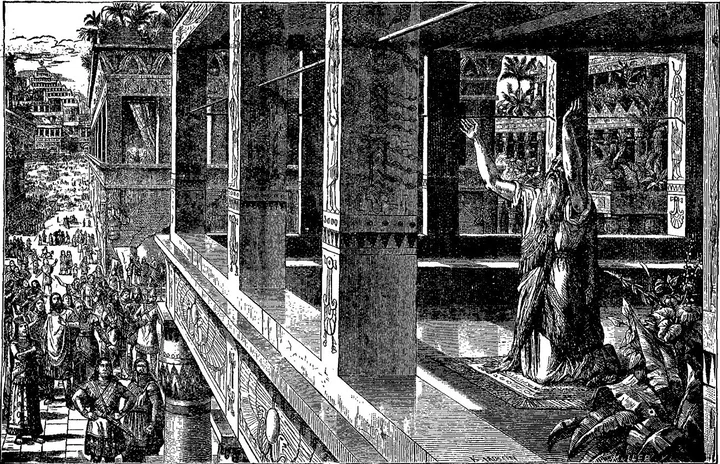
Daniel, the Hebrew captive at the court of Nebuchadnezzar, was exalted by the latter to great eminence in the government of Babylon, but in every place, and in all that he did, he maintained his integrity toward God. The illustration on the preceding page sets forth his faithfulness to God while chief of the three presidents appointed over the realm by King Darius. His enemies would not have found an occasion against him if he had not been accustomed to pray three times each day with the windows of his room opened toward Jerusalem. It was not upon anything that he had enjoyed in Babylon, under either the reign of Nebuchadnezzar or of Darius, that he had set his heart. His thoughts were upon Jerusalem. He was in Babylon as a stranger and a pilgrim. The longing of his soul, expressed in his earnest prayers to God and in his searching of the books of prophecy, was that he might see the captivity of his people turned, and the kingdom of Israel restored again in his beloved city. But that kingdom looked forward in purpose to the coming of the promised Messiah; and this it was to which the prophet looked, and which seemed by the captivity to have been set aside. Daniel looked forward to the setting up of the kingdom of Christ. He had in view the promise made by God to Abraham, which was to be fulfilled in the inheritance of the earth by the faithful.
Conscience in Secular Business.
Daniel was a man who took his conscience into his business, which was that of civil ruler in the province of Babylon. No better example does history afford of Christian integrity in the conduct of secular affairs; no better can be furnished by any man living to-day. Yet Daniel did not impose his religion upon any one. There was no mixing of religion with politics in his official life. His influence was not given to the enactment of religious laws. He simply lived a life of perfect uprightness in the sight of his fellowmen, conducting the affairs of his office with such honesty and justice that his enemies were forced to acknowledge that no fault could be found in him. And by this very thing Daniel did a wonderful work in spreading the knowledge of the true God. Would that there were many who would imitate him in the higher walks of public life to-day. It is by the life of Christian integrity that righteousness is to be preached and men brought into the path of obedience to moral requirements, and not by religious “laws.”
Christian citizenship is the same thing to-day that it was in the days of these ancient worthies. It is citizenship in the land of promise,—the promise made to Abraham that he should be the heir of the world. We read that “to Abraham and his seed were the promises made;” and “they which be of faith, the same are the children of Abraham.” Gal. 3:7, 16. Therefore those who are of faith to-day, are heirs with Abraham of the world,—not this world, with its curse and ruin caused by sin, but that new earth which shall spring forth at the word of God from the ashes of this present earth, which is to be burned up by the fires of the day of wrath. 2 Peter 3:10–13. “The meek shall inherit the earth, and shall delight themselves in the abundance of peace.” Ps. 37:11.
Christian citizenship, therefore, is not of this world. It cannot be attained by any earthly means. Wealth cannot purchase it, power cannot grasp it, votes cannot establish it anywhere. It is to be secured only by faith in Christ, just as Abraham and the other righteous men of old secured it. If we would work to spread the blessings of Christian citizenship among our fellows, we must live the life that they lived. We must follow the example of Jesus Christ. We must not proclaim that Christ's kingdom is of this world; we must not seek to have affairs which pertain to this world conducted on a religious basis.