Arguments in Its Defense Critically Analyzed.*
BY A. F. BALLENGER.
The Catholic Mirror, of August 29, published a defense of the Inquisition, written for that paper by James L. Conway, a prominent Roman Catholic layman. So able was the article considered in Roman Catholic circles, that it is reappearing in other Roman Catholic journals. Following are quotations from the article which are numbered for convenience in reviewing:—
1. “History divides the Inquisition into two distinct tribunals—the Roman Inquisition and the Inquisition of the Spanish Government.” “One is purely ecclesiastical, the other [the Spanish Inquisition] strictly secular,” “could not cloud the glories of Catholicity” even “were the charges as high as high Olympus.” It “must lean for its justification on national rights and privileges.”
3. To understand the Inquisition one must understand the “education” and “religion” of the time and “beget in his soul the reverence and love with which they cherished the time-honored traditions of their forefathers.”
4. “In the time of which we speak all the world embraced the teachings of the Catholic Church. King and subject, prince and peasant, rich and poor, priest and people, all believed her doctrines.” “Schools and churches, assemblies and meeting-houses echoed and reëchoed with her tenets and dogmas.”
5. “And so, quite naturally, it seemed to all who lived in such surroundings, and rightly, too [italics mine], that any one who sought to destroy the faith of a nation . . . was as great an enemy to the State, as one who contrived to undermine its civil institutions.”
6. “They [Roman Catholics] enacted laws and punishments in accordance with their religious convictions. To put it briefly, in those Middle Ages there was the greatest union of Church and State.” “It is evident that one who was a heretic then was by that very fact in opposition to the spirit of the laws and customs of his country—in other words—a disturber of the public peace, and an underminer of civil society.”
7. “This union was the natural outcome of the beautiful marriage of civil and religious institutions. The State then, as it should now [italics mine], protected and defended her [his] holy bride from danger and persecution” [from the teaching of any other than her doctrines].
8. “All the laws, then, had a tinge of Catholicity, and they were carried out in a manner savoring of the principles of that universal church.”
9. “The Inquisition was not formally established until 1248. Innocent IV. took the tribunal out of the hands of the seculars [Roman Catholic prelates not bound by monastic vows] and turned it over to the Dominicans.” “The Dominicans, according to their mission, introduced the Inquisition into all countries, and diligently sifted out and indicted heretics of every description.”
10. “Was the church justified in punishingp. 307 heretics for that reason alone? Most assuredly.” (Italics mine.) “Never could she countenance or encourage a formal heretic, a foe to civilization, a barrier in the way to salvation, to scatter his poisons unmolested.”
11. “To establish an inquisition, Ferdinand asked permission of Pope Sixtus I. That pontiff, however, was first unwilling to grant the request [the confiscated property of ‘heretics’ went to the Spanish king instead of to the Roman Pope], but was so urged by the Court of Spain, that he finally agreed, and in the year 1478 the Spanish Inquisition sprang into existence.”
12. “The permission of Rome was necessary for many reasons, but chiefly for two: First, because the men who were appointed as inquisitors by the Court of Spain were priests and prelates and theologians of the church, and were for that reason under the jurisdiction of the popes; and secondly, and most especially, because the Inquisition was instituted to try people on matters of faith!”
13. “Numbers of them [the Jews] . . . pretended to profess the Catholic faith, . . . and even were found among the priests and prelates of the church of God;” “but since there was no doubt but that very many of the Jews were honest in their conversion, what to do was a very perplexing question. Hence arose a great difficulty—a difficulty, which, as all will agree, could be overcome only by an inquisition.”
14. “Often was the tribunal at variance with the popes, and most frequently were the victims condemned by the Inquisition pardoned on appealing to the successor of Peter, . . . so serious were the frictions between them that several times the Holy See threatened the Spanish inquisitors with excommunication.”
15. “But the fact of the matter is there were no outrages committed by the Spanish Inquisition.” “Marian says that during the whole Inquisition about two thousand were killed.” Torquemada was a “pure, just, humane, incorrupted, and undaunted inquisitor.”
16. “Llorente tells us that on February 12, 1486, seven hundred victims were punished; but even granting these figures to be correct, he does not add that a single one of these victims was put to death.”
17. “When, then we say that those found guilty were compelled to make the ‘auto dafe,’ we mean that those who were publicly brought to trial and forthwith condemned and punished, were obliged to make some outward manifestation that they were really members of the church of Christ.”
18. “In fact, the Inquisition was a very merciful tribunal; I repeat it, almost a compassionate tribunal. Very few of those condemned were sentenced to death; and a man was only allowed to be racked once, which no one can deny was a most wonderful leniency in those times.”
Was the Inquisition “Strictly Secular”?
The church should not be held responsible, says this Roman Catholic champion, for the Spanish Inquisition, because it was “strictly secular” (1), although he confesses it was founded by Roman Catholics (11) with the permission of the Pope (11), was presided over by Roman Catholic priests, prelates and theologians (12), who were under the jurisdiction of the Pope (12); and “was instituted to try people on matters of faith” (12).
How can it be pleaded that the Spanish Inquisition was strictly secular (1) when “king and subject, rich and poor, priest and people” were Roman Catholics (4)? when all the laws were tinged with Roman Catholicism (8)? when Roman Catholics enacted laws and punishments in keeping with their religious convictions (6)? when, “to put it briefly, there was the greatest union of Church and State” (6)?
If the people of England, members of the English Church, were to establish an inquisition by permission of the Anglican archbishops, and would install as inquisitors clergymen of the English Church, and arrest, condemn, rack and burn Roman Catholics because they taught doctrines contrary to the teachings of the Church of England, would Roman Catholics permit the English Church to escape from the odium by the childish dodge that the civil authorities were wholly responsible, and that the Church of England was entirely blameless? Roman Catholics would ridicule such an attempt to escape responsibility. Then how can Roman Catholics expect intelligent men to accept such pitiable excuses for her bloody crimes?
A Dilemma.
Why try to relieve the church of the responsibility of the Spanish Inquisition by asserting that the Pope, while giving his sanction to the Spanish Inquisition (11), yet threatened to excommunicate the inquisitors for their cruelty (14), when in another paragraph it is asserted that the Spanish Inquisition was an absolute necessity (13); that it was not cruel (15) but a “merciful,” “compassionate tribunal” (17); that its inquisitor-general was a “just,” “humane” “inquisitor” (15)? Did the infallible Pope threaten to excommunicate a necessary, merciful, compassionate body of inquisitors because of their cruelty!!
Rome on Church and State.
According to this defense of the Inquisition, the only proper relation of Church and State is a “union of Church and State” (6), a “beautiful marriage of civil and religious institutions” (7). The laws of the State should be tinged with Catholicity and “carried out in keeping with the principles of the universal Church” (8).
Rome’s Definition of a Heretic.
Since the Roman Catholic Church ought to be united to the State, it follows that any one who teaches contrary to the doctrines of the Roman Church in countries where Rome is dominant is “an enemy to the State” (5), “a disturber of the public peace, and an underminer of civil society” (6), “a foe to civilization” (10).
But besides being a traitor to the State, every Protestant, according to Rome’s definition, is a “barrier in the way of salvation” (10), and for that reason alone the Roman Church is “most assuredly” justified in punishing him (10).
Rome’s Definition of Merciful Punishment.
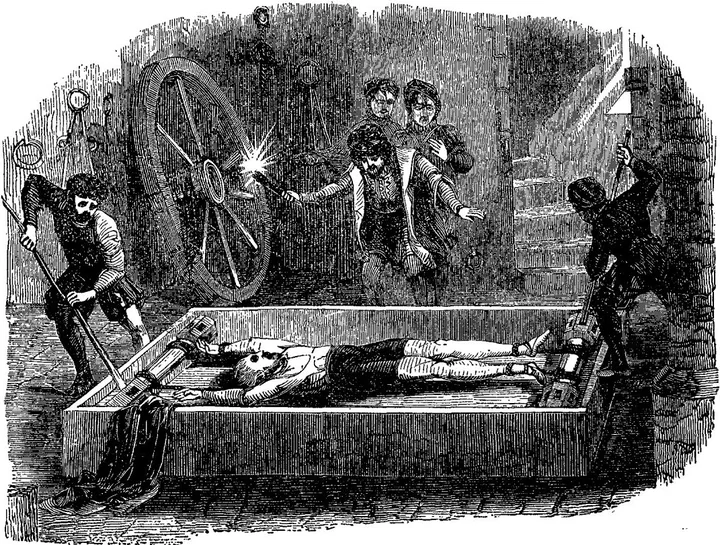
“Very merciful,” “compassionate” treatment for Protestants or heretics is to rack them once (17). Webster defines a rack thus: “An engine of torture, consisting of a large frame, upon which the body was gradually stretched until sometimes the joints were dislocated.” If tearing muscles and sinews and dislocating bones is in the mind of a Romanist merciful, compassionate treatment of Protestants, what would in their minds be justice to such “heretics”?
The papal champion argues that the inquisitors punished heretics, but very few were sentenced to death (17). But this is no justification. Ordinary death would be welcomed with joy by the man or woman who was the victim of an inquisitorial dungeon or rack.
The Inquisition is defended on the ground that racking a man once was merciful, compassionate, “wonderful leniency in those times” (17). But if racking, sanctioned by the priests and prelates of the church, the highest types of Catholicism, was wonderful leniency, what must have been the spirit of the times! And who were responsible for the spirit of the “times”? For centuries the Roman Catholic Church was the dominant church. Those who taught differently were driven into exile. “In the times of which we speak all the world embraced the teachings of the Catholic Church” (4), “prince and peasant, priest and people, all believed her doctrines” (4); schools and churches, assemblies and meeting-houses echoed and reëchoed with her tenets and doctrines” (4). Who, if not the Roman Church, was therefore responsible for the barbarity of the “times”?
The Inquisition Probes for Heart Motives.
The article under consideration defends the Inquisition on the ground that it was necessary to discover the motives of the heart. Under the Spanish union of Church and State the Jews were handicapped in the race for wealth and political honor. Consequently, some professed conversion, and so complete was the deception that many of them were consecrated as “priests” and advanced to positions of “prelates” of the Roman Church (13). Some of the converted Jews were believed to be honest-hearted believers (13), but to ascertain what was in the hearts of all it was necessary to place the doubtful convert on the rack (17) and dislocate his bones and tear his tendons from their fastenings in order to reach his heart.
How “Heretics” are “Really and Truly” Made Roman Catholics.
The writer of the “defense” under consideration gives us a method of “really and truly” making “heretics” Roman Catholics that is deserving of attention. First establish an inquisition, then interdict “heretics of every description” (9), that is, every person who teaches contrary to the doctrines of the Romish Church. Next fasten their limbs to an adjustable wooden frame, then enlarge this frame so as to stretch the muscles of the victim and dislocate his joints. This will cause excruciating pain. Proceed with this process slowly, and occasionally ask the victim if he is not persuaded that he is or ought to be a member of the “only true church.” If he says “no,” stretch his limbs still more, increase the pain, and then repeat the question. In a majority of cases the victim under these conditions will express a desire to join the church. If, however, it is feared that when he escapes he will change his mind put him to death while he is really and truly a member of the church that he may not later apostatize and lose his soul.
A Contrast.
The method of the Lord Jesus was to say: “Come unto me, all ye that labor and are heavy laden, and I will give you rest. Takep. 308 my yoke upon you, and learn of me; for I am meek and lowly in heart: and ye shall find rest unto your souls.” “But the hour cometh, and now is, when the true worshipers shall worship the Father in spirit and in truth: for the Father seeketh such to worship him. God is a Spirit: and they that worship him must worship him in spirit and in truth.” “And when his disciples James and John saw this [that they rejected Christ], they said, Lord, wilt thou that we command fire to come down from heaven, and consume them, even as Elias did? But he turned, and rebuked them, and said, Ye know not what manner of spirit ye are of. For the Son of man is not come to destroy men’s lives, but to save them.” “Who art thou that judgest another man’s servant? to his own master he standeth or falleth: yea, he shall be holden up: for God is able to make him stand.”
The Papacy Is Unchanged.
This “defense” of the Spanish Inquisition clearly conveys the important truth that Rome is unchanged, and that if the same conditions should come to exist as obtained before the Reformation, the Roman Church would not hesitate to revive the Inquisition. And yet many professed Protestants have become so blinded as to regard the Church of Rome as “one branch of the Church of Christ.” May the God of the Reformation which ended the “merciful” work of dislocating bones to convert the soul, open the eyes of professed Protestants before it is too late.