General Grant on Separation of Church and State.
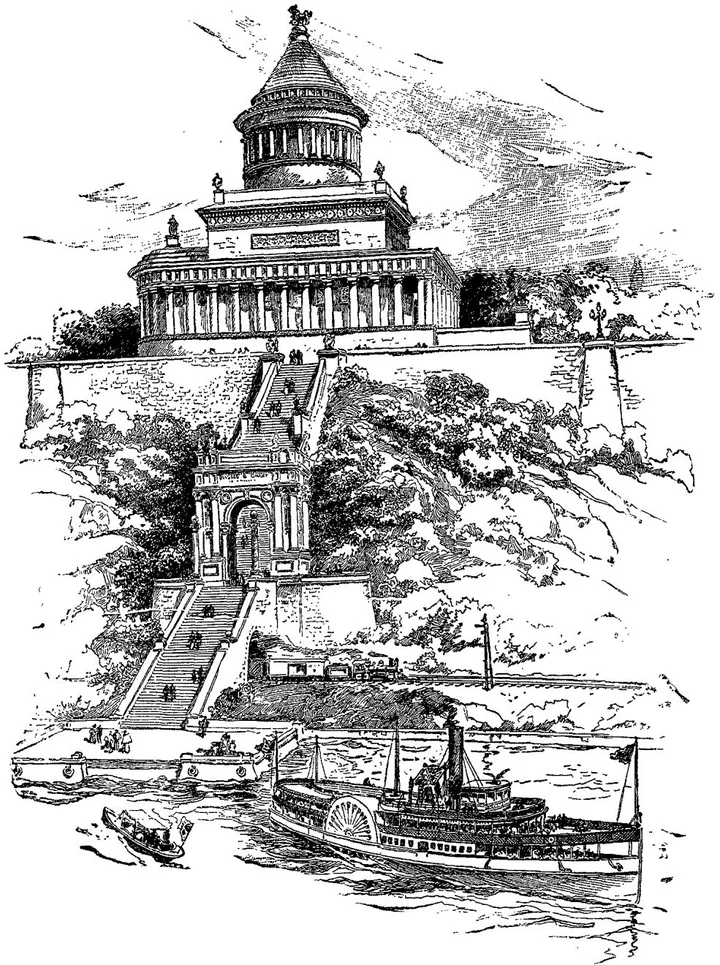
APRIL 27, the birthday of General Ulysses S. Grant, while the representatives of the military world unite in demonstrations of honor to his memory, the remains of the great leader will be transferred from the temporary tomb in which they have reposed since the general’s death, to their permanent resting-place in the new and imposing mausoleum in Riverside Park, New York, overlooking the Hudson River, as shown in the accompanying illustration. While all eyes are thus for the moment turned once more toward the commanding figure which must ever hold so prominent a place in American history, it is a fitting time to recall some of those utterances of the dead leader which, more than his feats of arms, revealed the stalwart integrity and true Americanism of his character.
For this purpose there is perhaps nothing more suitable than his Address to the Army of the Tennessee, delivered at Des Moines, Iowa, in September, 1875. It is especially fitting that the American people should recall this address at this time, because of the emphasis it puts upon the fundamental American principle of separation of Church and State, which is just now, through the machinations of religious combinations seeking political power, in the most imminent danger of entire subversion.
Following is the address.
ADDRESS TO THE ARMY OF THE TENNESSEE.
COMRADES: It always affords me much gratification to meet my old comrades in arms ten to fourteen years ago, and to live over again in memory the trials and hardships of those days,—hardships imposed for the preservation and perpetuation of our free institutions. We believed then and believe now that we had a Government worth fighting for, and, if need be, dying for. How many of our comrades of those days paid the latter price for our preserved Union! Let their heroism and sacrifices be ever green in our memory. Let not the results of their sacrifices be destroyed. The Union and the free institutions for which they fell should be held more dear for their sacrifices. We will not deny to any who fought against us any privileges under the Government which we claim for ourselves. On the contrary, we welcome all such who come forward in good faith to help build up the waste places and to perpetuate our institutions against all enemies, as brothers in full interest with us in a common heritage. But we are not prepared to apologizep. 266 for the part we took in the war. It is to be hoped that like trials will never again befall our country. In this sentiment no class of people can more heartily join than the soldier who submitted to the dangers, trials, and hardships of the camp and the battle-field, on whichever side he fought. No class of people are more interested in guarding against a recurrence of those days. Let us, then, begin by guarding against every enemy threatening the perpetuity of free republican institutions.
I do not bring into this assemblage politics,—certainly not partisan politics,—but it is a fair subject for soldiers in their deliberations to consider what may be necessary to secure the prize for which they battle. In a republic like ours, where the citizen is the sovereign and the official the servant, where no power is exercised except by the will of the people, it is important that the sovereign—the people—should possess intelligence. The free school is the promoter of that intelligence which is to preserve us a free nation. If we are to have another contest in the near future of our national existence, I predict that the dividing line will not be Mason and Dixon’s, but between patriotism and intelligence, on the one side, and superstition, ambition, and ignorance on the other. Now, in this centennial year of our national existence, I believe it is a good time to begin the work of strengthening the foundation of the house commenced by our patriotic forefathers one hundred years ago at Concord and Lexington. Let us all labor to add all needful guarantees for the more perfect security of free thought, free speech, and free press; pure morals, unfettered religious sentiments, and of equal rights and privileges to all men, irrespective of nationality, color, or religion. Encourage free schools, and resolve that not one dollar of money appropriated to their support, no matter how raised, shall be appropriated to the support of any sectarian school. Resolve that neither the State or nation, nor both combined, shall support institutions of learning other than those sufficient to afford to every child growing up in the land the opportunity of a good common school education, unmixed with sectarian, pagan, or atheistical tenets. Leave the matter of religion to the family altar, the church, and the private school, supported entirely by private contribution. Keep the Church and State forever separate. With these safeguards I believe the battles which created the Army of the Tennessee will not have been fought in vain.