The military spirit is the fighting spirit. It is for the purpose of fighting that the military forces exist. They do not exist to parade and give pleasing and impressive shows before the public. While their time is very largely spent in this way, the fact remains that were it not for the real fighting which they are supposed to be capable of doing, they would never have been called into existence.
The fighting spirit is essentially the same under all circumstances. The application of “science” to the “art” of disabling an opponent by physical force, does not change its nature. The professional pugilist displays much “science” in conducting a prize-fight, but he acquires this merely in order that his efforts may be more effective in overcoming his adversary; and so of military drill. An army is more effective than a mob, and that is the reason the mob is organized and drilled into an army.
The organization and drill are for the purpose of enabling the army to kill more men and do more injury to the enemy in a given space of time than it could do otherwise, and not for the purpose of elevating the “art” of killing and mangling human beings.
The sudden and widespread development of the military spirit in this country within the last three years, is a conspicuous and significant sign of the times. Within this brief space of time there has been evolved from the ranks of the youth in our public schools, a military organization, taking the name of the “American Guard,” and more commonly referred to as the “Boys’ Brigade,” which has extended itself into every part of the country, and is rapidly looming into prominence in the public eye. Measures have been passed in its favor by State legislatures, and Boards of Education now find it among the prominent things which claim their attention. “It is likely,” says one authority on the subject, “that before long military drill will be established everywhere as a part of the American common school system.”*
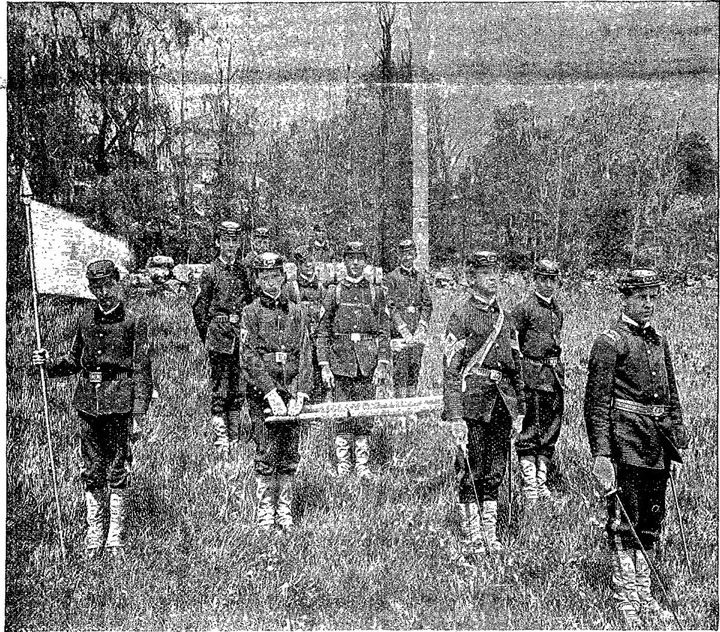
The friends of the organization are said to be many, and its opponents comparatively few. It is said in defense of the system that it confers much physical benefit upon the boys of the schools, giving them “neatness in person and clothing, a firm step, and a straight and graceful figure.” The correctness of this assertion no one will be likely to dispute. The physical advantages to be derived from thorough military training are too well known to need argument. It would be idle to maintain, however, that such benefits can be derived in no other way.
But it is said that there are other and greater benefits pertaining to the system. “Still more important,” we are told, “are the mental and moral lessons directly or indirectly given in the course of military instruction. The boys are taught to be brave, honorable, and manly; that they must be obedient, courteous, and respectful; that they must protect the weak, be helpful to their comrades, and above all else, be truthful and patriotic.” Evidently, if all this were true of the military system, the careful parent, solicitous that his sons should be well brought up, would need do little more than to see them safely initiated into this organization.
It is worthy of note that one of the earliest and most influential promoters of the organization, was the Grand Army of the Republic. It was not an educational sentiment, but a military, or “patriotic” one, in which the idea originated. The education which the system provides is almost wholly in the line of that necessary to military operations. Our illustration shows the “Ambulance Corps” belonging to one New York City “battalion” of the Guard, as they would appear equipped for operations on the field of battle. It contains few suggestions in the line of physical or mental education, but some very strong ones of a different nature. Indeed, it indicates plainly that the training given in the organization is of a kind which looks toward actual military operations.
That the system teaches “patriotism” of a certain kind, is doubtless true. But the patriotism which is represented by belligerency certainly does not need to be cultivated in the mind of the average school-boy.
The important question which presents itselfp. 234 in the consideration of these facts, is, Granting that the youth in our public schools will derive certain physical and mental benefits from such training, does this system provide the only method, or the best one, or even a proper one, by which it may be imparted? Do the benefits of the system more than outweigh the possible evils which it may contain?
We think they do not; but that, on the other hand, the evils far outweigh the benefits. Militarism is not a thing which should be developed in any form on this continent. We do not want a “patriotism” which appeals to arms rather than to the principles of right and justice,—a “patriotism” which is but another name for selfishness, which puts national prosperity above right and regard for humanity. We want rather the patriotism which first called this nation into being, by standing in support of those universal principles of justice asserted in the Declaration of Independence. The youth in our public schools need nothing more than they need instruction in those very principles. They need to be taught what are the unalienable rights of all men, and respect for those rights, in order that they may become the best citizens. The fighting instinct is sufficiently strong in all. It needs to be repressed, rather than cultivated.
The nation’s youth, and its older citizens as well, need to be taught that Justice, not Force, is the proper arbiter of all disputes. If this nation is again to become involved in war, far better will it be if its citizens go to the conflict in the strength of an enlightened conviction that they are contending for the principles of right and justice, than if they are impelled by a mere blind enthusiasm which trusts only in the strength of arms, and pays heed to nothing but the signal for combat.
The country may have reason to be thankful that the military idea and spirit were not more fully developed than they were when a few months ago it became involved in the Venezuelan dispute with Great Britain. As it was, the air was full of war clamor, which was recognized by sober-minded citizens as one of the greatest dangers of the situation.
Militarism and free government do not go together. Militarism belongs with despotism. The natural affinity between the two is illustrated sufficiently upon the shores of the Old World.
The evil effect of this militarism upon the public school system and through that upon the nation, is pointed out in the following from the New York World, of July 6, in reference to a resolution then before the Board of Education authorizing the introduction of military training as a feature of grammar-school education for boys:—
The adoption of such a resolution would seriously cripple the schools. It is wholly at odds with the fundamental idea on which they are based. They are founded and supported by the State that the instruction given in them may in turn support civil government.
For the support of military government free schools are unnecessary. Where the military idea predominates intelligence must be subordinated. It is inevitable that it will be. The history of the world offers no case of a people which has been able to found civil government responsive to the intelligence of the people on militarism and the military idea. If the boys of New York are to be made into soldiers in the public schools, it cannot be expected that they will be developed into the best possible citizens. They have only a few years for acquiring the rudiments of education, and if these are to be wasted the gravest injustice will be done them and the community whose destinies they are hereafter to decide.
But it is now not a question of accepting or rejecting the innovation upon its merits. The evil has fastened itself upon the common school system, and while we may and should combat it to the extent of our power, it must be with no reasonable hope of effecting its removal. The thoughtful, liberty-loving citizens who see danger in this development, are but few in proportion to the number who look upon it with favor or unconcern. It seems to be generally accepted as a proper if not a necessary and desirable feature of our “Christian” civilization.
Indeed, we find this same militarism in the “Christian” Church itself. An authority tells us that “In addition to the drill in public and private schools, there have in recent years sprung up, all over the country, cadet companies in connection with churches of various denominations, some of them numbering hundreds of boy soldiers.” There are also, we are told, many companies of youthful cadets connected with temperance organizations and similar bodies.
Militarism is one of the great curses of the world to-day. Its sudden appearance and development in this favored land is an ominous sign of the times. It bodes no good to liberty or to peace. It harmonizes not with the pleasing dream of “peace and safety,” but with the internal dissension and strife now so manifest in our own national affairs, and the world-wide unrest of the nations, and the jealousy and distrust with which they are watching each other. In view of all this the prospect is that the youthful organization will soon have opportunity to turn its military knowledge and skill to another use than that of pleasing the public eye. The authority from which we have quoted, significantly says: “Recent events have brought the question of national defense prominently before the public. If this country has rights which it desires to assert against the pretensions of foreign powers, it must be prepared to fight for them. Military authorities have recently agreed in urging the drilling of the millions of American schoolboys as a useful training for a volunteer force, which could go to the front without losing time in learning the rudiments of war.”
Reader, is it not evident to you that the spirit of the times, at home as well as abroad, is making for war and not for peace,—for despotism and not for liberty? And the spirit of war is not the spirit of righteousness. Be not deceived. War is fighting—the outlet for the same instinct which animates the principals in the prize ring. It is murder and ruin on a vast scale; as General Sherman pithily remarked, “War is hell;” and not all the dignity and glory with which “civilization” can invest it can make it anything else. The universal spirit of the world to-day is the war spirit; the drift of events the world over is for war. It is for you, reader, to ponder the situation with all seriousness and earnestness, in the light of these facts, and—what is more important—the light of the prophecies of the inspired Word.