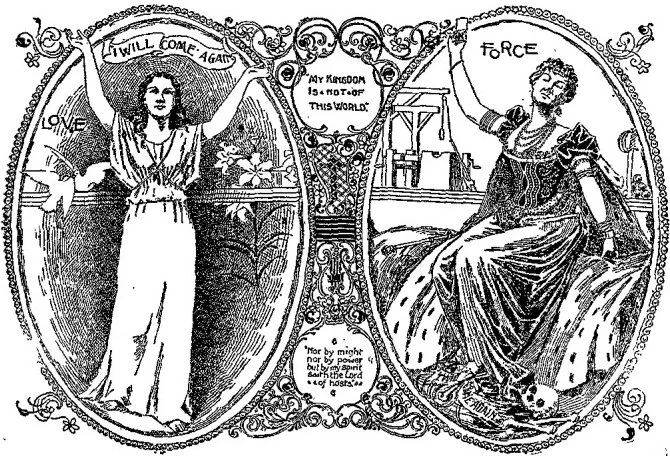
“I sit as a queen and am no widow and shall see no sorrow.” These are the boastful words of the fallen woman, the fallen Church of all the Christian centuries. She has been clothed with the purple and scarlet of civil power, and has seated herself as queen beside the Cæsars on the throne of earthly glory. Her waiting for the return of her loving husband is ended. He had given her His promise as the Prince of Heaven that he would return for her. With tender loving tones he told her of his infinite love and of his untold riches, and of his sure return. “Let not your heart be troubled. . . . In my Father’s house are many mansions, if it were not so I would have told you. I go to prepare a place for you. And if I go and prepare a place for you, I will come again and receive you unto myself, that where I am, there ye may be also.” To the plaintive reply, It will be lonesome when you are gone, he had quickly answered, “I will not leave you comfortless.” “I will pray the Father, and he shall send you another Comforter.” “He shall not speak of himself, but whatsoever he shall hear that shall he speak; and he shall show you things to come. He shall glorify me; for he shall receive of mine and show it unto you. All things that the Father hath are mine: Therefore said I that he shall take of mine and show it unto you.” “Lovest thou me?” “I have loved thee with an everlasting love.” “If ye love me keep my commandments.”
Oh what a divine story of infinite love! How could this woman so quickly forget “the chiefest among ten thousand,” the one “altogether lovely” who poured out his princely life to redeem her? How could she part with that snow white garment which had been given by her faithful Lover, every thread of which he had woven amid weariness and woe, and washed in his own blood—how could she bear to be clothed in that blood-stained robe of purple and scarlet which cruel hands had placed on her pale and patient Lord? How could she receive the crown of a queen from the power that had platted that crown of thorns? How could she forget his love? How could she send him that cold and cruel message of rejected love, “I sit a queen and am no widow.” Cæsar is now her accepted Lord, and she has ceased to look for the return of her lawful spouse.
This is the sad story as told by the Lord himself; let us now trace it in the annals of history. A single paragraph will tell how in the fourth century and onward, when the Church became wedded to the State, the doctrine of the personal second coming of Christ was rejected, and the adulterous union of the Church with the Roman empire was declared to be the fulfillment of the “blessed hope” of the apostolic church:—
“This state of matters, however [the general belief in the literal second coming of Christ], gradually disappeared after the end of the fourth century. The change was brought about by two causes,—first, Greek theology, which reached the West chiefly through Jerome, Rufinus, and Ambrose; and, second, the new idea of the Church wrought out by Augustine on the basis of the altered political situation of the Church. . . . He himself had at one time believed in it; he too had looked forward to the holy Sabbath which was to be celebrated by Christ and his people on the earth. But the signs of the times pointed to a different prospect. Without any miraculous interposition of God, not only was Christianity victorious on earth, but the Church had attained a position of supremacy. The old Roman empire was tottering to its fall; the Church stood fast, ready to step into its inheritance. It was not simply that the world-power, the enemy of Christ, had been vanquished; the fact was that it had gradually abdicated its political functions in favor of the Church. Under these circumstances Augustine was led, in his controversy with the Donatists and as an apologist, to idealize the political side of the Catholic church,—to grasp and elaborate the idea that the Church is the kingdom of Christ and the city of God. Others before him may have taken the same view, and he on the other hand never forgot that true blessedness belongs to the future; but still he was the first who ventured to teach that the Catholic church, in its empirical form, was the kingdom of Christ; that the millennium kingdom had commenced with the appearing of Christ, and was therefore an accomplished fact. By this doctrine of Augustine’s the old millenarianism, though not completely extirpated, was at least banished from the realm of the dogmatic. For the official theology of the Church it very soon became a thing of the past; certain elements of it were even branded as heretical. It still lived on, however, in the lower strata of Christian society.”—Encyclopedia Britannica, Vol. XVI, p. 317.
Turning now from the “mother” to the daughters, of the Reformation periods, let us see if they are not repeating the history of the mother of harlots. Through all the long night of apostasy the Lord has had a faithful bride who was true to his love and who was making herself ready, and patiently “looking for that blessed hope and the glorious appearing of the great God and our Saviour Jesus Christ.” As above stated, they were regarded as heretics by the reigning queen, and “confined to the lower strata of Christian society;” but this great truth lived in the same lowly “strata” in which Christ planted the truth, when he taught it to the fishermen.
At the dawn of the Reformation the “blessed hope” was revived.535
“The German and Swiss Reformers all believed that the end of the world was near.”—Ib. 318. After the successors of the early Reformers had become entangled with human governments “they took up the same ground in this respect which the Roman Catholic church had occupied since the days of Augustine.”—Ib. 318.
We will let the late Dr. A. J. Gordon, that godly Baptist minister, who though dead yet speaketh, state in his kindly way the present attitude of the daughters of the Reformation periods, on this subject:—
“It is to be regretted that our Protestant Christianity, in its separation from Rome, never passed entirely out of the baleful shadow of this pseudo-millennium. For many to this day confound the Church with the kingdom, and apply the promises of the glory of the age to come, to the present triumphs of the gospel. God forbid that in the slightest degree we should undervalue the missionary and evangelical victories which have so signally marked this century; but if we are tempted to predict the speedy conquest of the whole world to Christ through these successes, we need to be admonished to speak according to the Word. The present is the dispensation of election; the declared purpose of preaching the gospel to the Gentiles in this age is to take out of them a people for His name (Acts 15:14), and it is a premature grasping of the kingdom to apply to this period those glorious predictions of universal righteousness in the age to come, with which Scripture abounds.”
Next let a prominent Methodist clergyman, signing himself “Ignotus,” tell in his powerful style another phase of the same truth:—
“Our ministry have been dazzled and bewildered by the splendor of our unparalleled material progress. They have shared it and have been lifted by it out of the poverty and sacrifice of the fathers, clothed in purple and fine linen, and made to fare sumptuously every day. They have come to glory not in the cross, but that in preaching the gospel they have gotten beyond all its crucifixions and sacrifices, and that henceforth the world would be saved by our national progress and our splendid ecclesiastical equipage.
“All this we have accounted the good time coming, the breaking of the millennium. This is the style of boasting and conceit that has characterized our pulpits for the last twenty years, and now we awake—if we do awake—to find our progress has been material and selfish—progress toward death. I am not saying that our nation is near its downfall, but I do say we are rapidly hastening in this direction. We need only to make progress. The inevitable tendency of our current economics and politics is to anarchy through tyranny, rebellion, revolution.”—Christian Advocate, Feb. 14, 1895.
We will now submit a few quotations from the leaders in that gigantic movement of the churches called “Christian Citizenship,” to show that the control of civil affairs by the Church is now, as in the days of Augustine and onward, coming to be regarded as the fulfillment of Christ’s promise to come again:—
“Not until the kingship of Jesus is established over our land and the world, and his teachings made the rule in public affairs, will the Christian Citizenship League have achieved its purpose to prepare the way of the Lord. And then it shall be found that not only has the way for his coming been prepared, but that he has indeed and in truth come.”—The Christian Citizen, the organ of the National Christian Citizenship League, Dec., 1896.
This is exactly what the mother of harlots said in the fifth century when she had gotten control of public affairs and seated herself as a queen on the throne of the Cæsars. She said, “Christ has come.”
“We mean to lay hands on politics, we mean to wash politics clean and clothe her in white raiment, and make her an obedient handmaid to the Great King.”—“Official Report,” Boston Christian Endeavor Convention, p. 214.
This is just what the mother thought to do, but instead of clothing politics in “white raiment” she made her own white raiment scarlet with sin, and then she thought she had reformed politics, and that she was ruling as the handmaid of the Great King, when in reality she was ruling as the “great harlot” the arch-enemy of the Great King.
“What is my work as a member of a good citizenship committee? It is to enthrone Christ in every town and city in the State, to have every mayor and councilman a Christian, then Christ will rule.—Official Report, Boston Convention, p. 215.
An official description of the Christian Citizenship meeting of the Christian Endeavor Convention, held on Capitol Hill, Washington, D. C., July 11, 1896, reads thus:—
“Never before has our government permitted the area around the Capital, the very heart of the nation, to be used for other than governmental purposes. And indeed a governmental purpose was that, since the 50,000 represent nearly 3,000,000 young people whose force of character will make them the country’s governors before many a moon has passed. That grand exhibition of young manhood and womanhood is the clearest omen yet seen of the coming time when Christ, whose right it is to reign, shall be supreme on Capitol Hill.”—Official Report, p. 289.
Pages of similar quotations might be submitted, but these must suffice as samples, showing that the Roman Catholic conception of the kingdom of Christ pervades the Protestant churches. It is this papal conception that is spurring them on to gain control of civil affairs that they too may sit as queens and be widows no longer.
Meanwhile the faithful bride prepares and waits. Meanwhile she listens to the tender messages brought by the Holy Spirit from the loving Lord who shows her “things to come.” Like Stephen, filled with the Holy Ghost, she looks up to heaven and sees her husband seated at the right hand of God. As he passes from the holy to the most holy apartment of the heavenly sanctuary she follows with her loving looks. To the Spirit’s tender message from Him, “Surely I come quickly,” she lovingly answers, “Even so, come, Lord Jesus.”