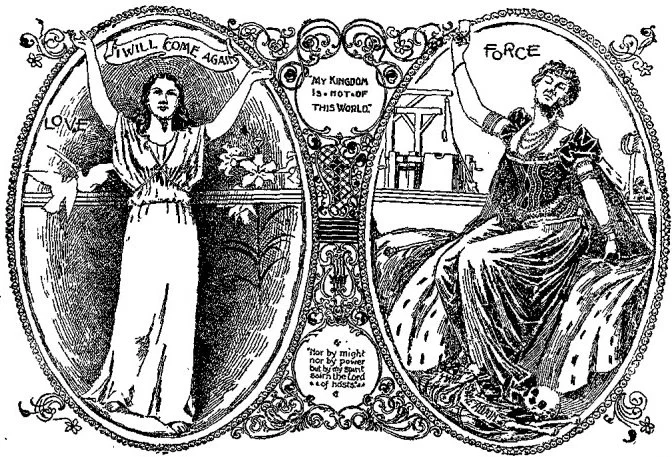
The White and the Scarlet, the Conflict of Colors.
By A. F. B.
“THE marriage of the Lamb is come and his wife hath made herself ready. And to her was granted that she should be arrayed in fine linen clean and white.”
White is the royal color of the kingdom of heaven. “The Ancient of Days did sit whose garment was white as snow.” “And he was transfigured before them. And his raiment became shining, exceeding white as snow, so as no fuller on earth can white them.” “The angel of the Lord descended from heaven . . . his raiment white as snow.” “He that overcometh shall be clothed in white raiment.” “I counsel thee to buy of me . . . white raiment that thou mayest be clothed.” Thou hast a few names even in Sardis which have not defiled their garments, and they shall walk with me in white.” “Though your sins be as scarlet they shall be white as snow.” “Wash me and I shall be whiter than snow.” “I beheld, and lo, a great multitude which no man could number, of all nations, and kindreds, and tongues, stood before the throne, and before the Lamb, clothed with white robes and palms in their hands.” “And white robes were given unto every one of them.” “And unto her was granted that she should be arrayed in fine linen clean and white, for the fine linen is the righteousness of saints.”
From this it is plain that the white robe is heaven’s symbol of power and purity. It is the only robe which the Lord, the lawful husband, ever places upon his wife, the Church. In this white robe she faithfully waits the return of the Lord. To accept any robe from the hand of another is to be untrue to her absent Lord.
“I saw a woman sit on a scarlet colored beast. . . . And the woman was arrayed in purple and scarlet color, and decked with gold and precious stones and pearls.”
Purple and scarlet are the royal colors of earthly rulers. “If thou canst read the writing and make known the interpretation thereof, thou shalt be clothed with scarlet and have a chain of gold about thy neck, and thou shalt be third ruler in the kingdom.” “Purple raiment that was on the kings of Midian.” “And the soldiers . . . put on him a purple robe, and said, Hail, king of the Jews.” “And they stripped him and put on him a scarlet robe, . . . and mocking him said, Hail, king of the Jews.”
“And the woman was arrayed in purple and scarlet color, and decked with gold and precious stones and pearls.” Where did this woman get her gaudy attire? Not from the lawful husband of the Church, for he clothed his bride in white raiment. “They which are gorgeously apparelled . . . live in kings’ courts.” The sad truth is, the woman has forgotten her lawful Lord and has exchanged her white robe of heavenly purity and power for the purple and scarlet robe of earthly kings. And what did this earthly power cost this fallen woman? She paid an infinite price. It cost her all. She is now only a harlot, soon to be hated even by those who now share her shame.
What a faithful picture of the apostate church of the Dark Ages. She deliberately solicited civil power at the hands of the Roman emperors. She disdainfully doffed the pilgrim white and donned the purple robe. She threw away the “sword of the Spirit” and grasped the sword of civil power. Thus attired she sat no longer in “heavenly places in Christ,” but in earthly palaces arm in arm with Caesar.
No longer in possession of the Holy Spirit, the shield against heretics (Acts 5:9–13), she now sought the civil arm. She passed from the “everlasting arms” of her lawful Lord into the arms of earthly emperors. Let her tell the shameful story herself:—
“For many ages after the conversion of Constantine it was easier for the church to repress heresy by invoking the secular arm than by organizing tribunals of her own. . . . But in the thirteenth century a new race of temporal rulers rose to power. . . . Philip Augustus was refractory toward the Church in many ways. . . . The Church was as clear as ever upon the necessity of repressing heretics, but the weapon, secular sovereignty, which she had hitherto employed for the purpose, seemed to be breaking in her hands. The time was come when she was to forge another weapon of her own; . . . which in the task of detecting and punishing those who mislead their brethren should employ all the minor forms of penal repression while still remitting to the secular arm the case of obstinate and incorrigible offenders. Thus arose the Inquisition.”
The reader is now invited to look in another direction, and with Christian candor see if he does not discern some traits of the mother of harlots in popular Protestantism of to-day. Bear in mind that the “mother” began to fall when she became worldly, when the church began to be filled with unconverted men and women. Wealth and luxury and fashion took the place of poverty, plainness and purity. Let the author of the Fletcher Prize Essay, Rev. George Guirey, a prominent member of a popular Protestant church, point out the similarity between the mother and the daughters:—
“Is there not some reason for the common impression that the worldly spirit in the Church is weakening her power with the public. Are there not evidences at hand that seem to confirm the impression that the Church in the Roman empire in the fourth century is repeating itself in the United States to day? . . . The enervating influence of wealth, luxury and fashion tells upon the church, producing spiritual declension, neglect of holy vows, and indifference to responsibility. The blandishments of the world are too much for human nature to withstand. And we see the sad spectacle of the great moral and religious activities of the Church dropped down into the rut of the ordinary routine of mere business officers, while her beautiful and glorious life is shorn of its spiritual power.”—The Hallowed Day, pp. 57, 58.
It was after the Church of the fourth century was “shorn of spiritual power” that she sought the civil power. It is the inexorable logic of cause and effect that the Church “shorn of spiritual power” should grasp after the civil power. This is certainly what the Church of to-day is doing, and strange to say, this is just what this Protestant clergyman advocates. On the same page he thinks that the Church “with her vast resources and advantages” consecrated to the service of God, “and with the leverage of civil law in her hands,” could accomplish great things for God.
To-day the lobbies of the halls of legislation are fast being crowded as in Constantine’s day with clergymen in quest of the purple and scarlet robe—the leverage of civil power. Within a few years this sentiment has been reinforced by what is known as the “Christian Citizenship” movement. A few of many quotations from its advocates will show that the Church is seeking civil supremacy now as in the fourth century. The following from a prominent speaker at the Boston Christian Endeavor convention shows that the fatal fall of the Church of the fourth century is regarded as a triumph:—
“In less than three centuries from the ascension of Christ, Christianity, in the person of Constantine the Great, had ascended the throne of the Cæsars and wrapped itself in the royal purple and ruled the Roman empire.”
With the false idea that the Church triumphs when she wraps herself in civil robes and rules the nations, the reader will not be astonished at the following utterances from the leaders in the new movement called Christian citizenship. They are all, save one, quoted from official reports of speeches made at International Christian Endeavor conventions held in Boston and Washington:—
“Taking an interest in politics does not mean that the minister of the gospel should bring politics into the pulpit, but it does mean that he should take his pulpit into politics. It does not mean that he should bring politics into the church, but it does mean most emphatically that the church should be translated into political power.”—Official Report, Washington Convention, p. 109.
“Christians must arise in the interests of righteousness and take control of civil affairs.”—Official Report, Boston Convention, p. 103.
“We have a right to make and enforce human laws that shall call for the observance of the laws of God.” Official Report, Washington Convention, p. 304.
“When the primary and the prayer-meeting are held on the same night the true prayer-meeting is the primary. ”—“Christian Citizenship,” by Rev. Carlos Martyn, p. 65.
Pages of such quotations might be presented, but these must suffice.
Oh, where are the Spirit-filled men and women who will call the churches to repentance,—call them away from the political primary back to the prayer-meeting of Pentecost? Where are the men and women clothed with the “power from on high” who will persuade them to turn from the purple and scarlet of political power to the snow white robe of the Prince of Peace? These are perilous times. Reader, have you received “power from on high?”
A. F. B.