THE FAITHFUL BRIDE AND THE FALLEN WOMAN.
By A. F. B.
The last act of sin’s awful tragedy is presented in the closing chapters of Revelation by means of the most startling symbolical scenes.
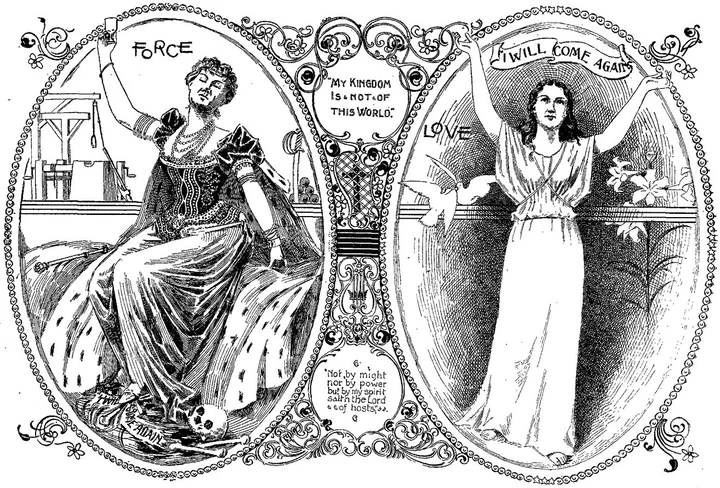
The two central symbols in these scenes are two wonderful women. The one wonderful because of her infinite purity, the other wonderful on account of her unspeakable shame. One is represented as “clean,” the other as “filthy.”
The striking contrast in character appears also in clothing. Of one it is written: “To her it was granted to be arrayed with fine linen, clean and white;” of the other, “and the woman was arrayed in purple and scarlet color decked with gold and precious stones and pearls.” One is dressed in the righteousness of saints; the other is drunk with their blood. One is clad by her lawful husband, the other by those who share her shame. One is clothed by the King of heaven, the other by the kings of the earth; one with the loyal white of her heavenly King, and the other with the purple and scarlet of earthly courts. One faithfully waits for her husband from heaven, the other shamefully revels with the rulers of earth; one is a stranger to earth, the other is a stranger to heaven.
These two women have nothing in common. They symbolize opposing kingdoms; one is a friend of God, the other a friend of the world. Of one it is written: “Ye adulterers and adulteresses, know ye not that the friendship of this world is enmity against God?” Of the other, “Ye are not of the world, but I have chosen you out of the world, therefore the world hateth you.”
It is hardly necessary to state that these two women symbolize two churches, one “the church of a living God,” the other, “the synagogue of Satan.” Paul wrote to the church at Corinth, “I have espoused you to one husband, that I may present you as a chaste virgin to Christ.” All through the Scriptures a pure woman represents the true church of Christ, and an impure woman a fallen church.
Though the Lord left his church in a persecuting world, he did not leave her powerless. “Ye shall receive power after that the Holy Ghost is come upon you.” “Tarry ye in the city of Jerusalem until ye be endued with power from on high.” The story of the apostolic church, the church of the Holy Ghost, throbs with power:—
“All of one accord”—“a sound from heaven”—“a rushing mighty wind”—“tongues of fire”—“filled with the Holy Ghost”—“great power”—“pricked in their heart”—crying “what shall we do”—“three thousand souls” saved—lame man “leaping and praising God”—“wonder and amazement”—Pharisees frightened—soldiers afraid—hypocrites flee—Stephen steadfast—stoned to death—“Threatening and slaughter”—Saul prostrate—Paul “filled with the Holy Ghost”—“confounded the Jews”—stoned to death—dragged out of the city—resurrected—feet fast in the stocks—“midnight”—“praises unto God”—“a mighty earthquake”—“doors were opened”—“bandsp. 473 were loosed”—jailer converted—Herod vexes the church—“arrayed in royal apparel”—“the angel of the Lord smote him”—“eaten of worms”—“gave up the ghost”—“great wonders and miracles”—“much people was added unto the Lord”—“of the devout Greeks a great multitude”—“of the chief women not a few”—“a great company of priests were obedient unto the faith.”
Oh, what an inspiring conflict! On the one side are stones and stocks, on the other, the Holy Ghost; on the one side principalities and powers, on the other side, “power from on high.” On the one side, the high priest and Herod, on the other side, the Holy Ghost. On the one side Felix and Agrippa, Cæsar and Rome, on the other, the HOLY GHOST.
“To say nothing of apostolic Christianity, let us ask what it was that gave the Christianity of the first two centuries such extraordinary vigor in its conflict with heathenism. An eminent writer, Gerhard Uhlhorn, has shown with a graphic hand that it was just this quality of absolute unworldliness which constituted the secret of its power. The men who conquered the Roman empire for Christ bore the aspect of invaders from another world, who absolutely refused to be naturalized to this world. Their conduct filled their heathen neighbors with the strangest perplexity; they were so careless of life, so careful of conscience, so prodigal of their own blood, so confident of the overcoming power of the blood of the Lamb, so unsubdued to the customs of the country in which they sojourned, so mindful of the manners of ‘that country from whence they came out.’”
“The help of the world, the patronage of its rulers, the loan of its resources, the use of its methods, they utterly refused, lest by employing these they might compromise their King. An invading army maintained from an invisible base, and placing more confidence in the leadership of an unseen Commander than in all imperial help that might be proffered—this was what so bewildered and angered the heathen, who often desired to make friends with the Christians without abandoning their own gods. But there can be no reasonable doubt that that age in which the church was most completely separated from the world was the age in which Christianity was the most victorious in the world.
“It was also the era of undimmed hope of the Lord’s imminent return from glory, so that it illustrated and enforced both clauses of the great text: ‘For our citizenship [R. V.] is in heaven from whence also we look for the Saviour, the Lord Jesus.’” (Phil. 3:20.)—Dr. A. J. Gordon.
This, in brief, is the history of the church of the living God, the faithful bride, for the first two centuries. At this point she slowly retreats before the scarlet woman, until she hides from view for more than a thousand years in the wilderness home prepared by her Lord. A. F. B.