The Declaration of Independence has a deeper meaning than that of simple renunciation of allegiance to the government of Great Britain. While it was just that that allegiance should be renounced, the occasion was a vastly greater one than could be measured by the commercial and personal interests bound up in our colonial relationship with the mother land. A greater cause was to be championed by that declaration—a vaster audience addressed than the assembled Parliament of Great Britain.
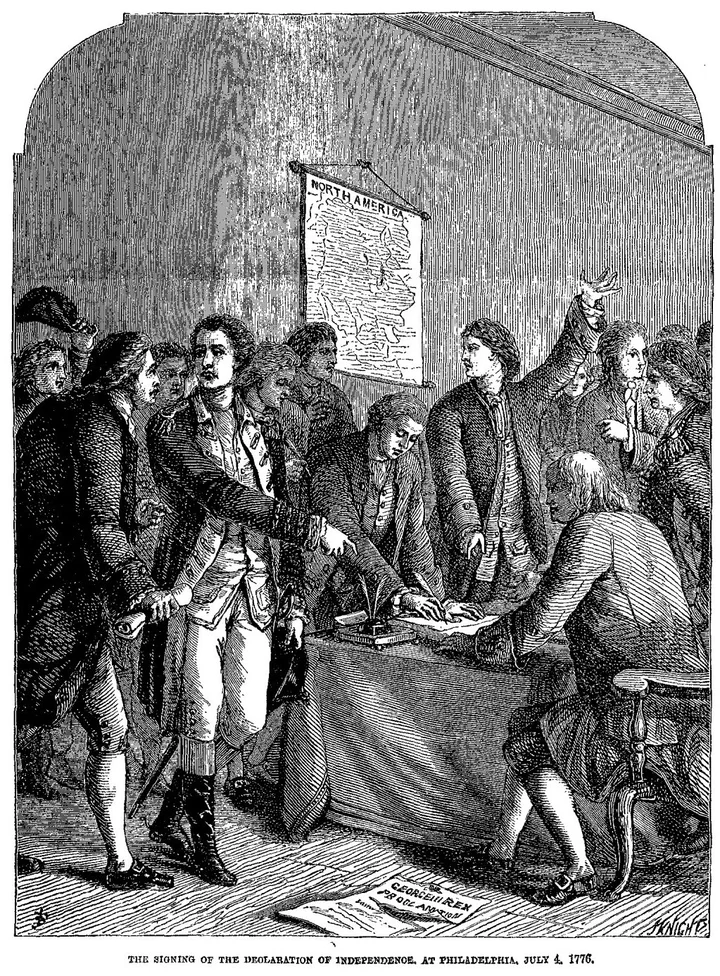
“We hold these truths to be self-evident, that all men are created equal, that they are endowed by their Creator with certain unalienable rights, that among these are life, liberty, and the pursuit of happiness; that to secure these rights, governments are instituted among men, deriving their just powers from the consent of the governed; that whenever any form of government becomes destructive of these ends, it is the right of the people to alter or to abolish it, and to institute new government, laying its foundations on such principles and organizing its powers in such form, as to them shall seem most likely to effect their safety and happiness.” Such a declaration was of necessity addressed to the whole civilized world. It spoke in behalf not only of the thirteen American colonies, but of all the victims of oppression the world over.
“The heart of Jefferson in writing the declaration, and of Congress in adopting it, beat for all humanity; the assertion of right was made for the entire world of mankind and all coming generations, without any exception whatever; for the proposition which admits of exceptions can never be self-evident. As it was put forth in the name of the ascendent people of that time, it was sure to make the circuit of the world, passing everywhere through the despotic countries of Europe; and the astonished nations, as they read that all men are created equal, started out of their lethargy, like those who have been exiles from childhood, when they suddenly hear the dimly-remembered accents of their mother tongue.”*
The Rights of the People.
In the long contest which has made all lands its battlefield, between liberty and oppression, the time had at length arrived when the world was to hear proclaimed in no uncertain tones the doctrine of individual rights, and not merely the rights of certain individuals, but the rights of all individuals, or in other words, the rights of the people. The world had long been hearing about the “divine right” of kings; the monarchs had diligently proclaimed this doctrine to the people. The world had heard also about the rights of barons and nobles; Magna Charta had proclaimed them. The Petition of Right, Bill of Rights, and the Writ of Habeas Corpus, had also struck more or less effectually against monarchical usurpation of power, in favor of the rights of the people. But in the immortal Declaration put forth by Jefferson and his associates, the doctrine of the rights of the people first found full and complete expression. Then was heard a voice proclaiming liberty throughout all the land to all the inhabitants thereof,—a voice which went “out through all the earth,” and its “words top. 202 end of the world;” and which, while it could not directly confer liberty upon the oppressed, announced to them their possession by divine right of a personal independence of those oppressive relations which had bound them in slavery to their rulers, and roused them to put forth manly efforts to make that freedom real.
One more proclamation of liberty remained to be given,—the Proclamation of Emancipation;—and that was necessary only because the principles of the Declaration of Independence had been denied and prevented from being universally carried into effect in the very land which gave it birth, by the institution of negro slavery.
To Deny Rights Is to Deny the Creator.
The significance of the Declaration of Independence lies in the fact that it speaks for the individual. Considered from the standpoint of what is theirs by creation, the human race must be considered as individuals; and it is upon the fact of creation that the whole Declaration is based. “All men are created equal;” they “are endowed by their Creator with certain unalienable rights,” among which “are life, liberty, and the pursuit of happiness;” and “to secure these rights, governments are instituted among men, deriving their just powers from the consent of the governed.” These are the fundamental, self-evident principles which support and justify all else which the Declaration sets forth. Man has certain rights which are unalienable; and he has these rights not as a part of society, but as an individual. And therefore the primary rights of mankind are individual rights, and not rights which pertain to men in the aggregate. The rights of the organized body are secondary, growing out of the rights of the individuals composing it. And any form of government which subordinates the individual’s right to “life, liberty, and the pursuit of happiness” to the real or supposed rights of the majority, ignores the fact of man’s creation, and with that ignores God.
The Declaration of Independence has lost none of its force by transmission through the century that has elapsed since its original proclamation. It is to-day a charter of civil liberty for every individual,—a declaration of independence from the despotism which to-day would mask itself in the garb of civil authority, as it did formerly in the days of George III. He who sees in it only an interesting relic of antiquity,—a mere momento of the wisdom and determination of our forefathers—is blind to its real significance, and to his own best interests as well.
The Declaration of Independence is the world’s charter of civil liberty, as the gospel is its charter of soul liberty. It was—and is—the mission of Jesus Christ “to proclaim liberty to the captives, and the opening of the prison to them that are bound.” Isa. 61:1. It was the same Jesus Christ who created man,† and by creation endowed him with the unalienable rights which the Declaration of Independence sets forth. The two are in harmony with each other. S.