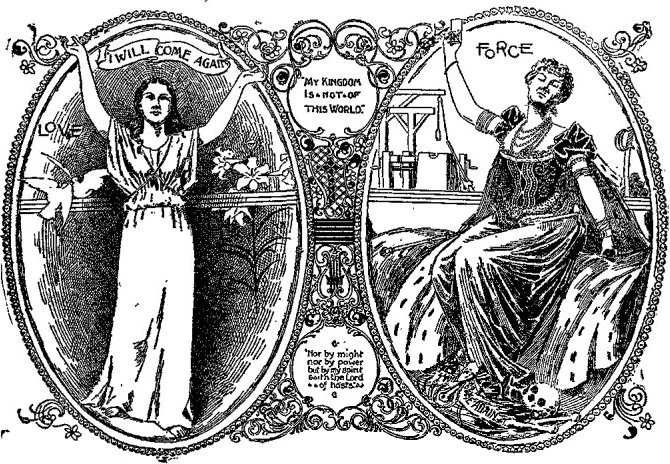
The Church having commenced the treasonable work of placing man in the seat of the Holy Ghost in the temple of God, and thus having lost the “power from on high,” she naturally sought for power from beneath, the only power remaining. A church will have power—if not the power of God, then the power of men. Ministers filled with the Holy Ghost will add men to the Lord; but ministers, of every church and at all times, if they are not filled with the Holy Ghost, will seek power by leading away disciples after themselves.
How many ministers to-day who bear the Protestant name are resorting to the most humiliating methods to fill their pews and platters—to lead disciples away after themselves. They are doing just what was done in the third century and onward by the “falling away” which made the papacy; and at the same time talking wisely of the apostasy in the early church. And when the faithful watchmen point to the parallel between the fourth century and the nineteenth, and warn men against the nineteenth century image of that fourth century church, they are declared to be enemies of Christ just as the faithful at that time were declared to be.
We are tracing the tracks of the scarlet woman through the early centuries for the sole purpose of showing that the trend of the popular church to-day is in the same path. Every point made has its parallel in the Protestant churches to-day, and we sincerely hope that the reader will see it and take warning. If the world has a seat in your heart while you profess to be Christ’s, it matters not what church you belong to, you are covered by that symbolical robe of purple and scarlet. “Come out,” is the call. Let the Holy Ghost sit in the temple of God. Dethrone the world, the flesh, and the devil, and let the Holy Spirit occupy the “holy see” of your heart, and thus escape the falling away of the nineteenth century.
Having lost the power of God, the bishops of the early centuries made use of worldly methods to gain disciples, and thus obtain power. Bishops vied with bishops in “methods of reaching the masses.”
One method is thus described and indorsed by Augustine, sometimes called a saint:—
“When peace was made [between the emperors of Rome and the Church] the crowd of Gentiles who were anxious to embrace Christianity were deterred by this, that whereas they had been accustomed to pass the holidays in drunkenness and feasting before their idols, they could not easily consent to forego these most pernicious yet ancient pleasures. It seemed good then to our leaders to favor this part of their weakness, and for those festivals which they had relinquished to substitute others in honor of the holy martyrs, which they might celebrate with similar luxury, though not with the same impiety.” —Aug. Epist., p. 29.
By such means did the early church seek and obtain the power of the world.
Look on that picture, then on this, from a prominent minister of a popular Protestant church:—
“The Church has gradually toned down her testimony, then winked at and excused the frivolities of the day. Then she has tolerated them in her borders, and now she has adopted them and provided a home for them under the plea of ‘reaching the masses and getting the ear of the people.’ The devil has seldom done a cleverer thing than hinting to the Church of Christ that part of her mission is to provide entertainment for the people with a view to winning them into her ranks.”
“This thing is working rottenness in the Church of God and blasting her service for the King. In the guise of Christianity it is accomplishing the devil’s own work. Under the pretense of going out to reach the world it is carrying our sons and daughters into the world. With the plea of ‘Do not alienate the masses by your strictness,’ it is seducing the young disciples from ‘the simplicity and the purity that is toward Christ.’ (R. V.) Professing to win the world, it is turning the garden of the Lord into a public recreation ground. To fill the temple with those who see no beauty in Christ, a grinning Dagon is put over the doorway.”
“It will be no wonder if the Holy Ghost, grieved and insulted, withdraws his presence; for what concord hath Christ and Belial, and what agreement hath the temple of God with idols?”—Archibald Brown, in “Devil’s Mission of Amusements” endorsed by Spurgeon and Needham.
Hear this from the author of the “Spirit-Filled Life”:—
“It is positively painful to see the substitutes that are being tried to-day for the power of the Holy Ghost. Miserable substitutes are they all! One church is trying this plan, another that, and not one of them has found a new plan that is a permanent success. They are floundering, and some of them are foundering, and no wonder. It will be no loss to the kingdom of God if churches which ignore the Holy Ghost should founder. Let us go back to the Pentecostal methods. The trouble is that the churches have lost their way to that ‘upper room.’ Let a church only find her way back there, and obtain her Pentecost; let pulpit and pew be baptized with the Holy Ghost and with fire, and the people will come running in to see it burning. That church will not need to cater for amusements as a bait to catch the masses, but the people will come crowding into her pews, climbing into them as Zaccheus climbed into the branches of that sycamore tree when he wanted to see the Lord; for the people still want ‘to see Jesus,’ and they have heard that he is ‘to pass505that way.’ We cannot improve on Pentecost’s methods.”—The late Jno. MacNeil in “Spirit-Filled Life,” pp. 112, 113.
And now let the reader weigh every word of the following faithful witness as found in the most influential Methodist publication in America:—
“The pulpit has come to be a stepping-stone. In the lower ranks of the ministry it is a stepping-stone to the higher, and in the higher ranks it is a stepping-stone to the high offices of the church. In the rural districts the average preacher employs his ministry to help him into a city church, and in the city the preacher in the suburbs faces toward the great central churches. I do not stop to note and name the noble exceptions—the godly men who in the suburbs and in the country are doing their work with Christly unworldliness. I state the general deplorable fact, known and read of all men, everywhere recognized, and honored and acted upon in the administration of the Church—the degradation and shame of the ministry, the curse of the churches. How rare is it that a preacher of the gospel refuses a high ecclesiastical office tendered him! Preaching the gospel is not accounted by us the greatest work in this world—the highest position and honor ever conferred on mortal man. We sometimes write this noble sentiment and praise it with our lips, but in our hearts and lives we scorn and trample on it. We account a great many things higher than preaching the gospel—yea, almost any semi-secular office of Church or State that seems to offer higher worldly honor or larger salary.”
“And so we are constantly drawn off, and almost every man seems to have his price. Professorships, lectureships, secretaryships, editorial tripods, agencies, political office, real estate speculations, almost everything and anything tempt and draw away the ministry from their heaven-appointed work. To this there are noble exceptions; but this, I repeat, is the drift, the dominating spirit everywhere recognized and honored and acted upon in the high councils and administration of the church. From these high places this spirit descends through all the lower ranks of the ministry, corrupting the aspirations of our young men, and poisoning the very fountains of ministerial supply.”
“Let us now note how this our lack of undivided purpose of the Christly consecration to the great central ends of our ministry vitiates our entire ministerial life, and first, our inner spiritual life at all points. We lose faith in gospel preaching and the Christly passion for saving perishing men, and half unconsciously fall into the spirit and methods that help us climb the ladder of ecclesiastical position and honor.”
“In the same way our studies are vitiated. Instead of the Word and in the Word, its inner spirit and life, Christ, the cross, the pentecost, we read and study almost everything else—apologetics, dogmatics, ‘the genuineness,’ ‘the authenticity,’ magazines, reviews, the latest book about the Bible, the latest moralizing novel. The literary and scientific spirit, as antagonistic to the spirit of our mission as mammon itself, possesses us; and we come to our people with sermons far away from the spiritual wants and daily lives of people. Toiling, tempted, starving for the bread of life, we give them husks. This is the complaint of the people against the pulpit as I hear it on all hands to-day.”
“Thus our preaching is vitiated. The style of preaching that saves perishing men, that the common people hear gladly, that succeeds among the slums, . . . that steadfastly withstands the popular vices that are steadily creeping into our wealthy churches, is not the style that helps us into the wealthy churches, the doctorates, and the high offices. So our preaching becomes careful and timid, without moral earnestness and without power.”
“In the same spirit, lecturing is largely taking the place of preaching the gospel. . . . I can but look on with sadness when I see one of these men descend from his high calling to the lecturer’s platform: and standing there in the awful presence of two or three hundred unsaved young men and women, give off for an hour a Christless, gospelless lecture, employing the lecturer’s tricks to call forth clapping. O for some Whitefields and President Finneys to call us back to gospel preaching, and show us how to save the people, the churches, the nation.”—Ignotus in “Christian Advocate” (N. Y.), Feb. 25, 1895.
“The nineteenth century,” says the late Dr. Gordon, “is presenting almost the exact facsimile of the fourth century in this particular. The notion having grown up that we must entertain men in order to win them to Christ, every invention for world-pleasing which human ingenuity can devise, has been brought forward till the churches in multitudes of instances have been turned into play-houses, with theater-boards announcing the courses for the gay season, boldly set up at the doors; and there is hardly a carnal amusement that can be named, from billiards to dancing, which does not now find a nesting-place in Christian sanctuaries. Is it then Phariseeism or pessimism to sound the note of alarm and to predict that at the present fearful rate of progress, the close of this decade may see the Protestant church as completely assimilated to nineteenth century secularism as the Roman Catholic church was assimilated to fourth century paganism?”—From “How Christ Came to Church,” by the late Dr. A. J. Gordon, pp. 81, 82. Copyrighted by the American Baptist Publication Society.
This is just what the faithful witnesses for the truth have been saying for years. They have been saying “that the nineteenth century is presenting almost the exact facsimile of the fourth century.”
What next? After the Church of the fourth century had filled its churches with unconverted men, the next step was to obtain power from the Roman government to control them. The Church next asked to be clothed with the purple and the scarlet robe of royalty and to sit on the scarlet beast, on the throne of earthly dominion.