WHILE the flowers are still fresh on the graves of our honored dead, let us pause and think. We are called a “Christian nation,” and yet this nation quarreled, and in that quarrel a million men were maimed, or lost their health or lives.
What a comment on the “Christianity” of this “Christian nation” to say that the questions of ’61 could not be settled without murdering or maiming a million men, and bringing want and wretchedness or woe and widowhood into a million homes!
One would think that a look at the slabs which mark the resting places of the brave husbands, fathers and sons who were buried in that baptism of blood, would cause men to hate the licensed murderer, called War, and shudder at the sight of his marching columns. But no; never has there been such a tendency toward militarism as there is to-day. It is not confined to the element which always selects war by choice as a life occupation, but is all-pervading.
The children of the public school, the children of the private school, and the children of the Sunday school, Protestant and Catholic, are being trained in the arts of war. In New York City alone there is an army of 25,000 school boys. On Grant memorial day a part of this army marched in the great parade carrying their muskets, with flags on which were inscribed the contradictory words “we are for peace.” While one could but wonder at the sight of this military tendency on the part of the public school in a nation whose boast has been that its strength lay in justice and intelligence and not in force of arms, yet that wonder changed to amazement when the bristling bayonets of the church armies passed by. Among them were the Baptist Boys’ Brigade, Episcopal Church Temperance Legion, Hebrew Orphan Asylum Cadets, St. Francis Xavier (Jesuit) Cadets, Our Lady of Sorrows (Catholic) Cadets, etc., etc.
Turning to the “Christian nations” of Europe we find the situation appalling. More than twenty-one millions of trained soldiers stand ready to march into the battle of Armageddon and empty their veins into its crimson flood. Sea and strait, harbor and river, groan beneath a navy numbering more than two thousand ships and carrying more than twenty thousand guns.* All of this tremendous armament is maintained by “Christian nations,” not to defend themselves against the heathen, but against each other in their covetous scramble for each other’s territory and for the territory of the heathen. The cost of all this—more than nine hundred million dollars†—is wrung from the people by taxation. The poor man’s bread must be divided with the government to make and maintain this murder machinery before he divides it with his children. As a result the masses are growing hungry and restless. The struggle for bread is growing fiercer every hour, and pinching poverty is eclipsing all thoughts of the Prince of Peace.
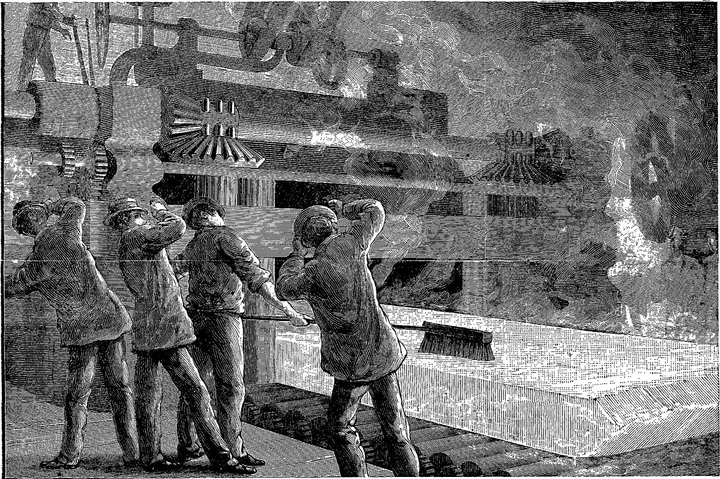
A wierd and touching incident occurred recently illustrating this fact. It was night in the city of Bethlehem, Pa.,—not “Bethlehem,” the birthplace of the Prince of Peace. A stranger was passing along its streets, when suddenly church bells began to ring and whistles to scream. What could it mean? Did it announce some great calamity? Was the city on fire? Oh no. Were the church bells ringing the glad news of the coming of the Prince of Peace or of some great conquest for his kingdom over the passions of men? No, no; the bells of Bethlehem ring out on the silent air no such joyful tidings. They are ringing with hungry tones the announcement that the Bethlehem Iron Co. has just been awarded the contract for forging the armor plate for Russia’s great war ships. Men have long been out of employmentp. 345 Poverty and suffering have resulted. Now they will have work and bread. No matter though it be to make engines of war which shall pour from their fiery throats shot and shell into the breasts of their fellow-men. Now they can eat and drink. No matter though they do eat and drink the flesh and blood of their fellows,—let the bells of Bethlehem ring.
These are the signs of the times. And with these awful facts staring us in the face, men will tell us that we are in the dawning of the millennium. That though the Prince of Peace has not yet returned, these are the days of peace.
To those who are disposed to regard these things with complacency we recommend a careful reading of the article on the next page from the pen of Hon. Thomas F. Bayard, Ex-secretary of State, and late ambassador to England. “There is no thoughtful man,” says Mr. Bayard, “who is not anxiously questioning in his heart, what does all this preparation portend.” It is only the thoughtless man who is not stirred by these facts. It is only those who fail to discern the signs of the times who cry peace and safety at such a time as this.
Reader, can ye not discern the signs of the times? These are not days of peace, but of plague and poverty and passion, of “distress of nations; men’s hearts failing them for fear and for looking after those things that are coming upon the earth. . . . Then shall they see the Son of man coming in a cloud with power and great glory.”
“But of the times and the seasons, brethren, ye have no need that I write unto you. For yourselves know perfectly that the day of the Lord so cometh as a thief in the night. For when they shall say, Peace and safety, then sudden destruction cometh upon them, as travail upon a woman with child; and they shall not escape. But ye, brethren, are not in darkness, that that day should overtake you as a thief.”
Pessimist! some one will say. Yes, pessimist as regards the world in its mad rush for pleasure, pelf and power; but an optomist as regards God’s power to accomplish his purposes concerning the world. It is his purpose to save such as seek salvation and submit to his will. He could not save more without destroying man’s free will. “Whosoever will let him come.”
Those who have built their hopes on a millennium of peace and righteousness before the return of the Prince of Peace, have built upon the sand. God’s Word furnishes no foundation for such a hope.
“Denying ungodliness and worldly lust, we should live soberly, righteously, and godly, in this present world; looking for that blessed hope, and the glorious appearing of the great God and our Saviour Jesus Christ.” This is the Christian’s hope. To this he looks for the end of strife and war. A. F. B.