A cloud, larger than a man's hand, has appeared upon the national horizon. It is rising from a quarter which history tells us may well be looked to with apprehension,—that of religious zeal. It was not called up in answer to the prayers of an Elijah.
The past few years have witnessed the rise and unexampled growth of a great religious organization,—the Young People's Society of Christian Endeavor. To-day this organization presents to the world 46,125 local societies and a membership of 2,750,000. About four-fifths of this membership is represented in the United States.
The young people of this organization belong to the flower of American youth. They are the young men and young women of intellect and influence, of enterprise and resource. They are devoted to their cause; they are full of zeal for “Christ and the church.”
Their number is not the measure of their power.
These facts together do not constitute the cloud which we view with apprehension. Religious power and zeal are not in themselvesp. 226 a menace to national prosperity; but they become such when directed in wrong channels. It is from this fact that an ominous cloud has developed out of the Endeavor movement. The organization is being led into a path which leads to no Christian goal. What that path is the action of the convention reveals.
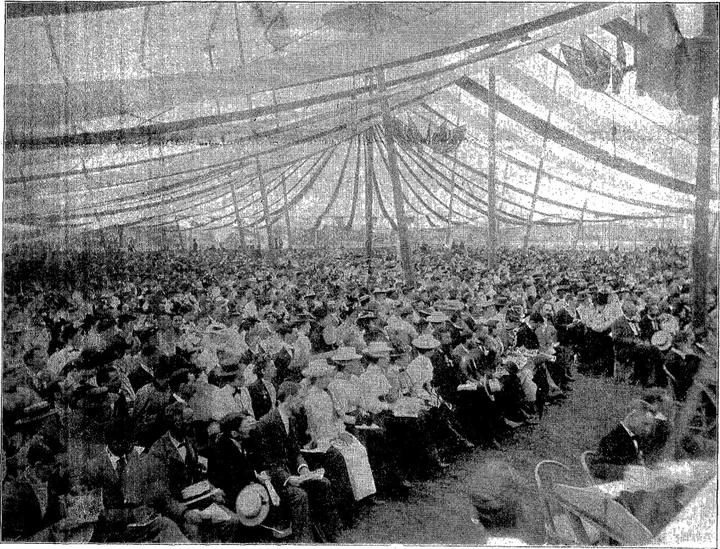
Our illustration presents a view of the interior of “Tent Endeavor.” This was one of three mammoth pavilions which were filled in like manner while the various themes under consideration were presented. The attendance from the Endeavor ranks is stated as in excess of 30,000, and represented nearly every country on the globe.
The Endeavor organization stands committed to the use of political methods for the attainment of its “Christian” aims. The adoption of this policy marks the point of its departure from the pathway of Christian usefulness. Among the chief “planks” of the Endeavor platform, as defined by President Clark in his annual address, was “Our Christian citizenship plank; our country for Christ; but as a society, no entangling political alliances.” It is in an utterly misleading conception of “Christian citizenship,” entertained by these young people, that the threatening danger lies.
They have determined upon securing this country for Christ not only by means of the winning influence of precept and example, but also by the immense power of compulsion which they can exercise through political methods, at the polls, and in the halls of legislation.
They have before them the view that this country is to be made Christian in all the aspects of its social and governmental life; that this change is to be brought about through the exercise of powers and the use of methods common to the conducting of any worthy human enterprise; that thus evil is to be driven out, righteousness established, and the kingdom of God set up. Stupendous error! Across the perspective of this view, the plain declarations of the Almighty interpose a barrier as high as the very heavens.
There is nothing more plainly stated in God's Word than that this present world is “reserved unto fire against the day of wrath and perdition of ungodly men.” 2 Pet. 3:7. It is not to become the abode of righteousness except through the most fearful process of purification from sin and sinners, by the seven last plagues (Rev. 16), the second coming of Christ in the clouds of heaven to gather his saints and execute vengeance upon the wicked (Rev. 17:11–21), and finally the melting of the very earth itself in the fires of the day of God (2 Pet. 3:10–12). We are told that in the last days iniquity of every kind will abound in the church itself,—among those “having a form of godliness.” 2 Tim. 3:1–5. We are told that the setting up of the kingdom of God as a visible kingdom on the earth, is to be “without hands,” and that it is to be set up by the breaking in pieces of all earthly kingdoms, which are to be swept away like chaff before it. Dan. 2:34, 35, 44, 45. See also Ps. 2:9. This is nothing else than the destruction which comes in the great day of God, as set forth in the texts above cited. And to those scores of other texts might be added. In short, the whole testimony of God's Word concerning the establishment of righteousness and his kingdom in the earth, utterly forbids this line of thought and work upon which the Endeavor forces are now proceeding.
To blend that which is heavenly with the earthly, has been the dream of the ages. Men have attempted this because they were unwilling to give up the earthly. They were willing to receive divine power and to embark both fortune and life in divine enterprises, if only they might use that power and conduct those enterprises according to their own ideas. But to give these up for the ideas and methods of God's choosing,—there is the test. It was much easier for the disciples to leave all and follow Christ, than to give up their cherished ideas which were directly contrary to what he spoke concerning his mission and kingdom.
The earthly and the divine will not blend together; yet to-day, as of old, the impossible is still being essayed in the attempt to join the two for the working out of purposes pertaining to the kingdom of God. There was a time when men thought that the earth and sky met,—that somewhere, on the far-distant horizon, terrestrial and celestial things touched each other. To-day it is believed just as firmly that somewhere and somehow the plane of things earthly comes into touch with the encircling sphere of things heavenly,—the affairs of civil government meet and blend harmoniously with the purposes of the gospel of God. They do not meet where we now stand,—that is evident; but many good people seem to see a blending line on the horizon of the near future. The Endeavor society have set out to reach that place. Alas! to what lengths will they go, and where will they lead the country, in the attempt?
The earth and heavens do not meet. They are everywhere an infinite distance apart. Only the ladder of Jacob's dream—the Lord Jesus Christ—connects the one with the other.
The Endeavorers have joined with the movement represented by the “National Reform” party, which aims to legislate this nation into righteousness. At the “Sabbath observance” meeting held Sunday, the 12th inst., the speakers advocated the stopping of Sunday trains, Sunday mails, Sunday excursions, etc., basing such action upon the language of the fourth commandment, which enjoins the observance of the seventh day, and no other! In their enthusiasm for that which promises speedy and glorious triumphs of Christianity, they have become strangely blind to most prominent Scriptural truths pointing away from their chosen path. They have even set their hand to the enforcement of a law of the most high God! As well might men undertake to enforce the law of gravitation. We may live in harmony with God's laws, and persuade others to do so; but to enforce them is the province of the Eternal One alone.
When human force enters the spiritual realm—for the law of God is spiritual—it can produce only evil results. “Whatsoever is not of faith is sin.” Rom. 14:23. Men may be forced to observe the sabbath, but it is then not of faith, and therefore is actual sin. It is mocking God with an empty form. How careful ought man to be not to force his fellowman in religious observances!
A far easier task to which the Endeavorers have also set their hand, is that of changing the fundamental law of this Republic. They are joining hands with the “Christian amendment” party, to secure an alteration of the preamble to the National Constitution, which will make it proclaim as the voice of the American people, that the revealed will of Jesus Christ is of supreme authority in civil affairs. This change, when it is secured, will mean the exclusion from “we, the people,”—in other words, the disfranchisement—of all citizens who cannot conscientiously indorse such a statement. It will mean the exclusion of multitudes of conscientious citizens from participation in the government and the retention of every person who has not conscience enough to care whether his profession is sincere or not. And this, it is expected, will purify the fountain of government and make this a Christian nation!
We have no word of condemnation for the Endeavor movement, as represented by its earnest work in very many departments of truly Christian activity. Pure motives, high aims, Christian integrity, enthusiasm, devotion, are features which appear upon the face of the Endeavor body at their general gatherings. All these have they possessed from their youth up; yet one thing they lack. There may be zeal, devotion, enthusiasm, which are not according to knowledge. How often has the world witnessed the same, and suffered because of it! Error is never so dangerous as when combined with a large amount of truth.
The interests of every American citizen are concerned in this Endeavor movement. The welfare of the whole country is concerned. For, masked beneath its Christian exterior, disguised even to the mass of the Endeavorers themselves, there moves with it the deadliest foe of our civil rights and liberties. In the proposed change in the Constitution's preamble, the arm of this foe is seen uplifted to strike at the Magna Charta of American freedom. In the zealous movement for legislation to compel Sunday observance, its hand is stretched forth to seize upon liberty of conscience. It is high time that the American people were aroused to the peril of the situation. The SENTINEL sounds the alarm. And the voice of history utters again the warning words, “Eternal vigilance is the price of liberty.”
S.