“WHOM were we talking about when our last week’s study closed?” questioned Professor Carman.
“That’s good; I see you are interested in these lessons,” he added, as he noted the dozen eager hands that were raised.
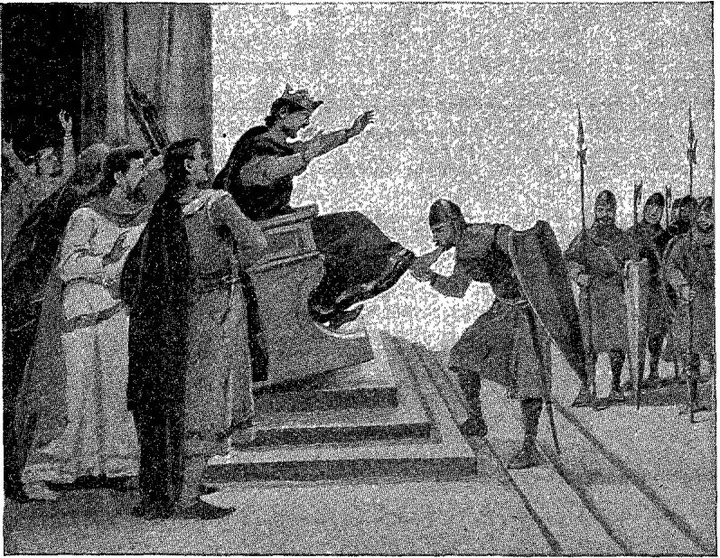
“It was about Rollo, the Norman,” answered Charlie White, in response to a nod from his teacher.
“Right. Well, Milly, what is on your mind? You may speak freely. In fact, I think we may as well devote the first of the half hour to questions, answers, and a familiar talk on the previous lesson.”
“Well,” said Milly, “aunt Mildred is at our house visiting, she is real good in history, and she told us a little story about Charles the Simple and Rollo. She said that when the king let Rollo have certain lands, it was necessary that he comply with the usual custom, and show his allegiance to his king by kissing Charles’ foot. But Rollo didn’t propose to do that kind of business, and so he sent a soldier to do it for him. But it was not at all agreeable even to him, and he was so indignant at being asked to do this, that he seized the king’s foot and raised it to his lips, instead of bowing down to perform the ceremony. As the king was sitting on a throne which was not stationery, it tipped him over, throne and all,” laughed Milly, “and then the Normans laughed at him; but the Frenchmen were quite angry, though the king wisely turned it off as a joke.”
“A very good story, Milly, and well told,” said Professor Carman, encouragingly.
“After Charles the Simple had been murdered,” continued the teacher, “which people supposed was done by one of his nobles, Hugh the Great, who was the son of the Count of Paris,—he who had been the real ruler instead of Charles the Simple, might easily have been king. But he did not choose so to aspire; so Louis IV. ascended the throne. He reigned eighteen years, and in 954 A. D. he left the kingdom to Lothaire, his son. He was succeeded by Louis V., called the Do-Nothing, because really his reign was so short that he could not have accomplished much, were he even so wise,—it was only a year. He was the last of the Carlovingian kings, the direct posterity of Pepin, and of Charles the Great.”
“Charles the Great and Charlemagne were the same, weren’t they, I believe?” asked Max Smith.
“Yes, the very same. Now, Hugh Capet, son of Hugh the Great, was made king by the nobles; and so you see that in less than two hundred years from the time when the great Charlemagne was placed in his tomb, the kingdom for which he fought so many battles and over which he reigned in such glory, had gone into stronger hands.”
“Don’t you think it would have been better for France if the descendants of Charlemagne had continued to reign?” asked Rob Billings.
“If they had been capable as their illustrious ancestor, yes; but they were not, so it was no doubt better to have a change. You see the nobles had almost unlimited power over those under them, and history says that the name of ‘king’ was almost a mockery.”
“How came the nobles to have so much power?” asked Joe Palmeter.
“I will try and explain how, Joseph, or rather, I will tell you about the Feudal System, then you can understand it.
“When a chief went to war, in very early times and was victorious, he used to give his principal men a certain share of the conquered territory, if they would promise to fight for him and work for his interests. This was called ‘owning allegiance,’ while the chief was called their liege lord and they his vassals. Then after a while these vassals themselves would do the same thing, and subdivide the land, among others, called ‘freeholders,’ and these freeholders had also others under them, called serfs, who were the very lowest class. So there were:—
“First, the king; second, the nobles; next, the freeholders: and lastly, the serfs.”p. 76
“I should think such a way of doing things would make no end of bother and worry for the king,” said practical Jack Smith.
“It did, indeed, for after a while the poor king didn’t own as much land as the nobles and vassals, and so they did not like to acknowledge their allegiance to him.”
“Wasn’t that the way with Rollo?” asked Florence Ray.
“Yes, and poor Simple Charles did not dare to resent the insult of being tumbled off his throne.”
“I should have thought they would have changed the foot-kissing ceremony after they had such an experience as this,” said Maggie Palmeter, laughing.
“So they did; after a while they signified their allegiance to the one above them by placing the hand inside that of their superior, which was certainly a more pleasing custom.”
“Let me see, professor, I would like to make a note of the time when Hugh Capet took the throne.”
“Very well; write; Hugh Capet, first of the Capetian kings, reigned from 987 to 996 A. D.
“I have been very glad to see that you all made good use of your note books during this lesson. We will close this study by giving the names of each of the kings of France as far as we have studied. This you will also do well to write in your note books. Then we will repeat them in concert:—
“Clovis, later, and unimportant kings, Pepin the Short, Charlemagne, Louis the Good-natured, Charles I. the Bald, Louis II. the Stammerer, Louis III. and Carloman, Charles II. the Fat, Charles III. the Simple, Louis IV. Lothaire, Louis V. the Do-Nothing, and Hugh Capet.
Mrs. L. D. Avery-Stuttle.