“WHAT became of King Childeric III?” asked Florence Ray at the next study. “The time to go home came so soon last week that we did not find out, and I have been worrying about him ever since.”
“Poor fellow,” answered Professor Carman, “they shaved his head again, and sent him back to his cloister.”
“Then I suppose Short Pepin had his way,” snapped Joe Palmeter, spitefully.
“Pepin the Short,” corrected Edna Phillips, whose memory of names and events never deserted her.
“Yes; Pepin the Short had his way, and now became the first of the Carlovingian kings, so-called from the word ‘Carolus,’ the Latin name for Charles.”
“Now to renew: Our last study took us over a period of 241 years, bringing us to the year 572 A. D. Who was the first French king?”
“Clovis,” answered a dozen voices.
“When did he rule France?”
“From 471 to 511 A. D.”
“After him came the later kings, hardly worthy the mention. But Pepin the Short was the first real king worth speaking about after Clovis. You will remember that his father was the great Charles, called the Hammer, but he was not really a king—only a mayor. This Pepin the Short was also the father of Charles the Great, or Charlemagne; he, Pepin, fought and conquered the Saracens and Bretons, went down into Italy and reduced the Lombards to submission, then gave their territory to the pope. This ‘Pepin’s Donation,’ as it was called, was the beginning of the wonderful friendship which existed many years between the popes and the French kings.
“Pepin was a very strong and courageous man. Once when he with many of his people were witnessing an exciting fight between a lion and a bull, as was the cruel custom, he asked, ‘Who dares separate them?’ No one caring to distinguish himself by running so fearful a risk, the king himself leaped between them, and finally cut off both their heads, saying as he did so, ‘Now am I not worthy to be called your king?’”
“When he died, he left the kingdom to his two sons, Charles and Carloman. But Carloman soon died, leaving to his brother, Charles the Great, or Charlemagne, as he is more commonly called, the entire kingdom. This wasp. 43 about the year 768 A. D. You should make a note of this date in your books, for now there was at last what the world calls a great man seated upon the throne of France. He was a man of great energy, military genius, and wonderful achievements. He was also a great friend of learning. But in those days, people did not have such books to read as we do now, for you must not forget that the art of printing had not yet been invented.”
“I don’t see,” said Jennie Jacobs, “how in the world they could learn anything without books, I have a hard time nowadays to learn even with them.”
“Well, you see,” replied Professor Carman, with a smile, “they had a few books, but they were very expensive, and were all copied with pen and ink; so you may imagine the labor they involved.
“It is said that Charlemagne made fifty-three warlike expeditions, and was always a victor, except in those against the Moors, who lived in Spain. Once when he was coming back home from one of these, he had to pass through the country of the Basques, and when he was crossing the Pyrenees with his army, these Basques, who were friendly with the Saracens, threw down great rocks, stones, and tree trunks upon them. This killed many and so frightened the others, that they became an easy prey to the fierce Basques, who killed them without mercy.”
“O I don’t see how any one could have been so cruel,” said Florence Ray, “it seems as if people were not half so bad as they were then.”
“But, Florence, human nature, without the renewing influence of the grace of God is pretty much the same in all ages.”
“It is from this battle that the romantic legend of Roland and Oliver sprang.”
“I’ve heard of them,” said Harry Ray, who was a great reader.
“O, please tell us about them,” pleaded Milly Brown, who was very romantically inclined.
“But, you see, I’m teaching truth now, and not fiction,” said Professor Carman, with a smile, “so you’ll have to get some one else to tell you the improbable stories.”
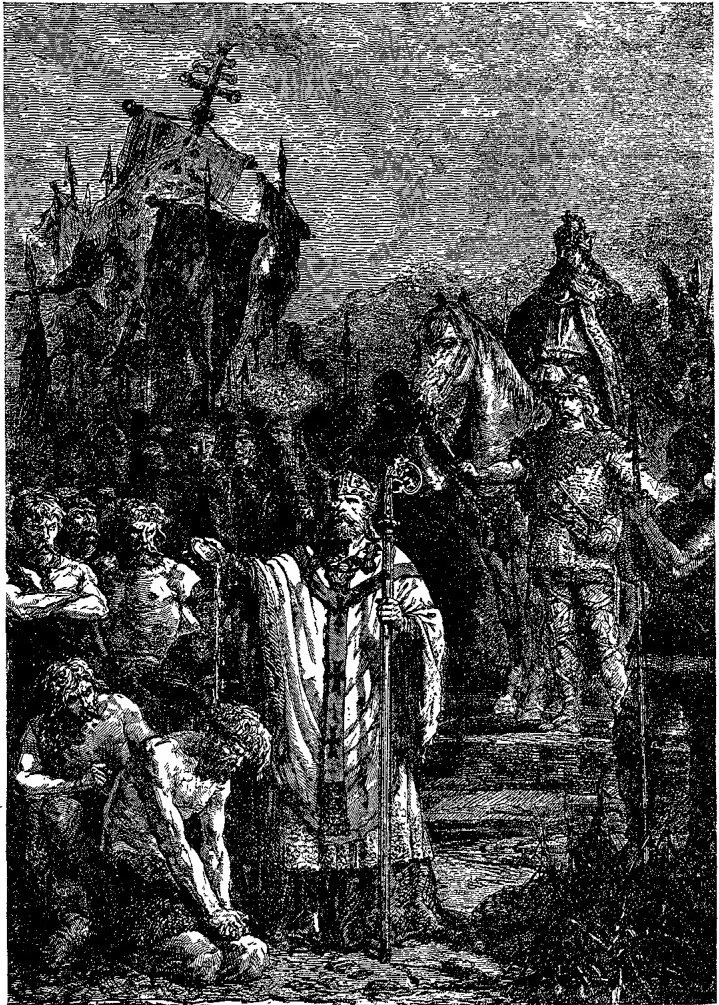
Milly looked quite disappointed, but the professor proceeded: “Charlemagne had a war with the Saxons, which lasted over thirty years; but they were finally forced to submit to the mightiest warrior of the age. But this war was another of those carried on in the name of religion. The zealous king wanted the Saxons to believe as he did. But I think he would have better succeeded if he had shown a more Christlike disposition toward his enemies. Only think of his ordering the wholesale slaughter of four thousand helpless prisoners at once, and then declaring that the war was carried on for the purpose of converting his enemies!”
Julia March raised her hand quickly. “I think he did not follow the teachings of Christ very closely, for he said, ‘Love your enemies, do good to them that hate you, and pray for them which despitefully use you and persecute you;’ he didn’t say to kill them.”
“No, indeed. Well, when Charlemagne had reigned thirty-two years as king of the Franks and Lombards, Pope Leo III crowned him also emperor of the Romans in the year 800 A. D.”
Professor Carman paused a moment, as nearly all seemed to be very busy with their note books. When the eager eyes were again raised to his, he continued:—“Foreign princes and kings were all anxious to form a friendship with this wonderful man. The Caliph Haroun Al Raschid, the famous hero of the ‘Arabian Nights,’ sent him a clock that struck, an elephant, and a monkey,—wonderful curiosities then.
“He created what was called the ‘School of the Palace.’ There Charlemagne would sit in great dignity, surrounded by his children, and some of the favored nobles, while Alcúm, a wise monk, brought on purpose from England, lectured to them about grammar, astronomy, and theology.
“The emperor tried to learn to write. But his hands were so stiff and accustomed to the sword, that he made sad work of it. But so anxious was he to improve everyp. 12 moment that he used to have some one to read to him even while he ate. He built a beautiful cathedral at La Chapelle, in Germany, which you can still see; therein is the very chair in which he was buried for near two hundred years, till Otho III removed the remains. Please write: Charlemagne died in the year 814, when he was seventy years old, having reigned nearly fifty years.
“Now you may all be dismissed, and see how much you can tell your parents to-night about Charles the Great or Charlemagne.”
MRS. L. D. AVERY-STUTTLE.