There has been introduced into the school exercises of the public schools of Boulder, Col., by the school board, a feature which is very significant when considered in its relation to the fundamental principles of American government. It is called the “American Patriotic Salute.”
The words of this salute are, “We give our heads, and our hearts, to God, and our country! One country! one language! one flag!”
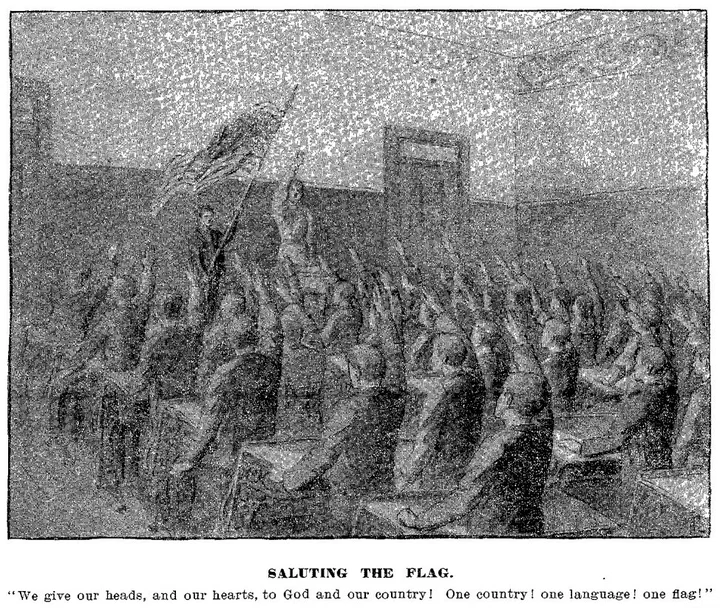
This salute is given by the pupils in a body, standing, and with appropriate gestures. It is delivered facing an American flag, which is held before the school during the giving of the salute by some one chosen as standard bearer. At given signals the pupils rise in their seats extend the right arm toward the flag, then bend it back so as to touch the forehead with the tips of the fingers, and at this point exclaim, “We give our heads;” then as the hand is carried to the breast and laid over the heart, come the words, “and our hearts.” Next the head is thrown slightly back and the arm outstretched, pointing upward; and with the countenance assuming an expression of reverence, the words are uttered slowly and in reverential tones, “to God and our country!” The arm is then dropped to the side, and after a brief pause the pupil exclaims, with emphasis, “One country! one language! one flag!” at the last word extending the arm so as to point directly at the flag; after which the pupil resumes his seat.
This salute is made obligatory upon all the pupils. Those who refuse to give it are suspended from the school; and this action has already been taken in a number of instances.
Let us consider, therefore, for what cause, in reality, pupils are now suspended from the public schools in the city of Boulder, Col.
In this salute the pupil says that he gives his heart to God. Now, no one knowing anything of the requirements of Christianity will deny that giving the heart to God is anything less than conversion. “Son, give me thine heart,” is the invitation of the divine Word by which God would draw the soul of the sinner to himself. He who gives his heart to the Lord, gives himself. The heart controls the life.
It is, therefore, beyond any contradiction, now required by the school authorities of the city of Boulder, that a pupil in the public schools must either profess conversion or be suspended from school!
And this, too, in the face of a provision of the fundamental law of the State, which declares the following (Art. 9, Sec. 8, of the General Statutes of Colorado):—“No religious test or qualifications shall ever be required of any person as a condition of admission into any public educational institution of the State, either as teacher or student; and no teacher or student of such institution shall ever be required to attend or participate in any religious services whatever.”
Beyond all controversy, the act or profession of giving the heart to God is a religious exercise. It is the very essence of religious devotion. It is a matter between the individual and his Creator. Into the sphere of this sacred relationship, comes the State, and with forceful hand assumes to dictate to the individual an act of devotion to God, taking the matter out of the hands of both the individual and God. And into the sphere of the sacred individual rights guaranteed by the law of the State, steps the school board of the city of Boulder, and in plain contravention of that law, compels public school pupils to engage in a religious exercise, under penalty of suspension if they refuse!
Do the pupils in the public schools of Boulder indeed give their hearts to God? They are required to say that they do. If they do not, they are required to utter a falsehood; and that, too, of the most damaging nature. But whether the pupil is sincere or not in his statement,p. 724 or comprehends the meaning of what he says, is a question of which the mandate of the school board takes no account whatever. The salute is obligatory upon all, and like any compulsory school regulation, can make no allowance for the beliefs or preferences of the pupils whom it affects.
Will those in favor of this religious requirement seriously claim that all the pupils who are thus made to say each day that they give their hearts to the Lord, do in reality make that consecration of themselves to him which the words imply? Is there any probability whatever, even the remotest, that the pupils of the public schools of Boulder, Col., are all consecrated in heart to the Lord? If they are, they were so of their own free will, and not because they have been made to say that they are; for a form of words has no power to convert the heart. But it is needless to propound the question, for it is perfectly evident that it must be answered in the negative. No; the children who thus say that they give their hearts to the Lord, are, many of them, not converted to God at all. This is absolutely certain. And therefore it is absolutely certain that in the public schools of the city of Boulder, Col., many of the pupils are compelled week after week to utter a falsehood, under penalty of suspension if they refuse!
Do the school board of the city of Boulder believe in God? Evidently they do. What, then, they may well inquire, does God himself think of this “patriotic salute?” Does he take account of such things? Does he take notice when an individual gives his heart to him,—when he does that in truth to secure which God sacrificed his only begotten Son, and poured out all heaven to mankind? Verily, he is well pleased with the gift of the heart of even the poorest and humblest individual on the earth. He is well pleased with the gift of the heart of “one of these little ones.” But how does he regard a profession of dedication to him which is not made in truth? What does he think of a lie spoken upon that point in which centers all his interest in humanity? And what does he think of a school regulation which compels children to utter such a lie before him?
There is a text of scripture which says that it is better for a man that he should be cast into the sea with a millstone around his neck than that he should cause one of “these little ones” to offend. There is opportunity for an application of this text in the city of Boulder.
But this is not all there is in this “salute.” It is a “patriotic salute.” There is the American flag held before them, as an emblem of patriotism, and the school children are required to say that they give their hearts also to “our country.” The gift creates a partnership, in which the parties are God and the United States Government! Can such a partnership be? Would the Almighty for a moment recognize it? Does the Creator claim anything less than the absolute right to the whole heart of every one of the human race? Who will seriously answer these questions in the negative?
If these words mean anything, they mean that the individual gives his life to his country, as he does to God. They mean that he will do as his country desires him to do. But when country calls, it is the government that speaks. The voice of government is taken for the call of country by the vast proportion of citizens. There is, indeed, a vital distinction between them; but it is not recognized by the many. And when the individual says that he gives his heart to “our country,” it may safely be taken as meaning that he stands ready to do the bidding of the government, whatever that may be. Of the bidding of God no account is taken; for the government speaks with an audible command which no citizen can possibly mistake; and having given his heart to the government, he can but feel bound to act as the government directs; and the government is not the mouthpiece of God. So that in the partnership which this gift assumes to set up, it is the government, and not God, that receives what is given.
God and civil government are parties that cannot always proceed in unison. This is because civil government is the creation of finite, sinful men; while God is infinite and altogether righteous. God’s ways are always just. Civil government often does that which is unjust.
God has said, “Thou shalt not kill.” But at the command of the government, the individual who has given his heart to the government, ignoring the command of God, takes his rifle and goes forth to kill as many of his fellow beings as he can. He seems to suppose that in some way the two commands can be harmonized; and feeling bound to obey the command of the government, he leaves it with the government to answer for the rightfulness of his course. He does not stop to ask himself where earthly governments will be in that day when every one shall give account of himself before God for the deeds that he has done in the body.
God has said, “Remember the Sabbath day to keep it holy.” But at the command of the government, men go forth to spend the Sabbath day in shooting down one another in battle.
God has said, “Thou shalt have no other gods before me.” But in the very act of giving the heart to another power than God, the individual chooses another god; for there is no point in worship if it be not supported by obedience. We cannot worship one power and obey another.
And therefore, since it is certain that in some things at least this government will proceed contrary to the laws of God, as all civil governments have since the world began, it is certain that in being required to say that they give their hearts to “our country,” the pupils of the public schools of Boulder, Col., are required to pledge themselves to act, at some time, contrary to the will of God!
Let it not be thought strange that the government should not act in all things in harmony with the will of God. The very nature of civil governments is unchristian. They are selfish, each seeking only its own interests, and that, too, very often, at the expense of thep. 725 others. They cast covetous eyes upon possessions that are not theirs. They never forgive an insult, but demand an apology and satisfaction; and if these are not forthcoming, there is war. Or if war does not follow, it is only because the aggrieved party feels too weak to risk the venture. These are facts which no one can dispute. In the very nature of things, therefore, it is not to be expected that civil governments will long act in harmony with the will of God.
And thus, in the light of truths that are self-evident, it is plain to the astonished gaze of every lover of liberty that in the city of Boulder, Col., in this latest year of American progress and enlightenment, the pupils of the public schools are compelled, by the constituted school authorities, to profess religion; to utter, in many cases at least, a direct falsehood; and to pledge themselves to the service of a power that is by nature contrary to God; they are forced to do all this under penalty of expulsion from the schools; and this is done in direct contravention of the provisions of the fundamental law of the State, forbidding any religious test, or forced participation in “any religious services whatever”!
What do the board of public schools of the city of Boulder, Col., propose to do about it? What will the people of Boulder do about it? What will the people of the State do about it? And what will the people of the United States, and of the civilized world think about it? These are things that remain to be seen.