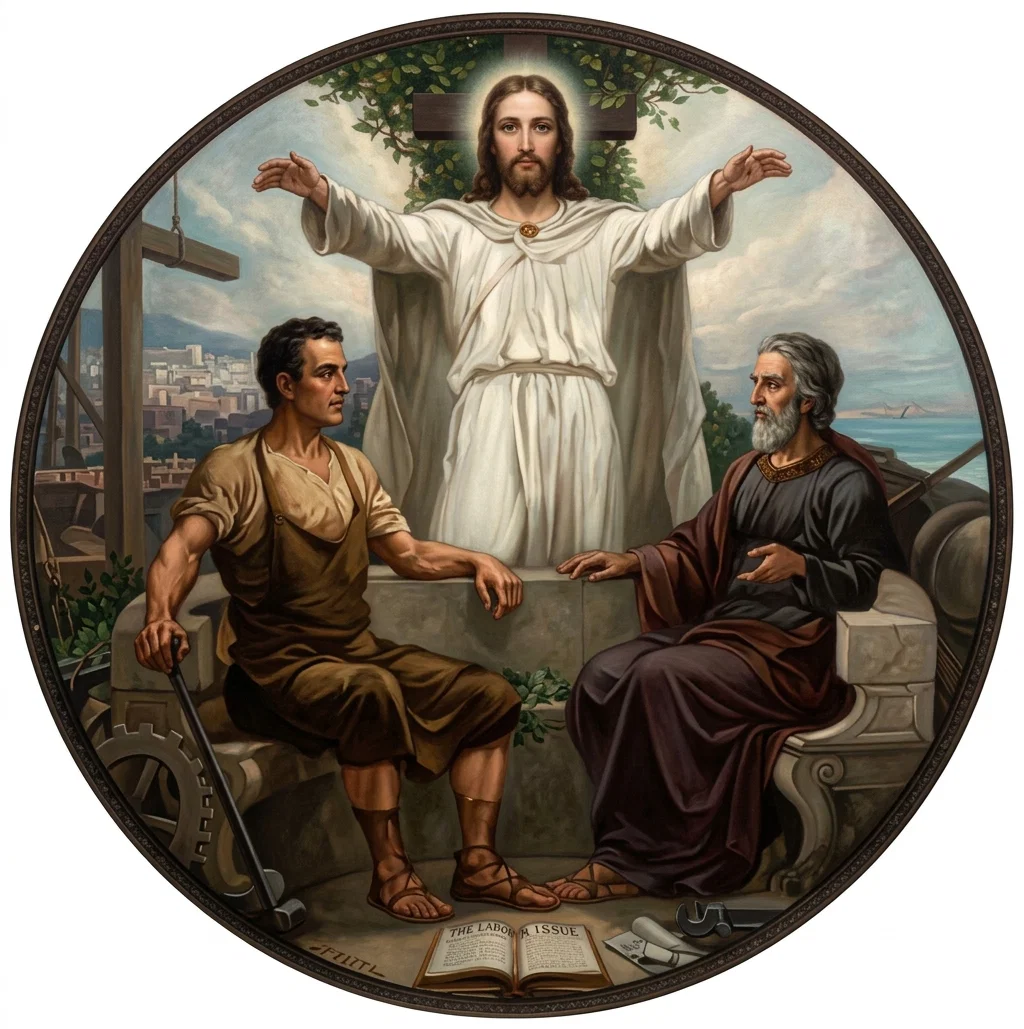
THE struggle between capital and labor is irrepressible and intense. The forces on either side are enlisted in a life-and-death war. It is not a friendly conflict of men holding antagonistic principles. There is intense opposition and festering hatred on either side. There are times of quiet, it is true; but these are dictated by self-interest. There are times of patched-up peace; but that is demanded by exhaustion of resources. The compromising "understandings" are tentative, experimental; and the bonds which bind together, slender and brittle. It is not a modern struggle; it is a conflict of ages, and intensified by modern conditions.
The side of labor is strongly stated by Mr. Clarence Darrow, labor's leading legal counsel, a great lawyer, and confessedly biased by his sympathies for labor. We quote from his article in the September "American" magazine:
THE MOST VITAL ISSUE
The most vital issue of trade-unionism is the closed shop, and it is around this issue that capital and labor have gradually closed in. Wages, hours, trade agreements, have been fought for and won, the outer fortifications in the struggle between capital and labor conceded; but the closed shop is the master's final citadel of refuge, its possession most eagerly desired, most violently opposed. No one can maintain that the closed shop is ideally right. Few institutions, if any, are ideally conceived; they are only right or wrong in relation to the times which brought them forth and the conditions of life which surround them. Thus to discuss the closed shop means first of all to understand the present relation between capital and labor; for the closed shop is not a finality, but only meant to be adapted to the industrial relationships of to-day.
Mr. Darrow carries the closed shop idea to that extreme that the workman has the right to choose his companions. He says:
The workman has the same right to choose the companions with whom he associates in labor as to choose the friends with whom he will spend his pastime; and the employer has no more right to force the society of another upon him during his hours of toil than during his hours of recreation.
Our sympathies are with the laborer; for we have been a laborer all our life, on farm, in forest, in mine and mill, in shop and office. But it seems to us that there is a radical difference between the two conditions. The time one spends in pastime is his, and he is not under any obligation to others, unless he so elects. But the time which he spends in labor is that for which he is paid. If he choose companions in his off hours, it is for social purposes; but in his employment he does not sell his time for social purposes, but for compensation. If men with whom he labors be a matter of contract, he has the right; but if not a matter of agreement, it would seem to us that companionship, where safety or health is not endangered, has no standing as a matter of right. Nor is this the practical outworking of the matter. The ardent trade-unionist who was putting on the roof of a twenty story building, would object as strenuously to the non-union plumber or plasterer who was working in the basement, as tho he were working at his side, even tho the non-unionist was a father or a brother. The objection is not one of companionship of the individual per se; it is hatred of a class, and of the individual because he belongs to that class. The devoted trade-unionist has apotheosized his union; it is in his eyes sacred. All things must yield to it—capital, wealth, chattels, conscience, men. All who do not agree with him are enemies, traitors, worthy only to die. We do not overstate this. Mr. Darrow says (boldface is ours throughout this article):
In this world men are crucified not because they are good or because they are bad, but because they differ from their fellows. Trade-unionists have for centuries believed they were upholding the rights of men, protecting the welfare of their class, and promoting the interests of their homes; that without the union shop their liberty and their independence would be gone. They have come to regard non-union men not only as the enemies of their homes, the destroyers of their families, but as traitors to their class, as men who seek to undermine and destroy the organization which protects them, and therefore in the nature of things there is a constant feud between them. This is not a fact in trade-unionism alone, but a deep, abiding fact in human life. In its last analysis it is the law of self-defense; and the employers have exactly the same feeling toward one of their members who gives his influence to the other side. Both feel that the offending man is disloyal to his class, and, tho in both instances the offenders may be acting from the highest motives, they must pay the penalty of disloyalty. They must be regarded as traitors. And just so long as industry is carried on by two classes in hostile camps this feeling must continue with both.
In the great industrial strife that has been fought through the ages, and which will prevail until employers and laborers are one, trade-unionists have waged the battles of the workmen; and in fighting their battles they have fought for the greater liberty of man. War and strife are not ideal states, but they have been ever present with the human race; and so long as the struggle of classes shall continue, the weak and helpless must look to trade-unionism as its most powerful defender. But when the work is done, and the class struggles are at an end; then trade-unionism will have accomplished its purpose, and the organizations will dissolve; then the closed shop will become the open shop to the brotherhood of man.
Upon this we will remark briefly at this time:
1. Conditions in society and commerce are wretchedly abnormal; the trust is abnormal, the trade-union is abnormal. With them humanity is nothing; the class is everything.
2. This responsibility rests largely with the men of power and influence. If they would have right regard for the laborer, all this strife might be avoided. Mr. G. K. Chesterton, in the "Illustrated London News" of September 6, aptly expresses this selfishness of humanity. Commenting upon the great strike in Britain, he says:
Vox populi, vox Dei is not a maxim we are in any danger of overdoing; for the modern world has profoundly lost faith in both the two entities. But there is one sense in which the voice of the people is really like the voice of God; and that is that most of us take precious little notice of it.
Then referring to agitation in various groups for relief, he says:
Even where agitation is successful, it is seldom the actual people that agitate. Small groups do get great concessions; but it is only for brief periods that they can pretend to represent the whole mass. Thus, before a war the stock-brokers are the nation; during an education debate the Non-conformist ministers are the nation; during a budget debate a handful of landlords is the nation; and this sort of nation is certainly in a towering rage and sometimes really gets what it wants. But the real nation, the nation that drives the stock-broker's cab and the Non-conformist minister's omnibus, is really very little present in the minds of most educated people. Therefore there is value in such a thing as the railway strike. There are some who can never realize that a workman is there until they find he is not there.
And this is too sadly true, and especially so in the towns in England. But it is not to the same extent in this country, where the11trade-unionists does not constitute nearly one half of the working men, yet he counts himself the people. But if those outside his class should combine against him, they would utterly crush him.
3. But is that a true struggle for liberty, is that a manly self-defense, which utterly ignores the basic principles of liberty? That is not liberty for humanity which is liberty for ONE CLASS of humanity. That is not liberty of man which gives liberty to one CLASS ALONE, that may for the time being be a submerged class. That is not liberty which works for the liberty of CLASSES at all, religious, civil, or social. The only true liberty is liberty for the individual whoever he may be — equal liberty with all his fellows, special privileges to none.
4. There are those outside of trade-unionists who are working for that very liberty, and in working for that are working for the liberty of the laborer. Not for license that he may trample on the rights of others, but the liberty of equality which he will not grant; for he works for his class, counts as enemies all who are not of his class, and then excludes from his class many who would like to join. Surely, there is little hope for liberty from such principles. But if men, both employers and employed, small and large men, rich and poor men, would work for, legislate for, the rights of the individual soul, suppress everything in the over-weaning ambition of men which overrode those rights, the equality, the right, the justice of all would be guarded. There is no other way. Under the present strife, there is no relief. If trade-unionists should win as a class, they would find a horde of tyrants springing up among themselves, till their own class would be rent with internecine war. If capitalists and selfish employers conquer, it will only be for a time, and then the renewal of the struggle; and the process means continued and increasing hatred, involving in its final destruction all the nations of earth. There is no other solution from the present conditions continued on present prevailing principles. This is demonstrated in the history of the ages; it is the inevitable logic of the situation; and divine prophecy has pointed out the sure result.
5. There is a better solution — in the Man Christ Jesus. In Him, as set forth in Mr. Mente's striking picture, there is peace, there is justice, there is fairness, there is equality, there is development of noble manhood. In Him is the demonstration of the only true process of freedom: that he only works for liberty — liberty even for himself — who works for the liberties and rights of the other man. He only is truly seeking to perpetuate his own freedom who is working for the freedom of the other man; for accident or conscience may place him in the class that he would strip of power or liberty and make subject to himself. Our appeal, therefore — we can in conscience as a man and a Christian make no other — our appeal to both classes to the controversy is to become one with Christ and so with each other. Let Him take away the hatred, the bitterness, and its basic selfishness. Take for the motto of life and business the Golden Rule, "ALL THINGS THEREFORE WHATSOEVER YE WOULD THAT MEN SHOULD DO UNTO YOU, EVEN SO DO YE ALSO UNTO THEM." In the words of Lowell:
Is true freedom but to break
Fetters for our own dear sake,
And, with leathern hearts, forget
That we owe mankind a debt?
No! true freedom is to share
All the chains our brothers wear,
And, with heart and hand, to be
Earnest to make others free.