The Balkan War

4%

Pacific Press Publishing Association · Mountain View, California · Nov 19, 1912

FromSigns of the Times, Vol. 39, No. 45.

Read the full edition

The Balkan War

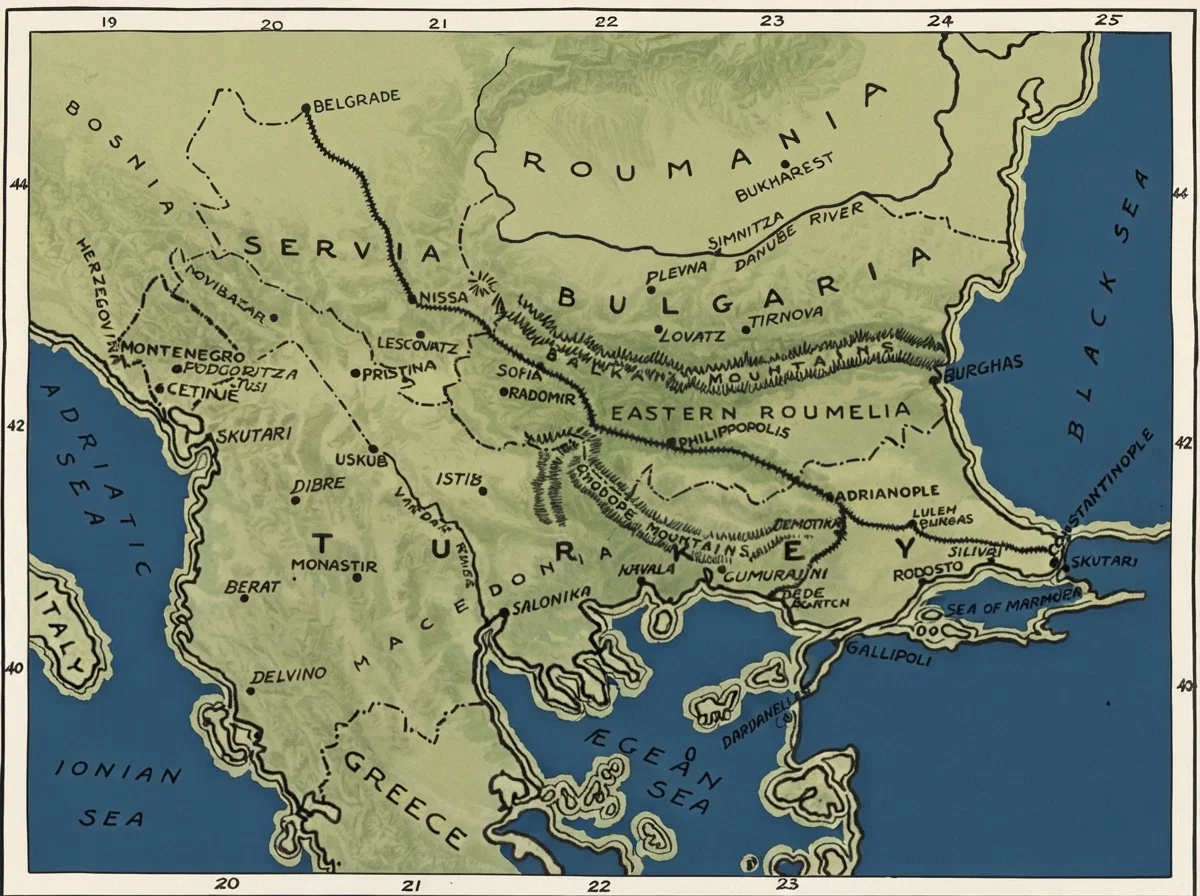
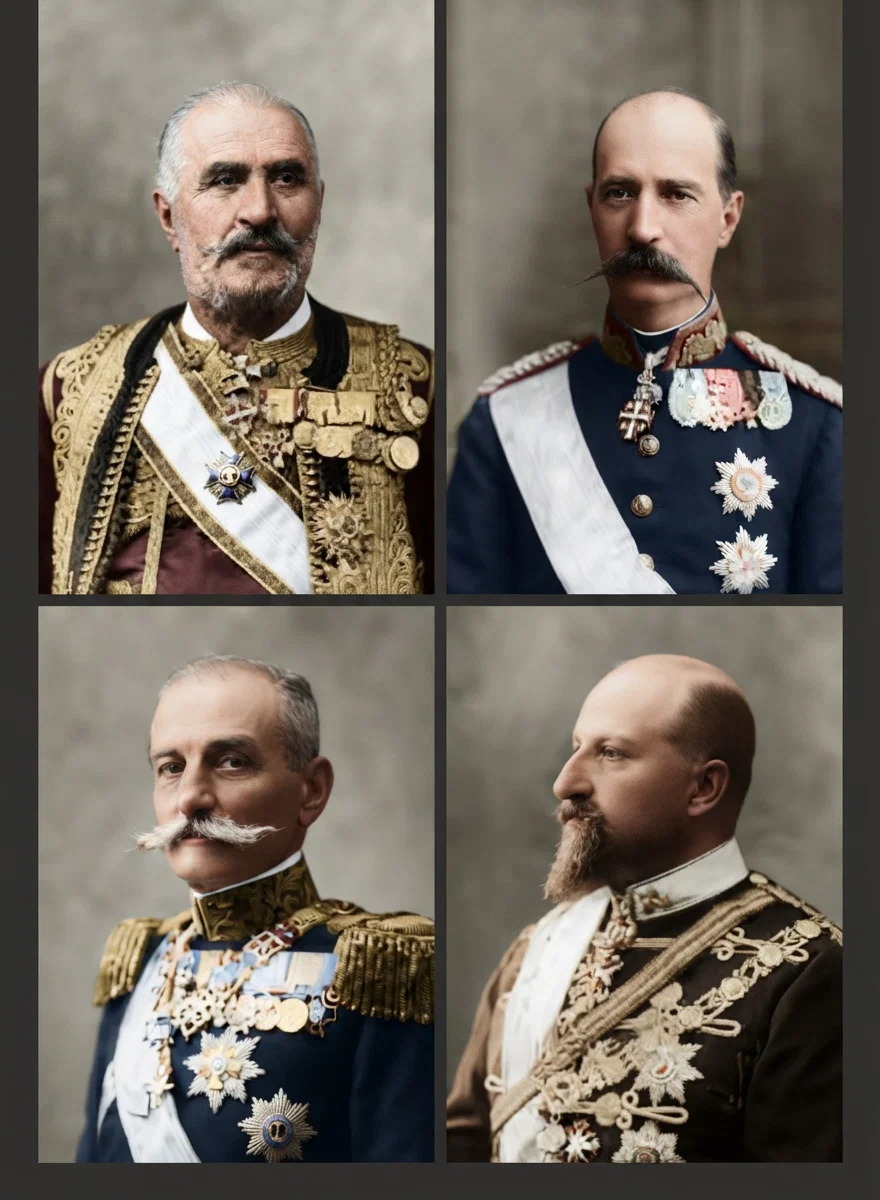
HERE is presented in this department a small war map of the Balkan territory, including Turkey and the little powers which have arisen against her, and the portraits of the kings of the four smaller countries which have allied themselves against their old tormentor, Turkey. These little countries are not able to cope with the Turk separately. It was not believed that they would be together. They have, however, surprised the world.
Montenegro is not a large state. The whole country holds only 225,000 people, and its capital city, Cetinje, has a population of only 4,500, but every able-bodied male citizen between 18 and 62 is subject to military service, making the maximum military strength of the country about 50,000 men.
For four centuries the little kingdom has maintained its independence against Turkey. It opened the conflict October 8, when the Montenegrin minister took his leave from Constantinople.
Montenegro has been the only Balkan State which has never bowed the knee to Moslem domination. The aged King Nicholas and three of his sons led their army to the front, and his son Prince Peter is said to have fired the first shot at Podgoritza.
Montenegro had some pretext for declaring war, we are told, but not so with the other states; and yet they have seemed to think that their only hope was to stand together, or fail separately.
Bulgaria is larger, really the strongest of the four states. It has a population of 4,284,844, less than the population of the city of New York, with an area of 37,200 square miles. Its capital is Sofia, its king Ferdinand, who seems to be certainly a vigorous and forceful ruler. The armed strength of Bulgaria is 52,500 in peace, with 297,000 reserves, or total war strength 350,000.
Servia, the capital of which is Belgrade, and whose king is Peter, has a population of 2,493,770, about the same as Chicago, with 18,630 square miles. Its total war strength is listed as 175,000. Its peace army is 35,000.
Greece has a population of a little less than Servia, with a few more square miles of territory. Its peace strength is 25,000, with available for duty, but unorganized, 200,000.
European Turkey has a population of 6,000,000, and 65,000 square miles of territory. Its military strength in peace is about 375,000, its war strength 725,000; available for duty unorganized, 2,000,000. Its ruler is King George.
All this war strength is on paper. Its accuracy is tested in time of war.
Dr. George Washburn, ex-president of Robert College, Constantinople, in an article in the New York "Independent" of October 31, lays before us some of the real grievances existing in the Balkans. In the treaty of Berlin, some form of autonomous government was granted by the Turkish government to Macedonia (a province within the borders of Turkey), but the Turks declined to carry out the provisions of the twenty-third article, and the powers could not agree to enforce it. Old Sultan Hamid was too clever for them, and the new Young Turkish government has failed to effect the reforms. "During all these years there has been a reign of terror in Macedonia which has not only been a disgrace to Europe but has aroused the indignation of the neighboring Christian states."
The Christians of Macedonia are divided among the Bulgarian, Greek, and Servian races, and are kindred to the Montenegrins. Naturally they would unite, and yet it was a surprise to Europe when it was found that they had united. Dr. Washburn thinks that nothing but the cold-blooded neglect of the great powers to listen to the cry of the Macedonians could have brought about such an alliance. The Turks entered the war with light hearts and wild enthusiasm. The declaration of war was welcomed in Constantinople with as much joy as the revolution of 1908. They seemed to think it would be a very easy matter to crush the small powers. And yet many of the wiser ones among the Turks hesitated. One old Turk remarked, "Whenever the pot boils in Europe and blows off the cover, it always falls on our heads." And this has seemed to be the case at the present time. It has seemed strange, to many, that the powers did not step in and prevent this war; but the difficulty has been that the powers of Europe could not agree. Each one has special interests of its own, and its own sympathies and point of view, as the London "Times" expresses it. Had they been united, they could have ordered the Balkan States to abandon their warlike intentions. But this must be accompanied with some program of settlement which would be satisfactory to the smaller powers; and no solution, the "Times" tells us, of the Macedonian question would be regarded as satisfactory that did not involve the disappearance of direct Turkish rule over the greater part of European Turkey. But no European power wished to undertake that task, and that was especially true of France and England, who have so many Mohammedan subjects under their flags. Austria is opposed to any change in the Balkanpeninsula which does not leave the way open for her to come down to Saloniki and annex Macedonia to her own empire, and is therefore opposed to any enlargement of Montenegro, Servia, Bulgaria, or Greece.
MAP OF THE BALKAN STATES
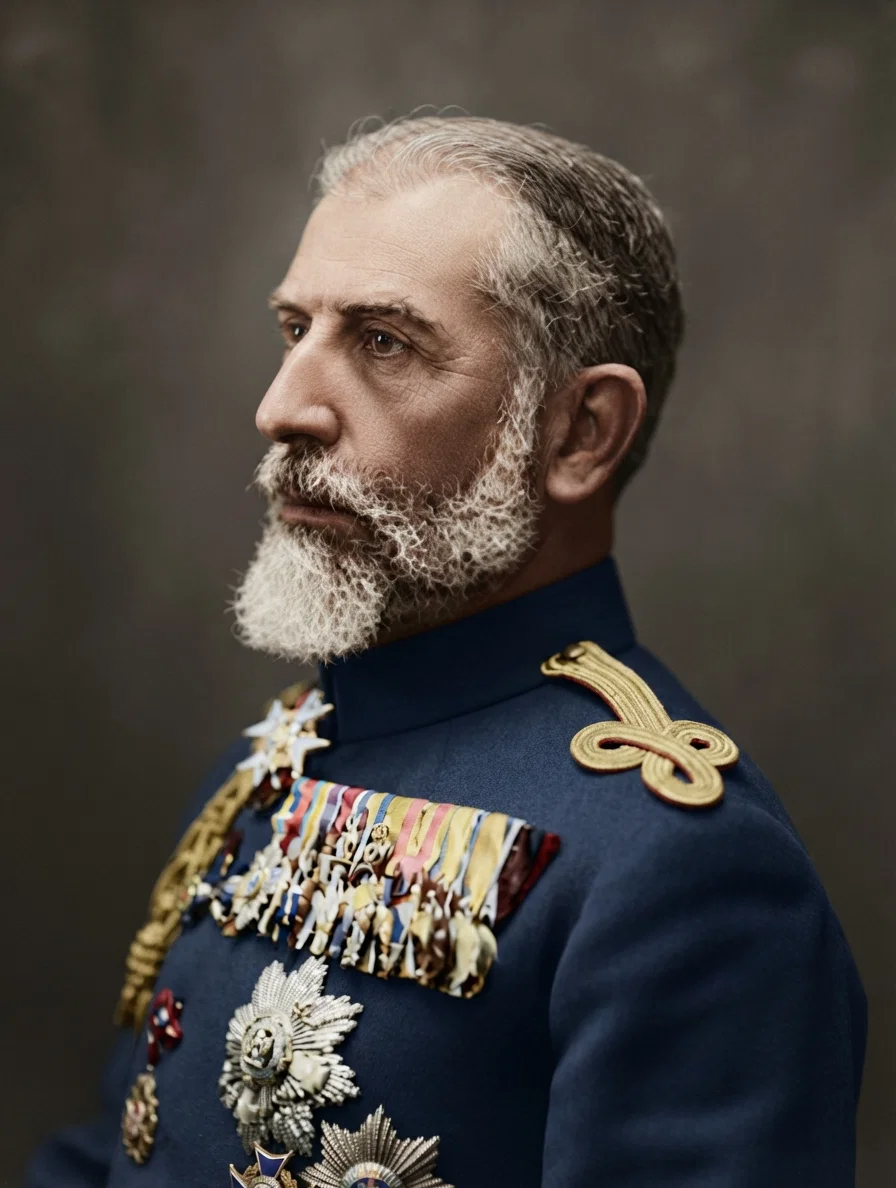
Charles, king of Rumania, who keeps out of the Balkan war, remaining neutral (From the "Illustrated London News")
Dr. Washburn declares that she would be glad to see the country peaceful and better governed by the Turks until her time comes, and that she would rather see the whole population massacred than to see the territory divided among the neighboring Christian states.
And opposing her is Russia, whose great ambition is to secure Constantinople, and Austria is the great object in the way. German ambition, Dr. Washburn tells us, seems to be confined to the exploitation and perhaps the annexation of Asiatic Turkey.
France is recorded as a special protector of Greece, and has friendly relations with Bulgaria, and both English and French are generally in sympathy with the Christian population of Macedonia; and yet since the Crimean war, the governments have professed to defend the integrity of the Turkish Empire. Still we are told, in the same article, "The truth is that Turkey has no protectors." Every power would be glad to see the last of the Turkish rule in Europe. It is only a question of who shall have the spoils of the empire. As England and France do not covet any of these, they are in a limited sense their best friends. All this is an old story.
Dr. Washburn says: "The only foreign soldier of whom the Turk is afraid is the Montenegrin. These mountaineers have never been conquered. A Turkish soldier once said to me, 'I am not afraid of men, but these Montenegrins are devils.'"
THE ALLIED KINGS OF THE BALKANS
The Turkish army has been greatly improved of late years, under the direction of the distinguished German officers loaned to Turkey by the emperor. The Bulgarian army was thought to be fairly well trained and disciplined, but has had no experience, so it was not known what it would do. The Greek army was considered an uncertain quantity. The Servian army was supposed to be composed of good fighters, but not very well disciplined or reliable. However, the last week has been full of revelations to the surmisers and guessers of the relative strength of these various powers engaged. Take, for instance, the city of Adrianople, considered to be one of the Turks' strongholds, one of the defenses of which had been planned and carried out by German engineers, and the Turkish commanders had for years devoted their grand maneuvers to the problem of the defense of that city against an invading army from Bulgaria, but the Bulgarians defeated them on that very practise ground.
From the time that Bulgaria began her southern march toward the strongholds of Turkey she has gone straight on. Battle after battle she has fought with tremendous power and vigor, but in every case she has conquered. As one paper expresses it, the Bulgarian commander had flung out a battle line of fifty miles, and within a week had coiled his right wing closely about Adrianople.
In the meantime little Montenegro had enveloped Scutari, Servia had marched forward toward the south, captured towns like Uskup and others, uniting finally with the Bulgarian army. Greece had climbed up from the south and invested Saloniki. In fact, all of the outposts of the Turkish Empire have fallen, and the Bulgarian army stands victorious at this writing at the gates of Constantinople, while Turkey is herself suing for peace. In fact, she is demanding peace, under friendship to the powers. Unless peace is granted, she threatens to massacre the Christians within her borders. This she would hardly dare do, in view of what might come afterward. Angry and desperate as she may be, she would hardly care to take the responsibility of meeting the tremendous vengeance which would follow in such case.
Germany seems to be more favorably disposed than the other nations to intervene in behalf of the Turks. She certainly wishes to keep intact her own interests in Asiatic Turkey. But there is no union between the powers. Some of them, it would seem, would be perfectly willing to see Turkey divided up among the smaller Balkan States. Austria alone is not in favor of permitting the Balkan allies to divide the fallen Turkish territory among themselves. And so the powers are alining themselves on either side, regarding the future of the Balkan States, so despatches from London under date of November 5 inform us. If this were done, it would check Austria's path to the Aegean Sea, a port upon which she is determined to have. Montenegro, Servia, Greece, and Bulgaria are all claiming big portions from the captured Turkey. None of them will be content with a mere wish-bone. One correspondent declares that the emperor of Russia will be taken as arbitrator between Servia and Bulgaria, in regard to these conquests.
But there is another element that enters into it: the Balkan allies are themselves somewhat divided as to the respective portion each shall have. Out of this the greater powers may find an opening wedge for stronger intervention. However it is, Turkey is conquered. The Bulgarian army has already cut off the capital's (Constantinople's) water-supply. The advance guard of the Bulgarians are under the very guns of the last stand of the Turks. The Turks themselves are endeavoring to flee from Constantinople, but are held there by practical force. The fall of Saloniki, the Biblical Thessalonica, is expected at this writing. Strong Greek force is at the very gates, while another combined detachment of Bulgarians is making enforced marches toward the city. The sultan's soldiers are in bad condition. There are hosts of wounded, thousands have dropped out of the ranks exhausted from want of food, and most of them have thrown away their rifles. Many of their reserves had nothing but the old muzzle-loading rifles at the best, and these some of the soldiers were too ignorant to load. Sometimes when they fired them, they fired into the backs of their comrades, and sometimes over the heads of the enemy. All the correspondents tell us that the Turkish troops fought well, but were outmatched by the Bulgarians in every conflict.
The world will look on with interest at the outcome. Certainly it looks as tho the world would be better if Turkey were eliminated from Europe, the Moslem power humbled, and more religious freedom given. This would permit the heralds of the gospel, which have naught to do with politics but everything to do with soul saving, to do much more rapid work than they have been able to do in the years hitherto. This is the one hopeful thing which we see in this war, which, like all other wars, is horrible. We pray that further cruelties and barbarities may be averted, that the lives of the innocent may be preserved, and that the European powers may have that wisdom, and act with that agreement, which will bring liberty and strength to the peoples of that long-suffering region. Sometime the war of Armageddon will open upon the earth, but that time is not yet. God's message must go to all the nations of the earth. His gospel of the kingdom must be preached as a witness to all nations, "and then shall the end come." And then no power will hold the winds of strife, or stay the fearful battles of the war of Armageddon. Beyond that comes the Lord Jesus Christ, the Sovereign of that kingdom which shall never fall, nor give way to another.