South America

6%

Pacific Press Publishing Association · Mountain View, California · Jul 9, 1912

FromSigns of the Times, Vol. 39, No. 26.

Read the full edition

South America

A Brief Survey of Its Past, and Its Needs as a Mission Field

WHAT the onward march of modern civilization has been arrested in South America is evident; but that the last decade has witnessed a great change for her betterment, both industrially and socially, is also evident; and the digging of the Panama Canal, in fixing the gaze of all the world on our sister continent, will not only mark a new era in industrial progress in this land of the Inca, but it is having, and will have, an ethical influence on all Latin America.
First of all, South America presents to the traveler a series of striking incongruities, no less apparent in those phenomenally rugged physical features than in her exotic social economy. Here, in the same day, may be experienced the torrid blaze of the valley and the frigid cold of the mountain; and contiguous with the arid plain is the water-soaked, impenetrable jungle. Here is the contorted, ribbon-like Chile, with an unbroken coast line of 3,000 miles, while her sister republic, Bolivia, has no outlet to the sea. For uniqueness of position, her west coast cities, from their dizzy heights looking down on all the world, scarcely find their analogy in geography.
Again we see this Latin American paradox in the maladministered governments, which, tho they pose as democratic, are, in the nomenclature of our great commonwealth, no more than New World oligarchies. Altho most transitory in nature, "continuismo" has ever been fundamental with the Latin administrators of the law, and to keep the military chieftains in the chair of state has involved the country in fratricidal warfare which has repeatedly threatened to decimate the population.
Viewed intellectually, the great pear-shaped continent to our south is truly a land of lights and shadows. While there have been few outstanding names which the world has cared to immortalize on the pages of history, still at times, illustrious characters have arisen to illuminate the darkness that has so long enshrouded those austral hills. While this country is characterized as the land of churches and convents, her academies are conspicuous for their absence. Splendid cathedrals everywhere embellish the plazas of Latin American cities, and popular shrines devoted to the worship of legions of canonized divinities crown the hills and grace the mountainsides; but — where are the schools? The blessing of letters has been denied this people, that an unscrupulous priesthood might the easier delude them with a religion whose dogmas are at the antipodes of the truths of the gospel. Under such conditions minds are debased, men soon cease to reverence the church or honor the state, domestic relations are reduced to the lowest level, and degeneracy is the inevitable sequence.

Why the Contrast?

But why this remarkable contrast in the degree of progress made by the two halves of the great American continent? Why must the North send men and means to the South to develop its resources? and why must Bibles and teachers be sent to raise the moral standard of that people? The southern half of the continent is nearly as large as the northern, and its resources are greater. The South was settled nearly a century before the North, for when the colonies of Jamestown and Plymouth were established, South America could boast of a score of flourishing cities. True, a few men, principally foreigners, have gathered wealth from the fertile fields of Argentina, others from the products of the Brazilian forests, and still others from the mines of the Andean district; but the masses have always lived in poverty, accepting the humblest necessaries of life as luxuries.
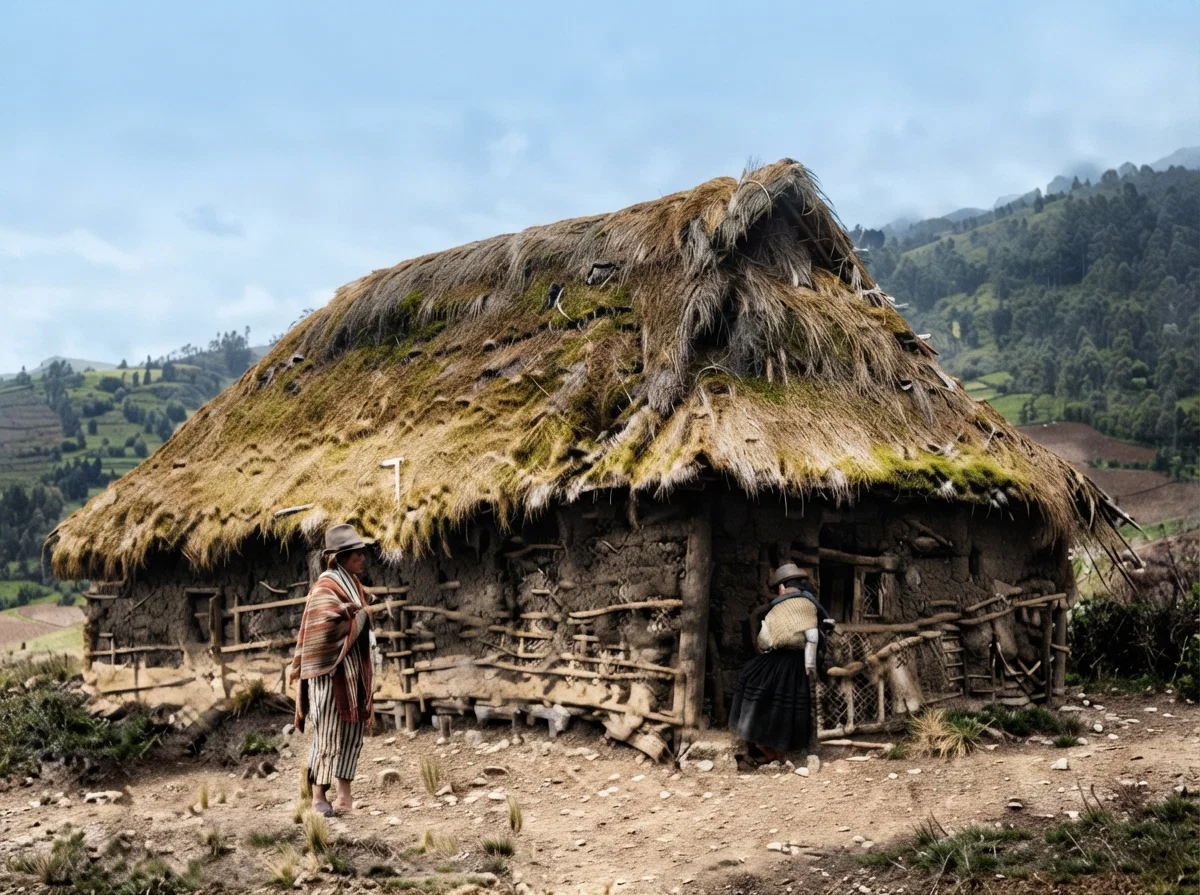
A typical house of Ecuador Indians
Some writers attribute the arrested progress to a tropical climate, while others reason that the country topographically opposes itself. Its high mountains, boundless plains, mighty rivers, and limitless forests baffled the courage of earlier generations, and only twentieth century energy could master such difficulties. But from personal observation and a study of existing conditions, we are persuaded that the real cause of South America's troubles is the system of religion which has kept the people in a state of ignorance and superstition which only finds a parallel in the Middle Ages.
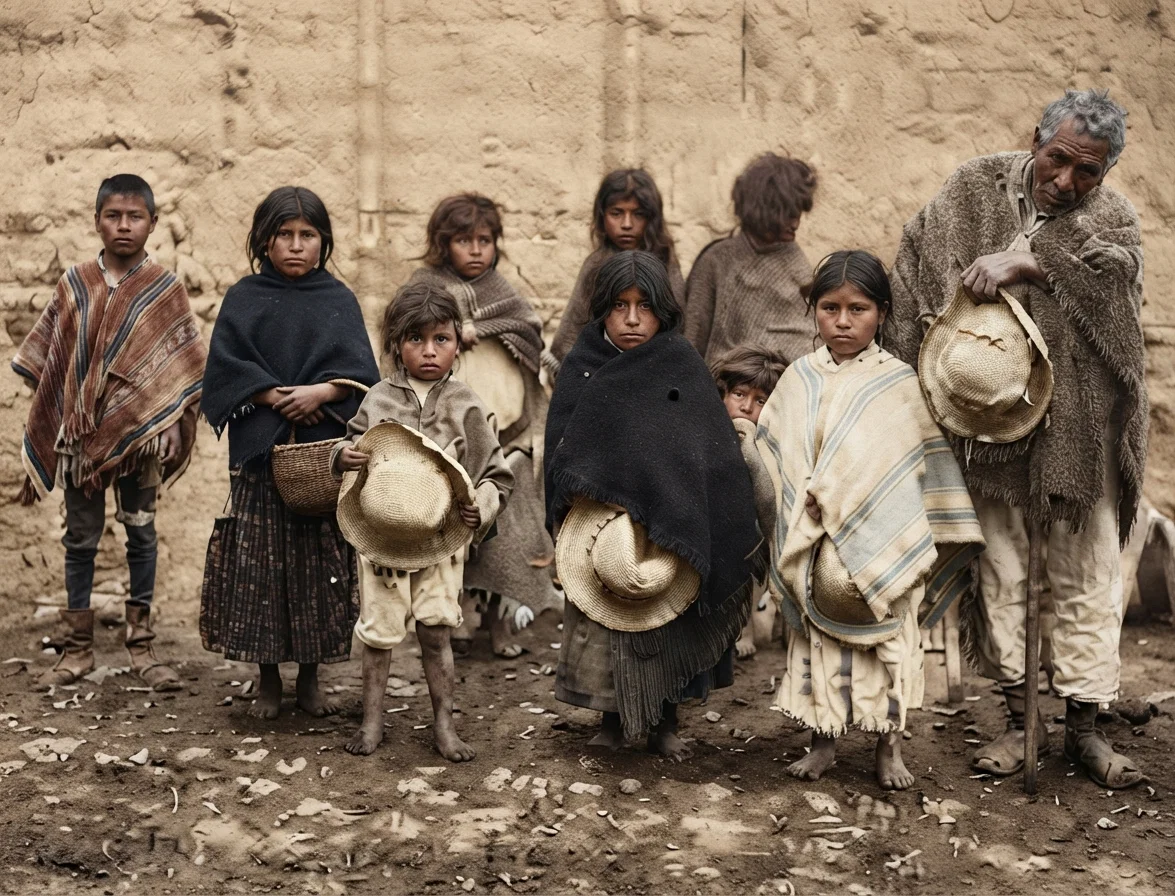
A group of Ecuador Indians
It is well known that since its discovery, the Papacy has had a free hand in South America,—as free as ever Buddha or Confucius had in India or China. We never heard of any attempt to make the climate of these countries responsible for the tyrannies borne by the long-suffering Orientals, for all know that the oppressions germinate in the despotic religion that is behind the government.
When Pope Alexander VI made Spain the overlord of what is now Latin America, he sanctioned a régime which has for centuries enslaved the peoples whom Providence had ordained to be free; and when the church sent an army of monks and friars to propagate the dogmas of the "holy see," there was laid a burden on the necks of the people which neither they nor any nation were able to bear. Spain failed, and lost her vast fiefdom and the fealty of her vassals. But not so with the church; she has guarded too well her charge. During the long centuries, her priesthood have so mixed with the masses, entering into the very warp and woof of society, that a sketch of South American life would be a history of the operations of the Jesuit, Dominican, and Franciscan friars in the southern half of the New World.
During the supremacy of this comprehensive papal scheme in our sister continent, the church has taken cognizance alike of the greatest affairs of the greatest states, and the humblest concerns of the most obscure home. No government could exist without her assistance, no revolution could prosper without her sanction, no industrial enterprise could succeed without her counsel, and not a ship could put out to sea without her blessing. The child began life under the influence of the parish priest, was tutored at his feet, made devotions at his altar and austerities at his confessional. To the average Latin the maxims of the priest were not only a standard of piety, but his ideas of heaven, the Deity, and his hopes for eternal life were all centered in the spiritual efficiency of the santo padre. Thus, in peace or in war, in business or pleasure, at home or abroad, and for life or death,—all was couched in the Roman priest, the alpha and omega of all that appertained to South American life.
Thus in a last analysis, the evidence, beyond a possibility of doubt, compels us to lay the charge of guilt at the feet of the Romish priesthood; for they have not only betrayed the most responsible trust as sponsors of the people, but they have invaded the realm of conscience, robbed men of their most sacred rights, placed the ban on intellectual knowledge, and through the centuries have kept the Book of God under the infamous papal interdict. Robbed thus of the very essence of manhood, the people have been enfeebled, and unfitted to cope with the problems of domestic and public life. While their men have been devoted to war, their fields have been untilled, their forests unexplored, their mines undeveloped, and in their cities have never been heard the hum of the loom, the lathe, or the press.
In the vernacular of the missionary, South America is still the "neglected continent;" but we forgive and forget all causes, and seek to deal only with effects. Nothing but the blessings of the gospel can atone for what these people have suffered and lost. The needs are great and the doors stand open. Many are entering these open doors with the saving message, but more must follow — yes, many more.
May we not fail in doing our whole duty in the little time that remains to us before Jesus comes. B. E. CONNELLY.