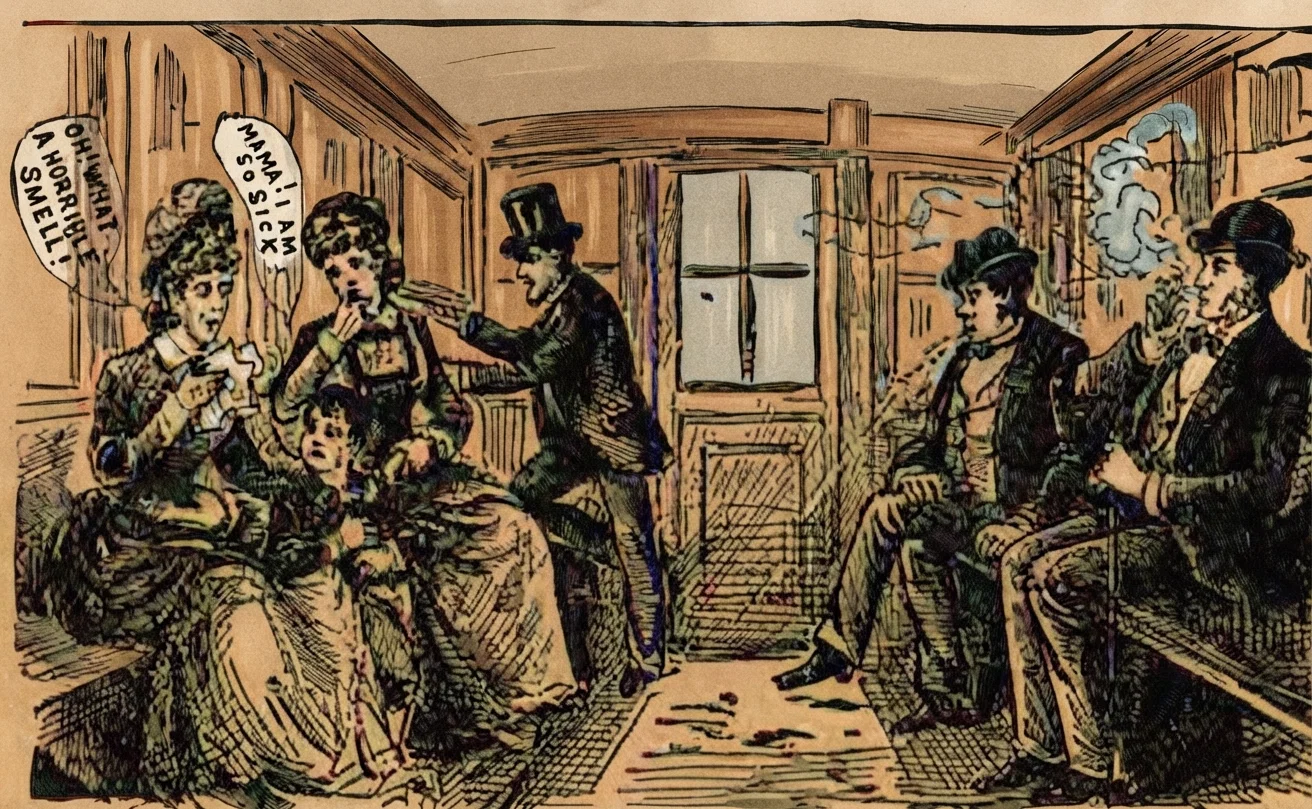
OUR artist has given us in the above picture an illustration of what exists somewhat less frequently than in former times, but still exists, and may be encountered in almost any large city where civilization has carried those relics of barbarism—the pipe, the cigar, and the quid. The engraving is supposed to represent the inside of a street-car or omnibus, in which two of the male occupants are paying their respects to the smoky god, Nicotiana, regardless of the feelings of their fellow-passengers. One complacently puffs his "long nine," making the air blue with its poisonous fumes, while the other as deliberately defiles himself and his surroundings by rolling the noxious weed beneath his tongue, and expectorating its stinking juice upon the floor. The hardened devotees of the weed take no notice of the nauseating effects of the poison upon the ladies who have the misfortune to be their fellow-passengers, or the little boy who protests against the vile smell.
According to the Cincinnati Times, a citizen of that place fell dead in a street-car, poisoned by the dense fumes of tobacco smoke with which the car was filled. "He was an occasional sufferer from heart disease, and the trouble was so aggravated by the suffocating smoke of the car that he died after breathing it a few minutes. The car in which he rode had only one compartment for men, women, and children, and the smokers were allowed full sway in it. Two other passengers were overcome by the tobacco fumes."
If human beings possess one inalienable right more sacred than any other, it is the right to breathe the atmosphere of heaven, pure, free, and unadulterated. No man has any better right to puff tobacco smoke into the air I am about to breathe than to defile the water I am about to drink, or to sit down beside me at the dinner table and sprinkle upon the food I eat, vile and loathsome substances, obnoxious to the senses and deleterious to the health.
Did any of you smokers ever attempt to imagine the felicity(?) of a lady or gentleman to whom the odor of tobacco is sickening and most repulsive, following in your wake on a still summer evening, while you puffed with self-complacency and intense satisfaction the, to you, fragrant Havana? Or did you ever endeavor to picture in your imagination the delightful(?) sensations which must be experienced by a sensitive man or woman, who has never offered incense to the smoky god, when compelled to ride in a close cab, on a seat opposite or beside you, while you rolled between your lips the stump of a "cold cigar"? Please put yourself in that man or woman's place; and see if you will not decide with unhesitating promptness that the tobacco-user is a nuisance which should be abated.
Tobacco smoke is excellent in its place. The writer set an old smoker going in a greenhouse one day with good effect. Every living thing that was able to travel left for parts unknown, and the few that were not able to get away, died of nicotine poisoning,—all except the smoker himself, who was tough and nicotine proof. Tobacco is to be recommended to kill vermin of all sorts. Christopher Columbus thus described the original smokers: "We saw the naked savages twist huge leaves together and smoke like devils"—not a very interesting experiment it would seem, but one which possesses such a strange fascination that since the description by Columbus nearly one-half of the civilized world have been following the example of these naked savages.
King James, in his "Counterblaste to Tobacco," very well says:—
"And now good Countreymen let us consider what honour or policie can mooue vs to imitate the barbarous and beastly manners of the wilde, godless, and slauish Indians, especially in so vile and stinking a custom. Why doe wee not as well imitate them in walking naked as they doe? In preferring glasses, feathers, and such toyes, to golde and precious stones, as they doe? Yea, why doe wee not denie God and adore the Deuill, as they doe?"
This royal anti-tobacco agitator stigmatizes the use of the weed in a most vigorous manner, pronouncing it "a custome lothsome to the eye, hatefull to the nose, harme-full to the braine, dangerous to the lungs, and in the black stinking fume thereof, neerest resembling the horrible Stigian smoake of the pit that is bottomlesse."
Passing a London cigar store one day, the writer noticed a flaming placard announcing, "The Devil's Own," as the name of a new brand of cigars just produced by the manufacturers. The name impressed him as exceedingly suggestive, and he wondered that so appropriate a cognomen had not before been utilized. The cigar is undoubtedly one of the devil's favorite instruments for converting boys who might become respectable citizens and useful men, into loafers, vagabonds, drunkards, and criminals of every description.
Notwithstanding the repeated exposures which have been made of the dangers to life and health incurred by the use of the filthy weed, the number of its devotees seems to be constantly upon the increase. The tobacco habit must be regarded and treated as a moral disease which has fastened itself upon society,—one of "the devil's own" means for degrading and depraving humanity. How perverted, indeed, are the instincts of the human being who deliberately defiles the image of his Maker till nearly every trace of the divine workmanship is obliterated by the scourge of the stinking weed, and he becomes fit only to be labeled "the devil's own"!
If smokers will persist in defiling themselves, and in spoiling the pure air, adulterating its life-giving oxygen with a deadly vapor, offensive to the natural instincts of man and beast, let them be compelled to indulge the precious10poison by themselves, apart from the rest of humankind. Let them together enjoy the pleasures of the pipe, cigar, and cigaret.