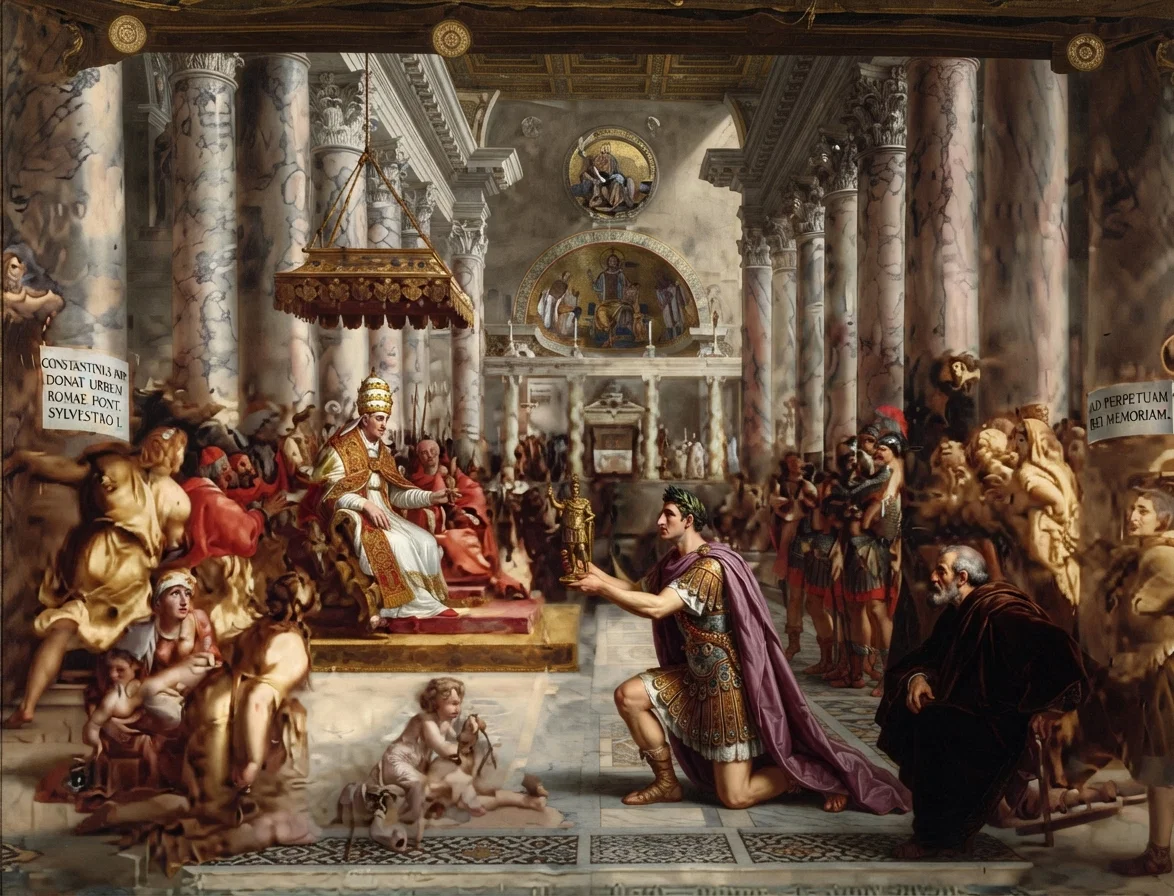
THE first glimmerings of the dawn of the temporal power of the Papacy are certainly to be found in the days of Constantine the Great. The tradition and teaching of the Catholic Church are to the effect that Constantine formally presented the city of Rome to Sylvester I., bishop of Rome, as a gift, and thence departed to found his new capital at Constantinople. This view of the matter has, until recently, been accepted as true by all with but few exceptions.
Dante, the great Italian poet, in his Divine Comedy sums up the general teaching on this point as follows:
O, Constantine, of how much evil wert thou the origin, not your conversion to the Christian faith, but that gift of Rome, which the first rich pontiff received from thee.—Inferno 115.
Rome Presented by Constantine to Sylvester I.
And in fact in the Vatican picture-gallery can be seen to-day an immense painting which represents Constantine in the act of giving Rome to Sylvester, under the symbol of an image of a warrior. (See illustration.)
But even if we should doubt the formal donation of the city of Rome to Sylvester, still the very fact of the departure of Constantine left the city practically in the hands of the bishop of Rome. As says Mr. La Banca, Professor of History in the University of Rome:
The mere fact of the abandoning of Rome on the part of Constantine was sufficient to afford an opportunity to the head of the Catholic Church to gain a great independence. It is true that there remained still in Rome the senate and the prefect, who represented the emperor; but it is also true that with the emperor at a distance, the church could better develop itself and enjoy great liberty of exercising its functions. That this was really the case we see clearly from many acts that were put in operation by the following bishops of Rome: Liberius (352-365), Damascus (366-384), Siricius (385-395).
Leo the Great (440-461) in one of his famous sermons pronounced the following words:
The sacred seat of Peter places you [Rome] at the head of the world to win with the power of religion a greater authority than the worldly dominion ever procured.
One historian in harmony with this says:
There did not lack in Rome tendencies to an absolute monarchy, but Leo, for reasons of prudence toward the Roman Empire and the Patriarch of Constantinople, did not manifest them openly. . . . But the Papacy, through the writings and acts of Leo the Great, raised itself to a marvelous greatness.
The Papacy had therefore already reached an elevated position before the fall of the Roman Empire in 476. And, as we have already noticed, the departure of Constantine left the city of Rome practically in the hands of the pope, because from that time no other throne than the papal was ever set up in "the eternal city" until 1870, when Victor Emmanuel II. made it the capital of united Italy; for the immediate successors of Constantine continued to reign with Constantinople as the capital of the Roman Empire. To be sure, at the death of Constantine the empire was divided in three parts, but this division lasted but a few years; for Constantius soon subdued the entire empire and ruled as sole emperor at Constantinople. Then after Julian and Jovian had reigned as sole emperors, the empire was divided with Valens as emperor of the East, while Valentinian I. established the capital of the Western Empire, not at Rome, but at Milan.
The capital of the Western Empire remained at Milan during the reign of Gratian and Valentinian II., and then Theodosius became sole emperor with the capital at Constantinople. At his death the empire was again divided, Arcadius taking the throne of Constantinople, while Honorius moved the capital of the Western Empire to Ravenna, where it remained till the fall of the Western Empire in 476.
After the fall of the Western Empire the capital still continued at Ravenna, as the following quotation from Gibbons shows:
The example of Honorius was imitated by his feeble successors, the Gothic kings, and afterwards the Exarchs, who occupied the throne and palace of the emperors; and, till the middle of the eighth century, Ravenna was considered as the seat of government and capital of Italy.
So we see that until the eighth century no throne had been established in Rome but the papal. And from that period onward we know that the power of the Papacy was so supreme in Italy that the pope reigned at Rome without a rival till 1870. And incidently I might remark that in this fact we see how wonderfully the prophecy of Revelation 13 has been fulfilled which says that the dragon gave to "the beast"—the Papacy—"his power, and his seat, and great authority."
However, while the city of Rome remained practically in the hands of the bishop of Rome from the departure of Constantine, yet some centuries passed before the Papacy formally and independently took the reins of government with all its responsibilities. As we have already noticed, before the fall of the Roman Empire the pope was already exercising a certain governing power in the city of Rome. And the fall of the Roman Empire "prepared a new and extraordinary future for Papal Rome." "And it is certain that with the fall of the empire to the succession of the emperors crept in that of the popes in Rome which resulted in a great material advantage to the Papacy." And again we are reminded that the death of Paganism meant life to the Papacy, as the following quotation from Professor La Banca will show:
If the lingering death of the Eastern Empire was injurious to the interests of the Patriarch of Constantinople, the sudden death of the Western Empire was a great advantage to the interests of the Papacy.
The power of the Papacy, from the fall of the Roman Empire until the famous decree of Justinian took effect in 538, might be well summed up in the following citation:
If the popes did not have in this epoch a sovereignty legally recognized, yet great was their spiritual power, and exceeding great their authority, over the affairs of Rome and Italy.—Galeotti, "History of the Sovereignty of the Popes."