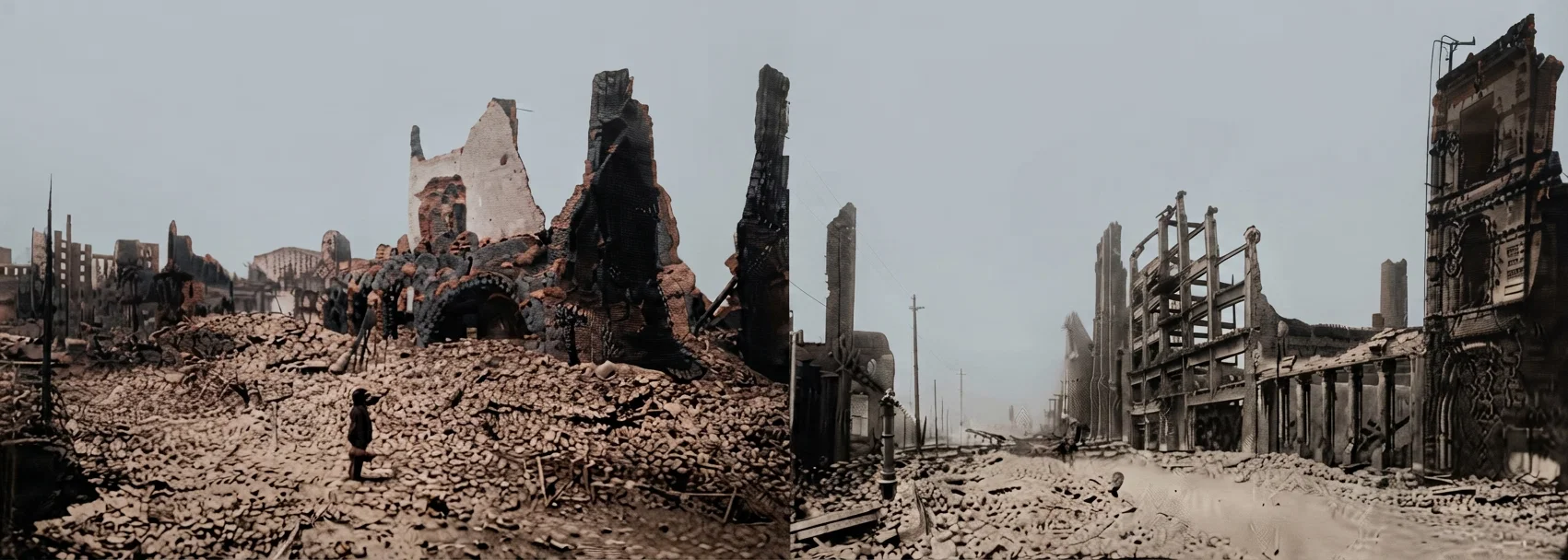
WILLIAM RANDOLPH HEARST after looking over the ruins of the city he knew so well, attempts to tell the people of the East what it means to San Francisco by the following illustrations:
I know that while I myself was very familiar with the locality and the conditions here I had failed to appreciate exactly the situation until I had visited the scene.
When I landed from the ferry the awfulness of the disaster almost overpowered me. There was nothing to be seen but a desert of tumbled brick, twisted7iron and blackened timbers. Out Market Street, as far as the eye could reach, there was nothing but ruins. North to the Bay, west to the Mission, nothing but ruins. The wholesale district was destroyed, the retail district was destroyed, the manufacturing district, the financial district, the water front section—all destroyed. The hills rolled to the seas as bare as when the pioneers landed in the days of '49. But the hills that welcomed them were shining in green and covered with grass and shrubs and trees. While now they are a blackened waste. Instead of grass there are acres of ashes; instead of shrubs there are but twisted iron and steel; and instead of tall trees there rise burnt brick chimneys and ragged fragments of walls towering above the desolation that surrounds them.
I will not attempt any detailed description of this scene. I know that no description gave me the slightest understanding of what had occurred, and I do not believe that any words of mine could convey to a reader the slightest comprehension of this interminable area of wreck and ruin. Indeed, to get any sort of accurate impression one must free the mind of the idea that there has merely been a fire, no matter how great, in San Francisco, and must realize that there has been a fire of San Francisco; that the whole city has gone up in one mighty blaze that roared and raged and burned for three days and nights and left nothing standing but a fringe of houses along the southern and western limits.
If a bonfire of barrels and boards and packing boxes had burned until it had burned itself out there might remain some few sticks on the edges that had not been wholly destroyed. So it is with San Francisco. The city burned unchecked for days without water, without effective hindrance of any kind. When the fire stopped it had practically burned itself out. It had got to where the houses were so thinly scattered that there was difficulty in finding fuel for the flames.
California Theater. The Grand Opera House.
Think of this fact:
The area of the Boston fire, added to the area of the Chicago fire, added to the area of the Baltimore fire would not make altogether one-half the area of the San Francisco fire. New York is so much larger than San Francisco that a mere comparison of square miles does not give an adequate idea of the situation, but considering the matter proportionately it is as if the whole of Manhattan had been destroyed, save a mere handful of buildings at the Battery, and as if there remained only the Bronx and Brooklyn.
Brooklyn corresponds in a way to Oakland, altho Oakland is several miles from San Francisco and across the Bay. The Bronx corresponds to the section of more or less scattered residences remaining on the western edge of the city.
Think of the water front districts of New York swept clean by fire. Think of Wall Street in ruins. Think of the East side and the West side destroyed. Think of all Broadway burned to the ground. Think of the wholesale districts destroyed. Think of all the big stores from Wanamaker to Macy's in heaps of ashes. Think of the beautiful residences on Fifth Avenue burned or blown up by dynamite. Think of the very trees in the parks bare and black and shriveled by the flames. Think of the streets littered with brick and iron and charred timbers two or even four and six feet deep, so that you can hardly walk on them or climb over them.
Think of men, women, and children huddled in Central Park and on Riverside Drive, living in tents or under shelter of sheets stretched upon posts. Think of men turning over the ruins of their homes and women weeping over them. Think of soldiers everywhere. Think of temporary tracks of the New York Central laid from Forty-second Street to the Battery, through the heart of the town, and wrecking trains carrying off the débris. Think of what all this would mean to you, and you will have some idea of the great disaster in San Francisco.
Mr. Hearst and others minimize the earthquake and its effects, and lay San Francisco's loss to the fire. But the fire was the indirect result of the earthquake, started in a half-dozen places at once. Many of the shattered buildings would have remained standing after the earthquake, but they were ruined, and the fire swept from them their frail supports, and they fell. The magnificent City Hall was not ruined by fire, but by earthquake. And that is true of hundreds of other buildings.
The earthquake had its freaks, all sorts and kinds. Here it demolished a building which looked as if it would stand forever. There it passed under without harm one so frail that it scarcely seemed able to stand alone. Some part of a house was badly shaken while the rest was not injured in the least. Some tall, thin chimney stacks stood, while others thick and strong crumbled.
But ask Santa Rosans which damaged them more, the fire or the earthquake, and the answer is ready, The earthquake. It was not the fire which wrecked the City Hall or the Grand Opera House, the fire swept them afterward. It was not the fire which wrecked St. Dominic's mighty pile on Steiner Street, and moved great three-story houses four and five feet off their base. It was not fire which for four blocks, from Valencia Street to Folsom Street, dropped the street bed from one to ten feet for rods, and slid the whole section down toward the Bay three or four feet. If the Call, the Crocker, the Flood, and other buildings had stood upon this ground, how would they have fared? Let men know the facts. It does not help matters to minimize the facts; they are too sad to magnify.