HEBER, THE FIRST-BORN

3%

HEBER, THE FIRST-BORN

A Story of Israel's Deliverance.
BY HART HALL.

CHAPTER I.

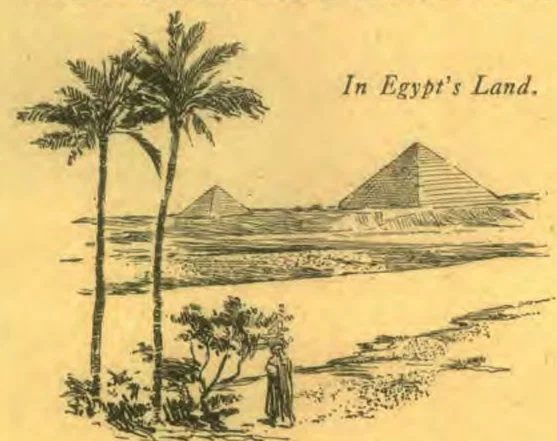
OVER the broad, blue expanse of the great River Nile, the warm, tropical sun shed its blistering rays one day, about the time of the month Ethanim, nearly four thousand years ago. As the great burning disk rose higher and higher, the Coptic fishermen, in their high-prowed skiffs, were compelled to abandon their work for the day, paddling away through the sluggish waters for the shore, discernible beyond the tall, reed-like papyrus that lined the natural borders of the stream. In the distance beyond lay green vineyards, orchards laden with blossoms, and fields of waving grain in their lighter shades, creating a perspective which had for its bas-relief the dark stone wall of Egypt's capital city.
To the eyes of two of the many pedestrians on the king's highway who were approaching the city, the walls looked high and formidable, the watchtowers jutting higher regularly along the top. The huge arched gate stood wide, and on either side, stolid and brown, were the guards, clad in the simple armor of the times,—helmet and mail, with the battle-ax for a weapon.
On through the city's busy mart the two travelers continued, through the gates that opened into the king's grounds, on through the outer court, and up the broad granite steps into the palace. One of the twain gazed eagerly and familiarly at the beautiful surroundings, the magnificent gold-mounted furniture, the rich paintings, the statuary, the great pillars with their quaint inscriptions that towered to the domes. These things he looked upon as friends of by-gone days, when as a lad he roamed at will among them. As a man here he dwelt, heir apparent to the throne, receiving the obeisance of princes, honored by the greatest of the land. But he esteemed 'the reproach of Christ greater riches than all the treasures of Egypt;' 'choosing rather to suffer affliction with the people of God, than to enjoy the pleasures of sin for a season.' So he left it all, and now, returning after many years as ambassador and prophet of the King of kings, he is hated and despised.
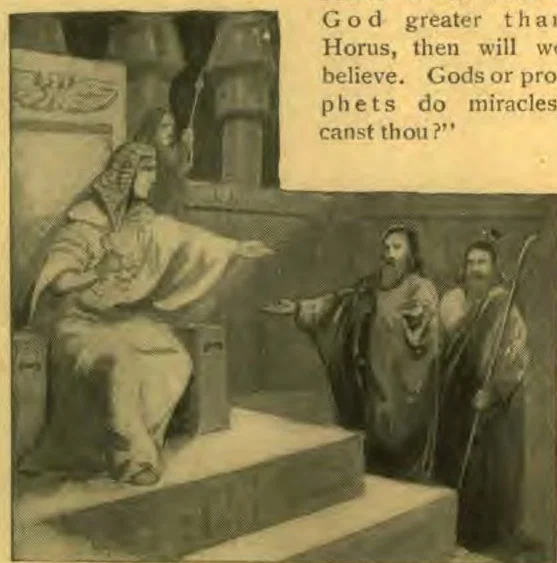
The beautiful objects held not their steps for a moment, but, passing on, ignoring the liveried doorkeepers who would have stayed them, they soon stood in the throne room of the greatest monarch of that time. The king was seated under a gorgeous canopy, among soft cushions and rich tapestries. Princes stood in attendance, and on either side were officers of state, scholars, priests, and musicians. At the foot of the throne stood the royal guards, gaunt and lithe, their spears beside them. Behind the monarch were winged effigies of Truth and Justice, and a great inscription above the throne represented a hawk-headed figure leading a lion and a sphinx.
As the two simply-clad Hebrews—for such they were—stood before the king, all other business was suspended in amazement. Solemnly and with uplifted hand, one spoke, demanding, on the warrant of the Most High God, the release of His people. The message was short and simple, but impressive; when he ceased speaking an ominous silence reigned, naught was heard but the wafting to and fro of the fans. Courtiers waited breathless and expectant, the guards were alert, ready for the signal to act, but none came.
Pharaoh's eyes glittered angrily, and sneeringly he reiterated, 'Let my people go.' Show yourselves to be from a God greater than Horus, then will we believe. Gods or prophets do miracles, canst thou?'
The men stepped back a pace, and one cast his rod to the floor. Hardly had it touched the marble pavement e'er it became a great hissing serpent of the most dreaded species in the land; writhing angrily into a coil, it lashed its venomous fangs to and fro. The attendants fell back instinctively, 'The fiery serpent!' they exclaimed in terror. Pharaoh gasped in wonder.
'That is magic of a truth,' he declared; 'but may not the magicians do also with their enchantments? Let us see. Call the magicians,' he cried. Soon they appeared before him, and, in response to his inquiry, they cast their rods to the floor, and to all appearances they became serpents as they fell. But the serpent of the Hebrews recognized a common foe, and, flinging itself upon them, devoured them all. Then the Hebrew advanced upon the reptile, and as he grasped it fearlessly it became a rod again in his hand.
The scene was ended; but Pharaoh was unmoved and unconvinced. The ruler recognized in the two men a superior magic than that possessed by his magicians, but nothing more. The interesting scene had abated his anger, but he despised the messengers, and reviled their God.
'The wise men and the sorcerers do as ye do, wherefore say ye then, 'Let us worship the Lord in the wilderness;' get ye hence, Moses and Aaron, I wot ye are enemies to the land.'
Without a word farther the men withdrew.

CHAPTER II.

The Egyptian king was a god. He was deified and invoked by all the divine appellations and epithets. He was not merely like the gods, but was one of them. He was the mighty Horus, the good god, the master. Therefore to appear unbidden before him was punishable with death. The offense of the Hebrew prophets was great, and would have met its punishment, but a greater King was keeping His servants, and Pharaoh dared not harm them.
For fear of a possible uprising among the slaves that served at the palace of this king, Menephthah I., they were kept, when through their day's duties, in the prison or dungeon; and the heavy stone doors closed behind many of Israel's choicest young men selected for their skill, wisdom, and strength. Lying on their mats or beds they recounted the scenes of the day and the tales of new afflictions laid upon their people in Goshen; they talked of their loved ones at home, and with gladdening hearts they dwelt upon the words that the prophet had spoken, that God had visited His people, and the day of deliverance was near.
Then they listened again to the wonderful story of the miracle told by one of the king's messengers, Heber by name, who in waiting at the court had beheld the scene himself. Vividly he described the wonder, his voice low-pitched in excitement. But finally one interrupted, 'Tell us, Heber lad, what manner of men are the prophets?'
'Did I not tell thee? They are both tall and strong, their hair and beards are black like the raven's wing. Tho alike yet are they different in many ways. Aaron is the speaker and a bold one is he; Moses is slow of speech, and his tongue hath a Midianitish sound.'
The voices of the lads grew low and drowsy. In spite of excitement, tired nature asserted itself, and at last they were locked in slumber.
When the gray of dawn began to creep through the narrow stone-walled passages, the bolts and chains rattled as they were loosened, the doors creaked heavily as they swung back, and the keeper looked in upon the slaves. 'Up, ye sons of Israel,' he exclaimed, 'the king goeth early to the river to worship. Hasten then to thy labors.'
'Anathpherah, my goodly keeper, sawest thou the prophets yesterday?' inquires Heber. 'Yea,' responded the keeper, 'I beheld them as they left, in the outer court, and, by the great Ra, methinks I beheld in one, behind his beard, the crown prince that fled many years ago. A goodly king, it seemeth me, he should have been. Twice spared he my head when the king was wroth with me. Come, my lads, the day breaketh.'
The sun was not yet two hands high when the king with his courtiers and attendants left the city in grand procession headed for the river to worship.
The king was borne under a canopy of purple. A score of priests, carrying censers and the statues of the gods, with trumpeters in the van, led the procession.
Fan-bearers stood on the right and left, and high officers of state bore the weapons and insignia of the king. Behind followed the body-guard, soldiers and priests, then the white bull, Apis, led by his attendants and nurses.
Following these were all the wise men, astrolo-gers, and magicians, for none of the royal house might omit devotions to the great river, which was worshiped as the symbol of the god of productiveness by high and low alike.
For, about the time of the summer solstice, the sun looked straight down upon the mountains of Abyssinia, setting free the weight of snow and ice, and as it melted it tumbled in yellow cascades over precipices, and rippled down in brooks and streamlets, and bubbled up in springs, all joining to swell the Nile until it overflowed its banks throughout the length of Egypt, watering and enriching with its deposits thousands of acres that otherwise would have been sterile. All that Egypt ever has been it owes to the annual inundation.
As the cortège reached the place of ceremonies, two men suddenly appeared before the king. They were Moses and Aaron.
The monarch paled with anger at the interruption again repeated, but before he could speak the hand of the prophet Moses was raised in warning, and solemnly the message from Jehovah fell on the haughty king's ears.
(To be Continued.)