A Mere Holiday Rest Not Enough—Church Attendance What Is Desired—Would Have Laws to Reclaim Erring
WHEN the advocates of Sunday laws seek legislation to compel the observance of that day, they usually deny that they want to enforce anything of a religious character, but claim they are seeking to obtain a day of rest for man's general physical and civil needs, without any religious significance.
The following extracts from speeches and papers by men prominent in the movement to obtain world-wide Sunday laws, as presented at the International Lord's Day Congress in Oakland, California, July 27 to August 1, show clearly, notwithstanding the oft repeated denial, that the real object of Sunday laws is to build up and strengthen the religious character of Sunday rest.
WHAT THE DAY STANDS FOR
"Of course the Lord's day stands for worship and rest, the religious idealism of worship."—Right Rev. William F. Nichols, D. D.
"The very crime of the sabbath breaker is that he takes that day and uses it against the One who gave that gift. Sabbath breakers are, unconsciously to themselves, ingrates. When they break the sabbath, they may well stop and inquire if they do not also break the infinite heart. . . . We have need of your presence, in order that in due season, upon the statute books of California, and inscribed upon the hearts of its citizens, you may help us to write that great principle of God almighty, 'Remember the Sabbath day, to keep it holy.'"—Right Rev. Edwin H. Hughes, D. D., bishop of the Methodist Episcopal Church.
SUNDAY FOR WORSHIP
"There is somewhere between these two extremes of a Puritan and a continental Sunday observer, to be found a Sunday which recognizes God by attending divine worship, and makes it a point to do it at least once on that day."—Judge Alton B. Parker, permanent chairman of the congress.
"It finds its necessity in the longing of man for religion. It is this culture of the religious, the spiritual, the inner life of man that is the highest benefit and efficacy of the sabbath. Nothing so expands the soul, and strengthens us for the supreme crisis, . . . as the setting apart of this day of worship."—J. B. Remensnyder, D. D., LL. D., ex-president of the Synod of the Lutheran Church in the United States.
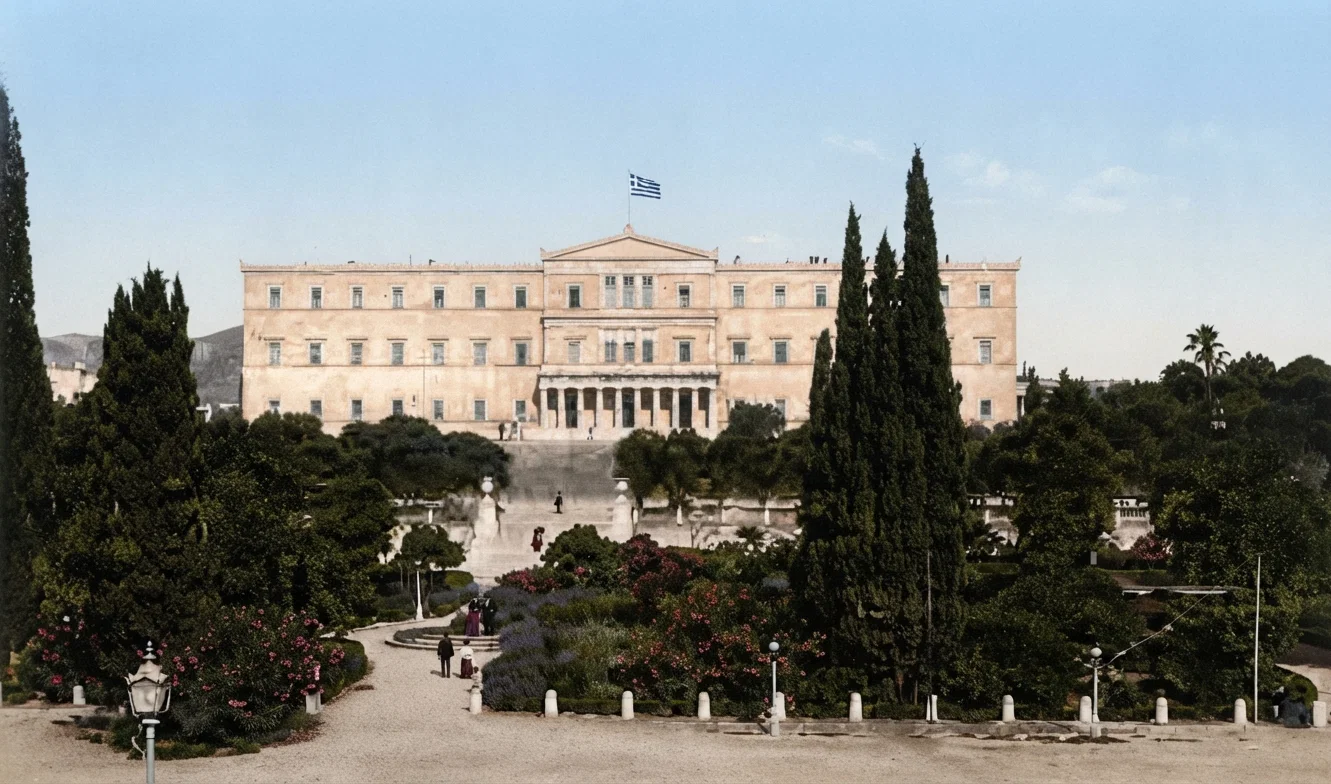
THE ROYAL PALACE IN ATHENS, GREECE
LAWS TO RECALL THE ERRING
"The deepest need of man's nature is his need of God. Unless he have the time to worship his Creator, life is not sustained and soothed by the unfaltering trust. . . . When the almighty God placed the obligation of labor upon us, He also commanded us that we observe one day in every seven for worship and rest. . . . Legislation on the part of the church did not begin until laxity and indifference showed themselves among Christians. It was then found necessary to make laws which would recall the erring ones to their duty. It was enforced by the councils and bulls of the pope. All through the Middle Ages, these were the civil laws of the land. . . . The historic church of Christendom makes the observance of Sunday the day of all importance to her members."—John J. Burke, C. S. P., S. T. D., S. T. L., editor of the Catholic World.
It is well to note, from this last quoted high authority, that there never was any demand for Sunday laws because of man's physical needs. They were only found necessary when "laxity and indifference showed themselves among Christians." The laws were made to "recall the erring ones to their duty." Those same civil laws which are admitted to have been "legislation on the part of the church," and "enforced by the councils and bulls of the pope," tormented and tortured to death millions of as conscientious, liberty-loving men and women as this world ever knew, who believed their salvation was found in obeying the word of God, and not in following the "bulls of the pope." To establish again legislation to enable the church to "recall the erring ones to their duty," is to destroy liberty, and renew the persecution of the Dark Ages.
ALL SHOULD GO TO CHURCH
"All the children on the Lord's day should go to the church or Sunday school, absolutely. . . . Don't listen to those who viciously say there is no God. . . . He who destroys the Lord's day destroys the temple of God; and whosoever defiles the temple of God, him will God destroy."—The Rev. V. V. Alexandroff, Greek Catholic of San Francisco, California.
"There is no religion without worship, and there is no worship without the sabbath."—The Rev. Mr. Griffith.
NOT TO BLACK BOOTS ON SUNDAY
"The organization I represent drafted, presented, and secured the passage of the Sunday law which is a national law. . . . The function of Sunday laws is admirably represented by that statute. I know of two laborers, living one thousand miles from each other, who on that memorable Sunday evening appeared in church, the first one for the first time in seven years, and the other one for the first time in three years. . . . Regarding bootblacks, and these other people, in Quebec the law is not yet being rigidly enforced. . . . Now people should get their boots blacked on Saturday. . . . Suppose those bootblack stands were closed on Sunday. How many boys would get their liberty? — One thousand. The churches would go into ecstasy over the gathering in of those boys."—The Rev. William M. Rochester, secretary of the Lord's Day Alliance of Canada.
Observe that "the function of Sunday laws is admirably represented" when it gathers men into the church. The object of closing the bootblack stands in Quebec is that the church may have a chance to gather in the boys. What if, in the course of time, it shall be found that many men do not go to church, and the bootblacks take to the swimming pool and the fishpond, and thus "the function of Sunday laws" is not met? Then695will it be found necessary to make another law to "recall the erring ones," and compel their attendance on "divine" worship?
BETTER TO HAVE PURITAN SABBATH
"The Christian sabbath cannot be divorced from Christianity. They stand or fall together. . . . California has a weak form of one-day-rest-in-seven law, which doubtless could be strengthened. One day's rest in seven does not and cannot take the place of Sunday laws. . . . Children must be taught the sanctity of the sabbath. . . . It would be better for us to have the Puritan sabbath to-day for the home, the church, the state, the country, and God, than the spineless, lame-backed Sunday we have in most of our states. We need to go on and defend it through our congress and cooperating bodies.
"Judge Parker raised the question in executive committee yesterday, and said, 'What shall we do after this congress is over?' I urge that we do this: ask and appeal to our Christian churches and every Christian citizen and every good citizen of the country to back, reenforce, and move with all our splendid Lord's day and sabbath organizations, to the end that one day we shall write upon the federal statutes a law similar to that of Idaho. When every state shall have her strong Sunday law, and one-day-rest-in-seven law to supplement it, then we shall not only be a Christian nation in name but in fact."—The Rev. H. L. Bowlby, secretary Lord's Day Alliance of the United States.
"Remember that thou keep holy the Lord's day. Is it not possible to refrain from work on Sunday, and still do nothing to make the day holy? Therefore it is evident that something positive must be done to fulfill this command. . . . A man must do something on that day which has a direct reference to God."—The Rev. Edward F. Brophy, chaplain United States army, Fort Baker, California.
THE GREAT QUESTION IS A RELIGIOUS DAY
"We are facing the great question in this congress only as we see it as a religious day. Primarily and essentially it is a religious day. All those social benefits are incidental."—Henry Collin Minton, D. D., LL. D., president of the National Reform Association.
"I do not fear the continental Sunday if it has that religious spirit through it all."—William H. Van Allen, S. T. D., Roman Catholic priest, Boston, Massachusetts.
WOULD MAKE THE GOVERNMENT RELIGIOUS
"What we need to-day is the exaltation of the Lord Jesus Christ in the civil sphere, and in that we find the foundation for everything in the way of reform that we seek to bring to the nation. . . . I would say the sabbath shall be sanctified by rest on that day from all labor or pleasure, such as is engaged in on other days of the week, a holy day, given to the worship of almighty God. So I would be in favor of putting into our literature and our platform addresses, whenever we speak of this day, the sabbath of God, and let the world have it for its day of worship. All opposition to the sabbath law that I have met, and I am sure that you have met, is based upon the secular theory of government, upon the idea that the state has nothing to do with religion, or religion with the state. . . . The only hope of meeting them is for the friends of the sabbath to stand by the Christian idea of government."—The Rev. Dr. James S. McGraw, Los Angeles, California.
When Dr. McGraw emphatically declared that the only hope for the success of Sunday laws was in making the government religious and not secular, his words were greeted with loud applause from the delegates.
OPPOSED TO THE SUNDAY PAPER
"Thousands of fathers who otherwise would go to church, get so under the influence of the Sunday newspaper that they do not attend. If they do go to church, they have filled their minds with the paper instead of filling their hearts with the thoughts of prayer, and the sermon does them very little good. The country needs to be delivered from the secular press on the Lord's day."—The Rev. J. B. Davison.
These words open up the true character and spirit of this movement, and point a few steps farther along the way to the Inquisition. They demand that the Sunday newspaper be suppressed, not because the workmen need rest—of course not. Any one knows that workmen do not need a law for rest on Sunday any more than they need one for rest on Monday, or any other day. But the Sunday paper keeps people away from church; and if they do attend after reading the paper, their hearts are not filled with "thoughts of prayer."
Religion is of the heart. Therefore, when the church and the state take the contract to legislate people into heaven, it devolves upon them to see that the heart is right. When it becomes evident, through listless attention to the sermon, or by other acts, that one's heart is not right, the cause must be removed, and something must be done to lead the "erring one" to repentance. In the days of the Inquisition, such persons were hanged up by the thumbs, their finger nails pulled out, and they were otherwise tortured, to compel confession of their sinful hearts. Will these modern censors of salvation, self appointed to control other men's thoughts, be able to improve upon those old inquisitorial methods?
THEY CALL FOR A STATE RELIGION
"Where there is a state religion, that day will be recognized by law on religious grounds. Where there is no state religion, the reason for Sunday laws must be based on economic grounds."—Judge Ralph E. Prime, Yonkers, New York, in a paper read by the Rev. Alexander Jackson.
This shows the deceptive character of the movement. It proposes to get the law on religious grounds when that can be done; and when that cannot be accomplished, then obtain it on "economic grounds," denying its religious significance.
A GO-TO-CHURCH SUNDAY
"Let us have a go-to-church Sunday, not once a year, but once a week. . . . The civil sabbath would not have been instituted if there had not been a religious sabbath."—The Rev. George B. Werner, ex-president of the Lutheran Synod of New York and New Jersey.
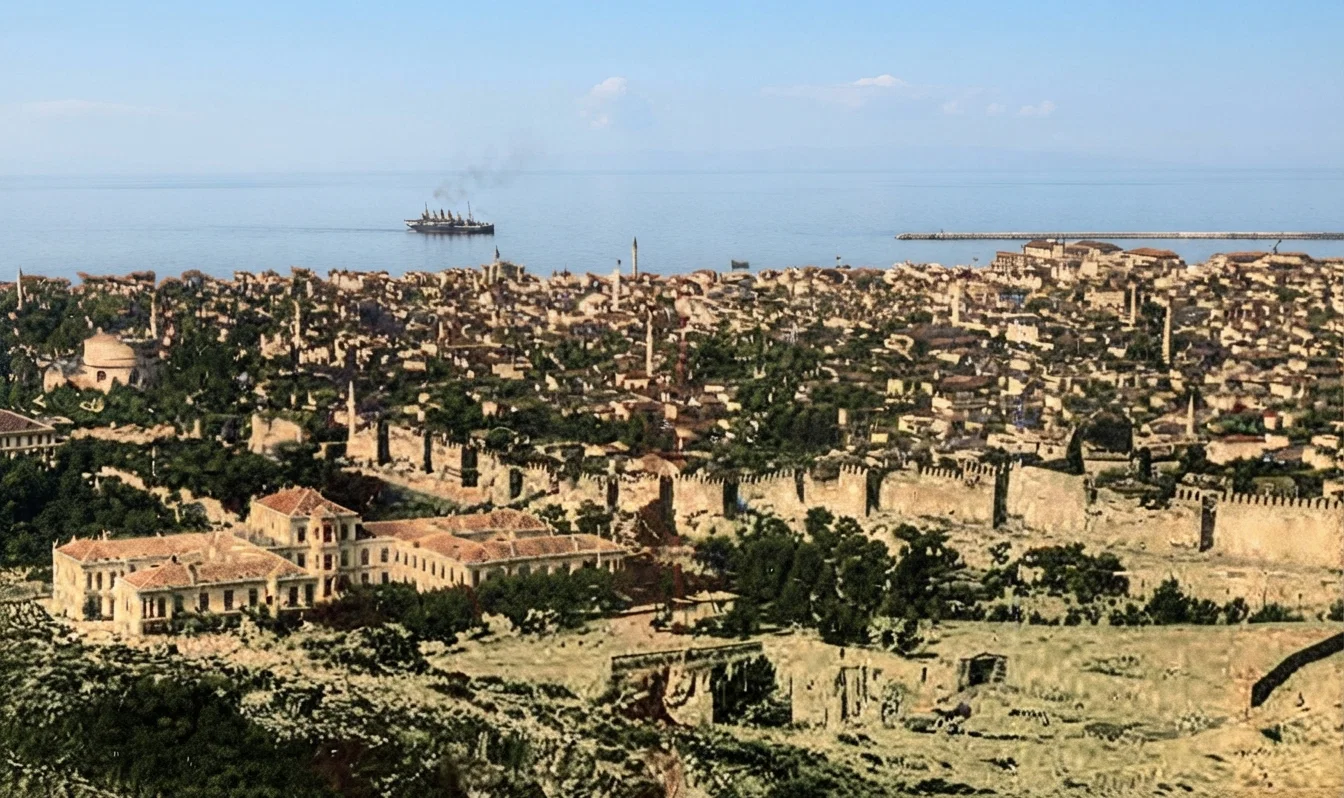
VIEW OF SALONIKI, GREECE'S PORT ON THE AEGEAN SEA
This admits the fact that the Sabbath has no other basis than that of religion; and all human laws for its enforcement must be in support of a religious institution.