WILL THE SEAT OF THE CATHOLIC CHURCH BE TRANSFERRED TO JERUSALEM?
THE past centuries have venerated the pope of Rome, and the present and future centuries will continue to see the pope at Rome. This is the fact, at least from what one can lawfully judge from the nature of things. It is ridiculous to suppose anything else." These are the words of a leading prelate of Rome, who is a general of a religious order, and a person that is very well acquainted with the inner workings of the Vatican.
A friend of mine who is well acquainted with this prelate secured a private interview with him and asked him concerning the possibility of the Church of Rome transferring its seat of government from Rome to Jerusalem, and the above words are his answer to the question. He furthermore stated: "Nobody has said that by divine right Rome belongs to the pope; but Providence has so placed matters that it seems that there is no other city outside of Rome which corresponds better with the great Gospel mission which has for its object the civilizing of the people. The character of the papal mission is really Roman in the sense that Rome was, and still is, the great teacher and corrector of the people. From this point of view, the city of Rome belongs to the pope, at least morally."
"Savors of Peter."
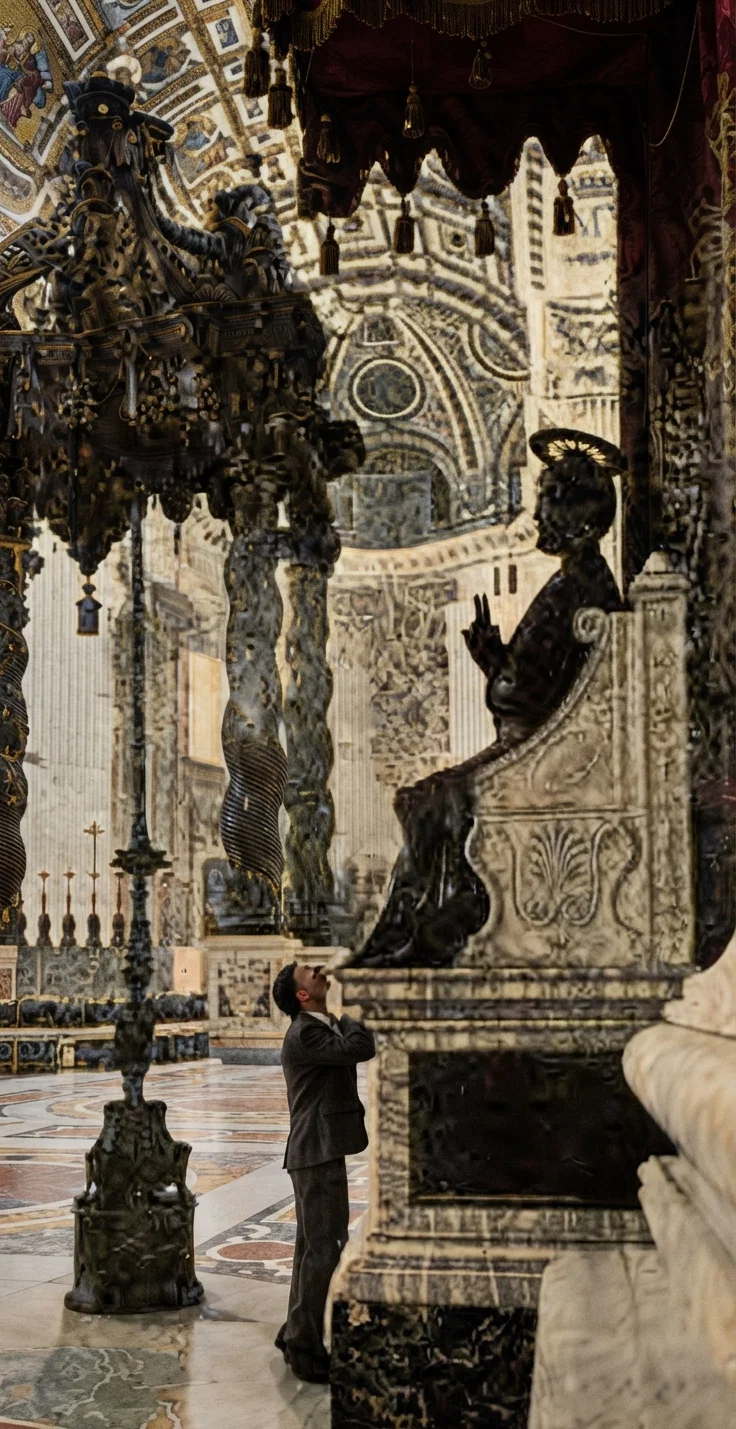
No one that is at all acquainted with the history of the Catholic Church will doubt the prelate's statement that "the character of the papal mission is really Roman," for Rome has always been to the church, what the hub is to the wheel. The fact that Rome has always been to the church what Catholic Church is not without its significance. Rome and the traditions clustering around "the Eternal City" are absolutely necessary to the very existence of the church. A visit to the fifty-million-dollar cathedral of St. Peters at Rome gives one some reasons for believing the foregoing statement. In this colossal church, which is the center of Catholicism, everything savors of Peter. The church is named after Peter, who is the patron saint of Rome. Then around the base of the gigantic cathedral dome are found, written in immense letters, the words: "Tu es Petrus et super hanc petram aedificabo ecclesiam meam et tibi dabo claves regni coelorum." ("Thou art Peter, and upon this rock I will build My church; . . . and I will give unto thee the keys of the kingdom of heaven.") Toward the center of the church on the right side, is the famous statue of Peter, which is the object of such veneration on the part of the devout Catholics that the great toe on the right foot has been worn away by their kisses. Then, in the very further end of the church, where it enjoys the most prominent place, is the great bronze throne which is said to enclose the original wooden chair upon which Peter sat in his official capacity as pope.
The name of the church itself, the inscription upon the base of the dome, the statue of Peter, and the so-called chair of the same apostle, are full of significance to the Church of Rome. For the principal argument to which Catholicism resorts to prove its claims to being the only true church rests upon the words inscribed upon the base of the dome of St. Peters. They claim that Christ built the church upon
Kissing St. Peter's Toe.
In the nave of St. Peter's, Rome, stands the bronze statue of Peter, said to have been cast by Leo the Great to commemorate the deliverance of Rome from Attila in 451. It is of crude workmanship. Its extended foot is eagerly kissed by devout Catholics, who rub their heads against the toes. So many have done this that the toes have been worn away. On high festivals this image is adorned with miter and pontifical robes.
Peter, and consigned to him the keys of authority whereby he was empowered to close or open the gates of heaven.
The keys were given to him in his official position as bishop, or pope, and, therefore, his successors are invested with the same authority. The proof that the popes are in the direct line of succession is established by the fact that the church possesses the body of Peter, the very apostolic chair upon which he sat, and are in the very bishopric over which he presided. It will not be necessary for me to stop here to dispose these claims, because of their falsity I am sure that we are persuaded, and this point does not enter into the scope of the present article; but we can plainly see that Peter as the foundation of the Catholic Church is an absolute necessity for its very existence.
But when the question arises, How would this argument that places Peter as the foundation of the church be affected by the removal of the seat of the Papacy from Rome? The removal of the residence of the church from Rome would be fatal to the maintenance of this position. The pope would then no longer preside over the bishopric of Rome, the so-called seat of Peter, and consequently he would not be in the direct line of succession. The church of St. Peters itself certainly could not be removed from Rome, and even if such a thing were possible the traditional spot upon which it stands has much to do with the veneration that it receives. And then it would take a century to build another church like it, and, in fact, it could never be duplicated for we have no Bramante or Michelangelo at the present time. And one can not imagine what a powerful influence the grandeur of the churches of Rome exert in keeping the people within its grasp.
Then the body of Peter is said to be buried under the high altar of the church; but it is quite certain that the body of the apostle is not there, and the church has been afraid to open the vault in order not to expose its fraud. Upon the belief of the existence of the body of Peter in the vault of the cathedral, the ecclesiastical supremacy of Rome has largely been built; for should we consider this question from a historical point of view its importance would immediately appear.
When, in the early centuries, the church of Constantinople was striving with the Church of Rome for
the Ecclesiastical Supremacy,
the relics of the apostle Peter were the great bone of contention. In fact, the church of the East attempted at one time to steal the body of Peter and carry it away to Constantinople, but the expedition failed. Later the empress, wife of Maurice of the Eastern Empire, tried to persuade the pope to give to Constantinople some relic of Peter, but the pope refused to concede the request.
One leading historian says: "The most prominent factor that contributed toward raising the pope to the ecclesiastical supremacy, is the tradition, accepted without controversy until the Reformation, that the apostle Peter came to Rome, was bishop of the city for twenty-five years, and suffered martyrdom under Nero, about the year 67, in defense of the Christian religion." "I say," he continues, "the tradition of the coming, the stay, and the martyrdom of Peter, retained as certain and without opposition for eleven centuries, served more than any other reason to extol the head of the Roman Church to a supreme and absolute authority."
Also the coming, stay, and martyrdom of the apostle Paul at Rome has been made use of by the Roman Church to further fasten its claims upon the world. To these apostolic traditions of the first order were united the antiquity and imperial majesty of Rome, and together they formed tremendous8factors in raising the Papacy to its exalted position. For centuries pilgrims and devoted Catholics from all over the world have poured into "the Eternal City" to visit the tombs of the apostles, the catacombs, and the traditional spots of the church, so that the Papacy gained great power and influence. The stream of pilgrims to the city of Rome has not ceased, but the stream that flows toward "the Eternal City" has rather been greatly augmented by the addition of thousands of tourists that come in ever-increasing numbers every year. Many of this latter class make their visit serve the double purpose of seeing the many interesting places of a historical value, and at the same time paying their respects to the Church of Rome.
Therefore, looking at the question from a historical point of view, we find how indispensable to the making of the Catholic Church have been the traditions that cluster around Peter and Rome. A removal of the seat of the Papacy from Rome would, therefore, be fatal to the maintenance of the traditional position of Peter, and the pope as his successor. Rome has, therefore, we might say, practically made the Roman Catholic Church. And it is a great question whether the Roman Catholic Church can get along without Rome.
But I have not been content to let the question rest simply upon argument drawn from history, and, therefore, in order to speak with more certainty upon the present aspect of the question, I have thought best to secure some information from a reliable source inside of the Catholic Church.
I sought, therefore, to obtain an Interview with Cardinal Rampolla, the famous Secretary of State under Leo XIII., who is by far the strongest man politically in the Vatican. It is by no means an easy task to obtain an interview with a person of his standing in the church; but, however, by the assistance of a friend of mine who is well acquainted with some of the leading prelates of the Vatican, it was obtained. Therefore, one evening toward sunset, I sought the massive palace of the cardinal which is situated a few steps from the Vatican. I was kindly received and after a short wait in the reception room, was ushered into the cardinal’s private office.
From what I had seen of Cardinal Rampolla in the large church functions in St. Peters, I had judged him to be a very austere and stern character, and therefore was much surprised to find him so pleasant and extremely cordial in this interview. But this affability was not without its purpose, for knowing that I was a Protestant, he did his best to leave a favorable impression upon me.
In the preliminary exchange of compliments, he used his subtlety to its best advantage in his endeavor to find out who I might be, but to no purpose, for I was on my guard.
I then came directly to the question in hand, and asked him if there was an intention on the part of the Catholic Church to move its residence or seat of government from Rome to Jerusalem. The cardinal answered, "The church has no intention whatsoever of making such a change." I then asked him if there had never emanated such a thought from the church. He replied, "The contemplation of such a move on the part of the church would be impossible on account of the traditions clustering around Rome." I then asked him how this rumor came into existence about the church removing its seat to Jerusalem. He replied that a few years ago some newspapers advocated this move as a hypothesis upon which to resolve the difficulties existing between the Catholic Church and the Italian Government. "They suggested that by transferring the seat of the church to Jerusalem, the Italian Government would be free to exert its functions, and at the same time the Papacy would have full liberty to govern its affairs without molestation." "This," added the cardinal, "was a hypothesis of the newspapers, but it was never contemplated or thought of by the church." He then told me, "You may say absolutely and categorically that the church has no intention whatsoever of transferring its seat of government from Rome to Jerusalem." The manner in which they were spoken and the words in which the expressions were formulated seem certainly to give the impression that such a move from the point of view of the church is not contemplated, nor is it possible.
In closing, I might say that when I was taking leave of the cardinal, he took my hand in both of his and said, as he shook it warmly, "We have the very best wishes for the Americans," and then repeated, "We have the very best wishes for the Americans." These words are also full of significance when viewed in relationship with the prophecy which points out the United States as the great power that will help the Papacy to regain its lost prestige. The prophecy has predicted this state of things for this present time, and we notice that the church on its part sees it coming, looking at it not from a prophetic, but a practical, point of view. The Papacy has never failed to fulfil the predictions of prophecy made concerning it in the past, and it is now getting ready to shoulder its share of those that deal with the present.