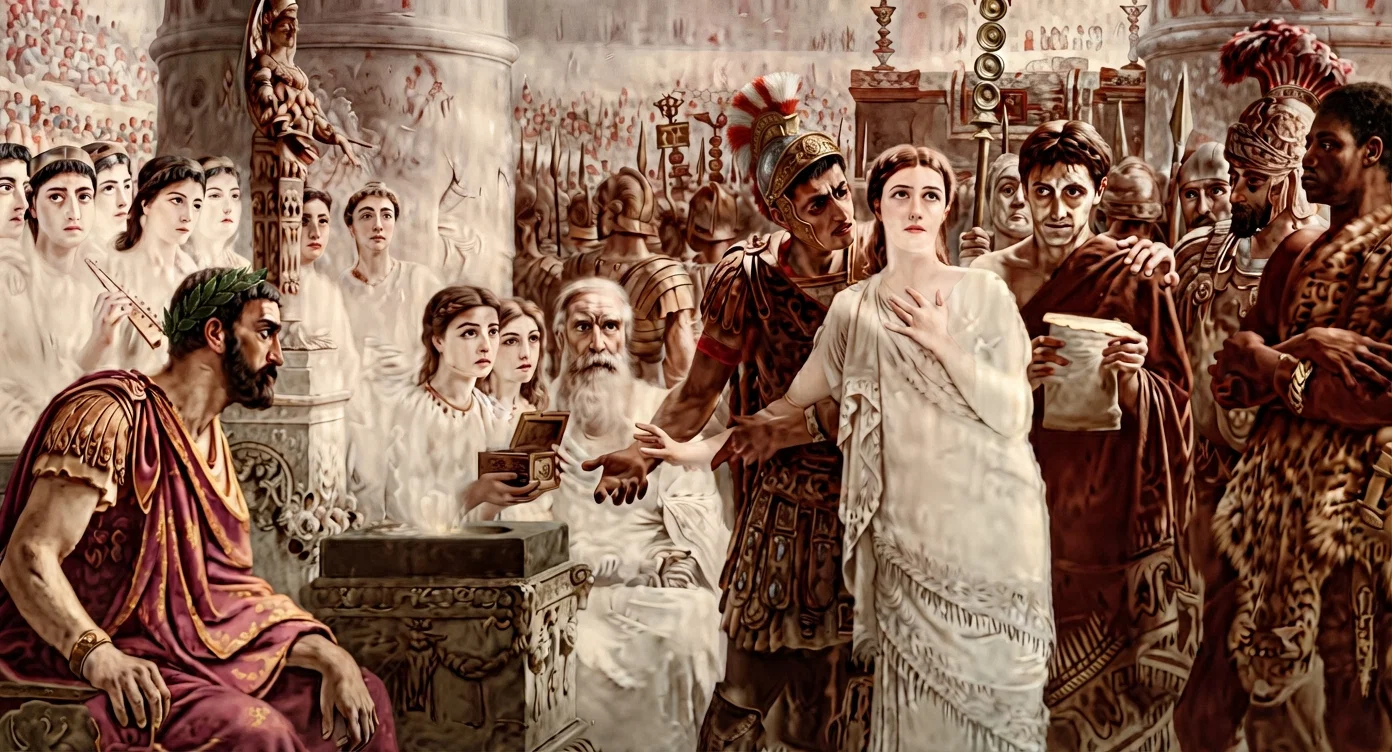
CHRIST OR DIANA

9%

Pacific Press Publishing Company · Mountain View, California · Jan 23, 1907

FromSigns of the Times, Vol. 33, No. 4.

Read the full edition

CHRIST OR DIANA.

Our beautiful engraving from Edwin Long's great picture propounds a question ages old—Shall we choose Christ or Diana?
Diana stands for nature worship: for the pleasures of earth, which at the best are only "for a season;" for the ambitions which wither and kill; for the lusts of the flesh which rot and disintegrate; for the self-love and self-indulgence which embitter and belittle the soul; for the ease of the present which dwarfs; for the passions which bestialize; for the greed of gain and power which tyrannize, enslave, and crush; for all that the human heart naturally loves and cherishes; for death as the result of all.
Christ stands for the very opposite of all the things for which Diana stands: for the eternal and ever-increasing pleasure of doing right; for the affections which bind together and save; for the ambitions which seek the good of others and make living, mighty men; for the righteousness of God which brings peace and rest; for the warfare which brings eternal triumph over wrong; for the liberty vouchsafed to every man, which, when received, makes men fearless and free; for the life which denies the baser lusts and passions, and gives power and purity to the ever upward growing character; for all of all good in righteousness and life and love, Christ stands.
Which shall we choose? To-day the Good Shepherd may seem near and we may see no want of needed things. To-day the pathway is cool and shaded beside the sweet, still waters; and we love its ease and peace. To-day the pastures are green and sweet; we love to feed upon the luxuriant grass. How good it is to follow Him! But to-morrow—our next to-day—the path may be rugged, and rough, and thorn-bordered. It has left the green meadows for the barren desert wastes. It has diverged from the still waters to the wild, roaring torrents of the mountains. The feet become weary and worn and bleeding. Earthly friends are calling us back to the lowlands of ease. The dulcet voice of the Dianas of nature woo us to eternal slumber, or call us back to an easier path. Christ, the Good Shepherd, goes on before; Diana invites to present ease and indulgence.
Which shall it be, God or nature? Christ or Diana?
Diana stands for force and compulsion in religion. Thus has every perversion of the true religion stood. When the apostle Paul went to the great city of Ephesus to preach, God wrought mightily thru him. A multitude turned to God. The devil did all he could to nullify the apostle's work by endeavoring to associate with him vagabondJews of no repute; but the Spirit of God wrought above them, and the name of Christ was magnified. Many of the most depraved turned to God. They showed the sincerity of their repentance by burning their evil books to the value of 50,000 pieces of silver. Turning from their idolatry affected the business of the devotees of Diana, and Paul was brought before the magistrates as a troubler of the peace of the city, when the fact was that he was working for peace—a mightier, deeper, holier, more lasting peace than Ephesus knew.
But Paul's work or Paul's right was not recognized. What right had he to preach in that city which had the great image of Diana, whom all the world worshiped? Her temple will be despised, and her magnificence destroyed. Then for two hours they cried, "Great is Diana of the Ephesians." The town clerk was a sensible, just man. He believed in Diana, and felt that she could stand by herself; but if these complainers "have a matter against any man, the courts are open; . . . let them accuse one another." See Acts 19.
It was the right principle. Men, not institutions, should be matters of law. Not men as against institutions, but men in their relations with each other, each protected in his own right, equal to his neighbor, tho the neighbor number a thousand and he but one. But the devotees of Diana did not discern so clearly as their town clerk. Later on, the hatred of the worshipers of Diana grew more fierce toward the worshipers of Christ, and doubtless the struggle depicted in our picture was a type of many others of variant form in which the worship of "Christ or Diana" was the crucial question.
All thru the times of pagan persecution the picture was repeated. All thru the Dark Ages the struggle was multiplied in a hundred forms. In our own day is a revival of the same spirit. Men have so little faith in the dogmas of the creed they hold that they are not willing to let them stand or fall by their inherent worth or worthlessness. "Great is the American Sunday" is ringing thruout the land, and prosecution of those who question its authority is demanded. New laws to protect it are demanded, lest it "should be despised," and its magnificence should be destroyed." Sensible town clerks and magistrates and legislators, and leaders of all classes are needed now. If Sunday be sacred, no human law can add to its sacredness. The truth and majesty of God within it will protect it. It will not give it a place in hearts to enforce it; and tho it be a thousand times Christian, it is a thousandfold un-Christian to seek to enforce it by law. If it be not able to stand in its own merits, let it perish. "Every plant, which My heavenly Father hath not planted, shall be rooted up," are the words of Jesus. "If it be of God, ye can not overthrow it," is equally true. Test all rival sabbaths by the word of God, but never do the un-Christian thing to seek to enforce by law even the true. We choose Diana when we choose the false. We choose the way of the heathen when we seek to enforce by law any religious dogma whatsoever. We stand with Christ when we grant liberty to others. We choose Christ when we choose the true.