Untitled article

8%

Pacific Press Publishing Company · Mountain View, California · Jul 1, 1908

FromSigns of the Times, Vol. 34, No. 27.

Read the full edition

The Beginning of the Inquisition in Portugal No. 2
[The following article in four parts is not from some ancient tome written by some prejudiced Protestant; it is from the Illustracao Portuguesa of June 18, 1906, a popular magazine of Lisbon, Portugal. We do not print it because we have ought of enmity or ill-feeling against one single Roman Catholic in this world. We have warm friends among them; we pray for them all. Many of them are Christians, far better than their creed. We publish the article to show a logical outworking and legitimate fruitage of the union of church and state. The members of the Roman Catholic Church are like other men and women by nature—neither better nor worse. If that church had not assumed to legislate and execute for God and demand that the state should submit to her creed, she would not have authorized the Inquisition. The Inquisition was but the logic of the church's claim and demand for power to punish heresy. Let all men take heed. Let those "Protestants" who are seeking religious legislation in behalf of Sunday learn the lesson. The translation of the article is not finished English; it has too much of the idiom of the Portuguese, but it does not misrepresent the original.]
LITTLE was necessary to merit oneself the honor of being persecuted by the Holy Inquisition. The least pretexts were sufficient.
A word, a gesture, a shadow of a thought, carried to the dungeons of the Holy Office. The denouncement was accepted without responsibility to the informer. To the Dominican censurer, infamy was the only crime for which punishment was not known. Anonymous documents were made bases of processes. Upon an infamy, a relic of a vengeance, the remains of a hatred, the perverse caprice of the first that might pass, a gibbet was erected, a funeral pyre was raised. Generally—almost always—the inquisitorial processes had a ridiculous and miserable base. In 1591, a gentle dame, Violante Mendes, and her husband, Francisco Borges, were sent to be burned by the inquisitor of Braga because their little son was seen playing with a little ivory calf that had its legs and little horns broken. In 1602, a poor Jew, Steven Nunes, was released to the secular arm, gibbeted, and burned in an auto de fe in Lisbon for the great crime of having ordered a beaver hat lined with silk.
Upon a phrase, upon the intention of a word, the denouncers, the consulters, the censurers of the Holy Office erected immense, complicated, Byzantine, and endless processes. Of all the creatures that passed, rapid as shadows, crossing themselves and trembling before the dark walls of the inquisitorial palace, there was not one that could have the certainty of not going there to sleep the day following. It was a real Terror; it was the Dominican Terror; it was the Terror of the church, the Terror of the black scapular, the Terror of rich ornaments. The people suffered the consequences of their work.
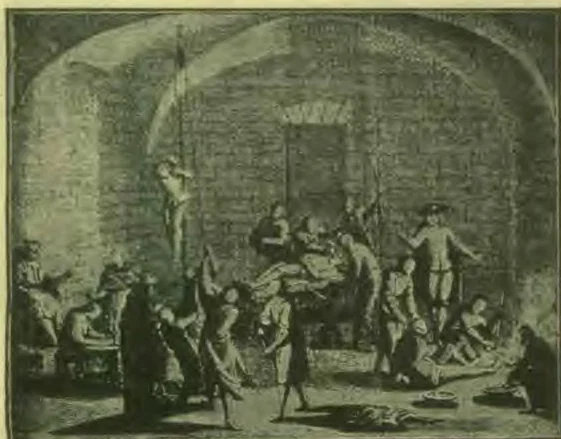
The Tortures of the Inquisition.—An Engraving of the Time.
But so that the unfortunate might remain at night in the inquisitorial prisons, the information of an enemy or the calumny of one who had hated was not absolutely necessary. The Holy Tribunal possessed a real secret police system, wisely and systematically organized, that introduced itself into families, that insinuated itself, that infiltrated itself under the vague title or form of confessors, doctors, jewelers, foremen; captivating, involving, provoking confessions, entering private lives,—finishing by denouncing, by shutting up in convents, by assassinating. This infamous and mysterious police, who had everything that the inquisition required, from the nobles of the highest rank to the Italian or Spanish adventurer, was constituted as Familiares of the Holy Office. A word, a simple nod of one of these men, and a life was condemned. There was no remission or mercy. Declared suspect, the poor being that fell into their hands was either immediately conducted to the palace of the inquisition by three or four dark creatures, with enormous white mantles in the Holland style, or in case of flight his capture was required by the secular power. Once in the place, the summary of guilt was made to him; this ended, the same Familiares in black, somber as statues, silent as specters, threw him in a rotten cloth to the depth of the inquisitorial dungeons. Then commenced the tragedy with all its terrible particulars. The flaming sword of Saint Domingos never pardoned.
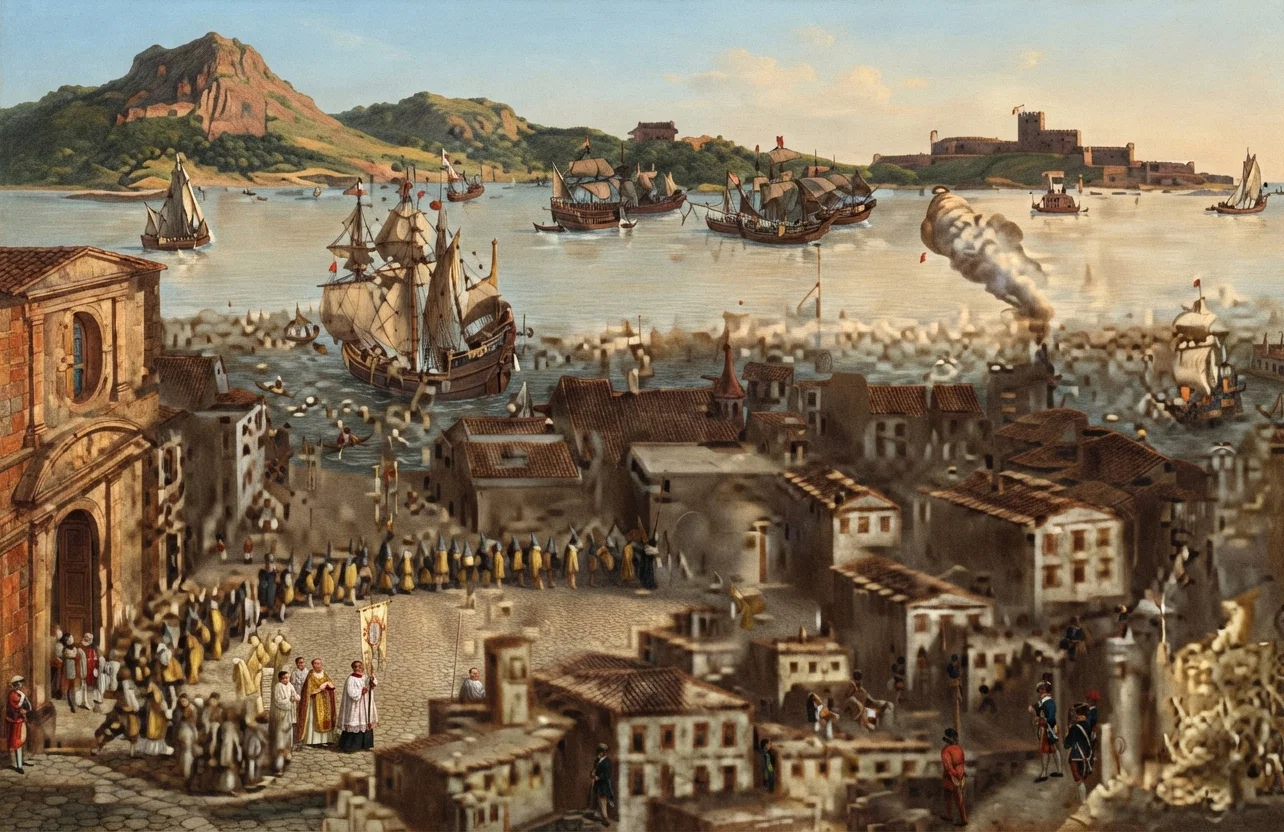
A Procession of an "Auto de fe" in Goa.
After a century of pacificating intrigues, no one calculates in the least what were the dungeons of the inquisition. They exceed the most repugnant that human perversity has produced. It was a wonder that one lived there, or that one breathed there, or that these sordid, deep holes were compatible with life. The most terrible secret prisons of the Holy Office would have a length of about five and a width of about three feet, a little more space than that occupied by a dead body. Dimly lighted by an opening high and narrow, enclosed by the wall of an interior court, the darkness within lasted eighteen out of the twenty-four hours. The arched ceiling weighed low upon the heads of the prisoners, the humidity congealed on their bones, and the exhalations of the two receptacles of filth, that only every eight days were removed, diminished little by little the existence, and created these hundreds of creatures into so many squalid and dried mummies, that a black samarra recovered. They were not permitted to speak to their own lawyers; fire was denied them in the coldest winter nights; they were not allowed a light from 4 P.M. until 7 A.M. Many became insane, and—infamy against which human nature revolts!—were carried in this condition to torture. Others died of infections, a form of typhoid, and their bones were carried in a small tumba to the first auto de fe, being piously carbonized with all ceremony and pomp. The strongest resisted to their own misfortune and suffering; and some—not a few during our three years of black Terror—sought in suicide freedom from the tortures that awaited them, smashing the cranium, with cries of pain and desperation, against the thick, rough stones of the prison walls.
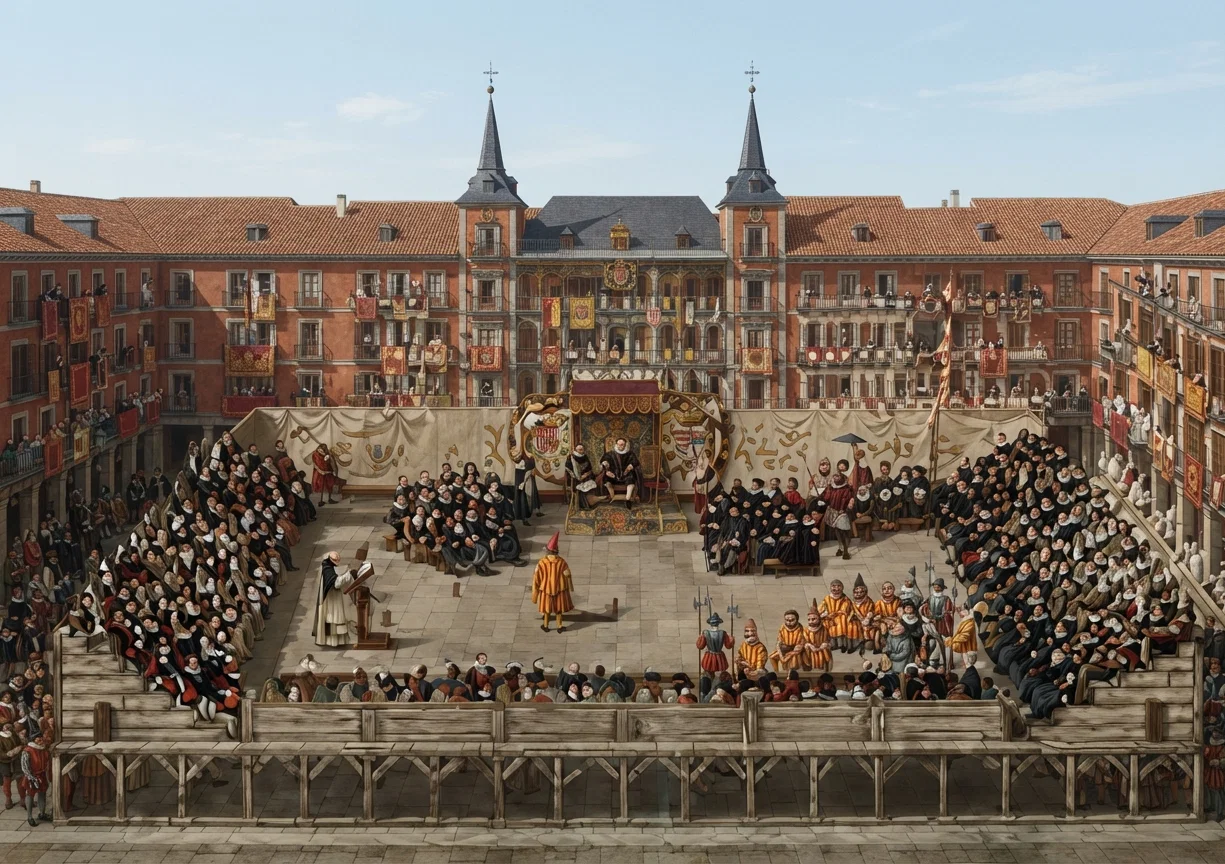
Reading of sentences by the Holy Office for an "Auto de fe," on the great square of Madrid. 1. King Philip and his court. 2. The inquisitors and their familiares. 3. The reader reading the sentences. 4. The culprit in special dress and cap. 5. Other prisoners.
This was what happened in 1685 to a poor Jew, Marcos Sommer, a seller of skins, accused of heinous sin, and awaiting in irons the establishment of the process, in the inquisitorial dungeons of Lisbon. With the horror of torments worse than death itself, the unfortunate one turned to suicide on his entrance, biting the wrists to open the arteries, finishing by bursting his cranium in a barbarous way against the solid masonry of the walls. At the end of fifteen days he showed signs of life; even as he was, two Familiares with masked faces, carried him in their arms to the torture.
In the meanwhile, in the palaces, full of laughter and gaiety, the inquisitorial bishops were carving fine roast pigs upon enormous silver trays, and the cardinal inquisitor continued to nurse, evangelically, the breasts of Maria de Motta.
(To Be Continued.)