What a Missionary May Meet in the Orient — Courage and Success in the Work Regardless of Difficulties
By ROSS C. PORTER
President Asiatic Division
MISSION life in the Orient is not all romance. It has much of the regular mission experience connected with its daily routine; but the customs and associations are quite different from those of the home land, and these add variety to the regular program.
NATIVE ACCOMPANIMENT TO BURDENS
When the glamour of going as a foreign missionary has worn off, and one finds himself located in an inland Chinese city, living in daily contact with Chinese life, he begins to catch a glimpse of mission life at the front. The "hah ah" sound heard all day long, and often all night, is the native accompaniment to carrying loads on the shoulder. A load is usually suspended from a bamboo carrying stick, one basket on either end of this springy shoulder pole. To the newcomer, this sound is novel; but in time it becomes wearisome and nerve wearing, especially when it peals out upon the stillness of night.
THE SEWERAGE SYSTEM A DEATH-TRAP
But there are other things of a more serious nature. The sewerage system in many Chinese cities is a source of menace to health and to life. It is a veritable death-trap. It usually consists of a square, box-like ditch, covered with paving stones, with much ventilating space between them. It is laid just beneath the pavement, almost on a level, and is never flushed. It runs along all principal streets in both the residence and the business section. The foul air rising constantly, reminds one that he is living over a horrible cess-pool, from the fumes of which there is no escape day or night.
HOGS IN THE HOUSES OF THE WELL-TO-DO
Passing along a street in the city of Chang-Sha, one of the foremost cities of China for education and culture, I thought I detected an odor that indicated a barn-yard near. Proceeding in the direction from which this odor came, what was my surprise to find in a well-to-do Chinese family residence, on a high-class street, nine hogs, weighing about two hundred and fifty pounds each. They were penned on a shelf-like board floor, elevated about three and one half feet above the floor of the living-rooms, and separated from the kitchen and the dining-room by a fourteen-inch board set up edgewise. On the other side of the room, between the dining-room and the sleeping apartments, separated from the bedroom by an openwork bamboo partition, were a larger number of shoats, ranging from fifty to one hundred fifty pounds.
My curiosity having been aroused, I was emboldened to ask permission to enter the house of a business man from whom we had frequently hired sedan-chairs for the women of our party. Again I was surprised to find, in that respectable home, thirteen large hogs, situated in the same relation to the living-room as were the others.
CHINESE CHARACTER FOR "HOME"
While in Canton, south China, I was speaking of this experience, and was informed that this was a common custom throughout China. The Chinese character for "home" was said to be a pig under a roof.
In confirmation of this statement, I was taken to a Chinese home in Fatshan in which I counted over one hundred hogs, ranging from fifty to two hundred fifty pounds each.
We also visited a home where six water-buffalo cows and one calf were kept in the home with the family. Beds were suspended on poles above the cows, where some of the family slept. These people seemed to enjoy about the usual health of the Chinese. I wondered what our germ specialists' diagnoses of some of these cases would be. For me it was difficult to see how a person could live under such conditions.
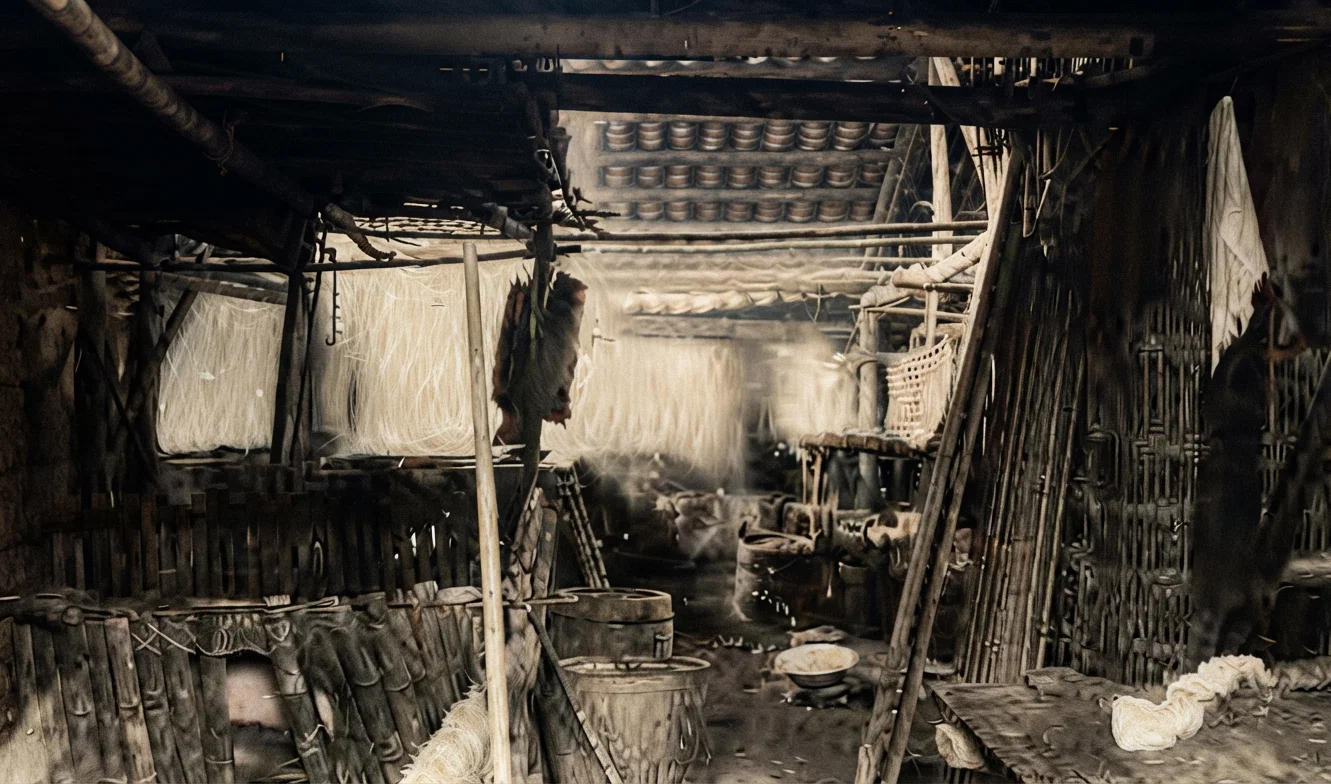
INTERIOR OF VERMICELLI FACTORY, CANTON, CHINA, SHOWING PIG-PENS ON THE LEFT
PIGS IN FACTORIES
I visited two vermicelli factories in Canton. In the first, I found seventeen hogs penned in the factory, in an ordinary pig-pen, just across the aisle from the vats. In the second, there were twenty-eight penned in the same way. Although the day was dark and rainy, we managed, by a four-minute exposure, to secure a picture of one of these factory scenes. The pens are fairly well kept, and seem to add no special flavor to the factory product. The hogs are housed thus for convenience of feeding, and also for safety. They live on the waste from the homes and the factories, and being inside, they are less liable to be stolen.
THEIR VEGETABLES UNSAFE
The Chinese method of fertilizing their gardens makes it positively unsafe for foreigners to eat any vegetables without scalding or cooking them. Even when taking this precaution, many missionaries are obliged to quit the field on account of contracting sprew. This disease is not incurable under favorable conditions; but very few foreigners recover unless they leave the field, when a few have been known to rally from its grip.
THE COURAGE OF THE MISSIONARY
Notwithstanding these perils, and added to these, the political revolution perils, it is marvelous how, as in apostolic times, the Lord miraculously delivers and sustains the missionaries, giving them an interest and a love for their work that is remarkable, and turns calamities into avenues through which to reach sin-burdened hearts. Two hundred thirty-two converts, mostly from heathenism, were baptized by our workers in central China alone last year.