[We wrote our esteemed contributor, John S. Wightman, for a report of the progress of the Sunday-law movement in Kansas City, and elsewhere in the Mississippi Valley. We found him so busy in his campaign as Secretary of the Central States Religious Liberty Association that he could not write up a report, but he sent us some facts from which we present the following article. We have some further very interesting matter to follow from the same source. The battle in that field is truly on in earnest.]
As is well known to the readers of the SIGNS OF THE TIMES, Kansas City has been for quite a while a strong storm-center for the Sunday-law movement. Judge William H. Wallace, of the criminal court, is the leader of the aggressive forces. He has aided and encouraged the making of a number of arrests, and at the present writing his court has a vacation and he is out campaigning in the Sunday-law interests, and incidentally for governor.
In a recent report of his work, Judge Wallace said that 40,000 people who seven months ago were laboring on Sunday are now resting on that day; business places to the number of 5,000 in addition to 700 groceries that were selling on Sunday have been closed during the same time; many small places of business, as well as barber-shops, have been closed on Sunday; of the eight theaters that were running wide open on Sunday, the judge says he has been successful in closing six.
Mr. Wallace is a criminal judge, and he began this campaign last fall by instructing the grand jury to indict any individual they might find violating the Sunday law. Three thousand indictments followed, and the theater people, managers and all, have taken the lead in the defense against the prosecutions. Some of the cases were carried to the United States court, but the judge refused to interfere, and discharged them.
Then there came an application for a change of venue, and the transfer of the cases to Judge E. E. Porterfield's court. A writ of mandamus from the Missouri Supreme Court was served on Judge Wallace, which he obeyed and transferred the cases.
The trial of the first case resulted in the disagreement of the jury. This failure to convict called from Judge Wallace some very caustic remarks concerning the jury, and he publicly threatened to have the grand jury investigate the petit jury that refused to render a verdict of guilty.
To this threat of Judge Wallace, Judge Porterfield replied in his court that no jury where he presided would be thus intimidated and threatened, and that there would be no further trials for infractions of the Sunday law until this language of the judge was modified. Judge Wallace then softened his remarks by certain explanations, and the almost immediate result was the nolle pros ("an entry of record in a civil or criminal case, to signify that the plaintiff or prosecutor will not press it") of the nearly 3,000 cases in Judge Porterfield's court in less than five minutes, an unprecedented record for the withdrawal of suits. "Insufficiency of evidence" was the stereotyped remark of the public prosecutor as the cases were passed; but there is little doubt of the affair resulting as a rebuke to Judge Wallace.
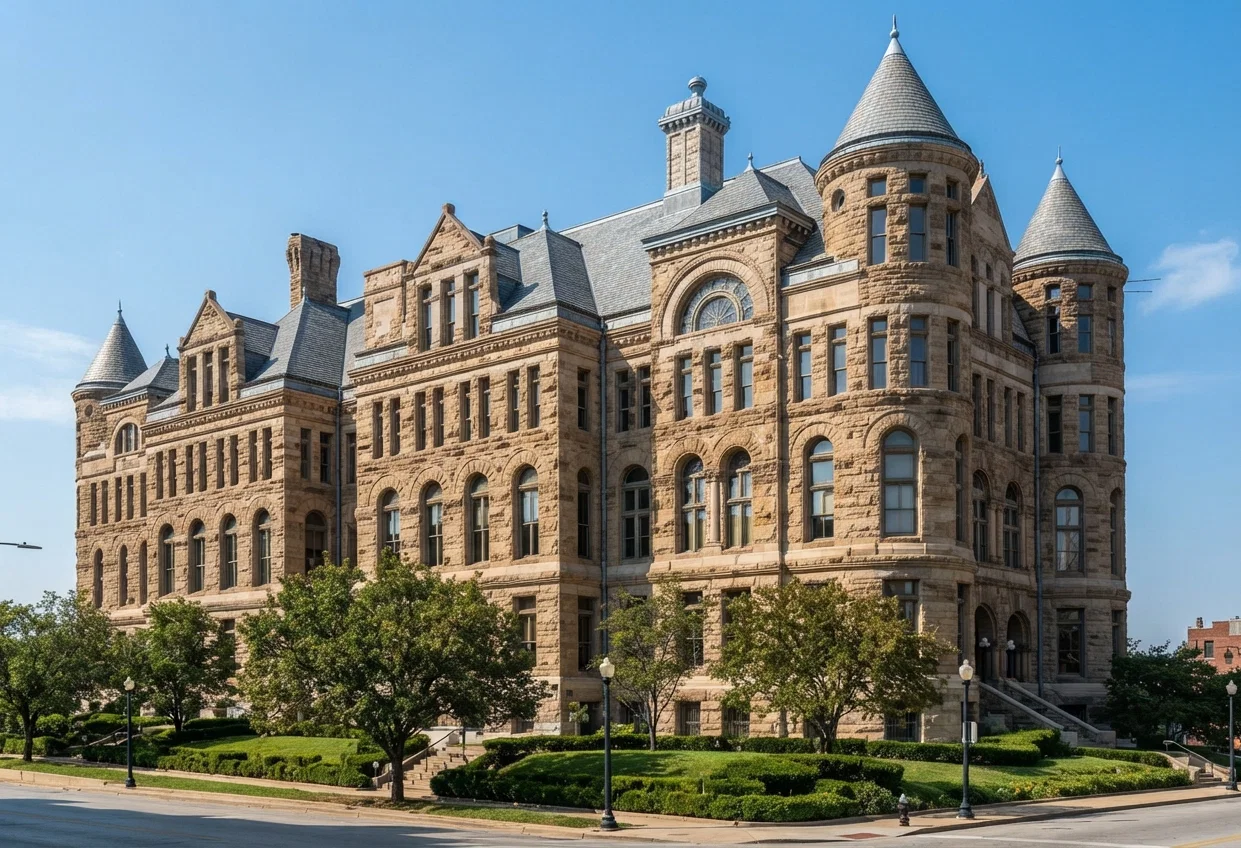
Jackson County Court-House, Kansas City.
But this is not the end of these cases. One hundred and forty fresh indictments were made during the week ending May 23, and motion was filed by each defendant for a change of venue to Judge Porterfield's court, where it is generally conceded that the defendants will have things pretty much their own way.
The manager of one of the theaters, however, was convicted in one of the first trials that were held, and he appealed his case to the United States District Court. If he is decided against in this court he is planning to appeal to the Supreme Court for a decision as to whether the statute under which he is convicted forbids theaters, plays, and the like; he wants to have it decided if acting on the stage is "labor" within the meaning of the statute.
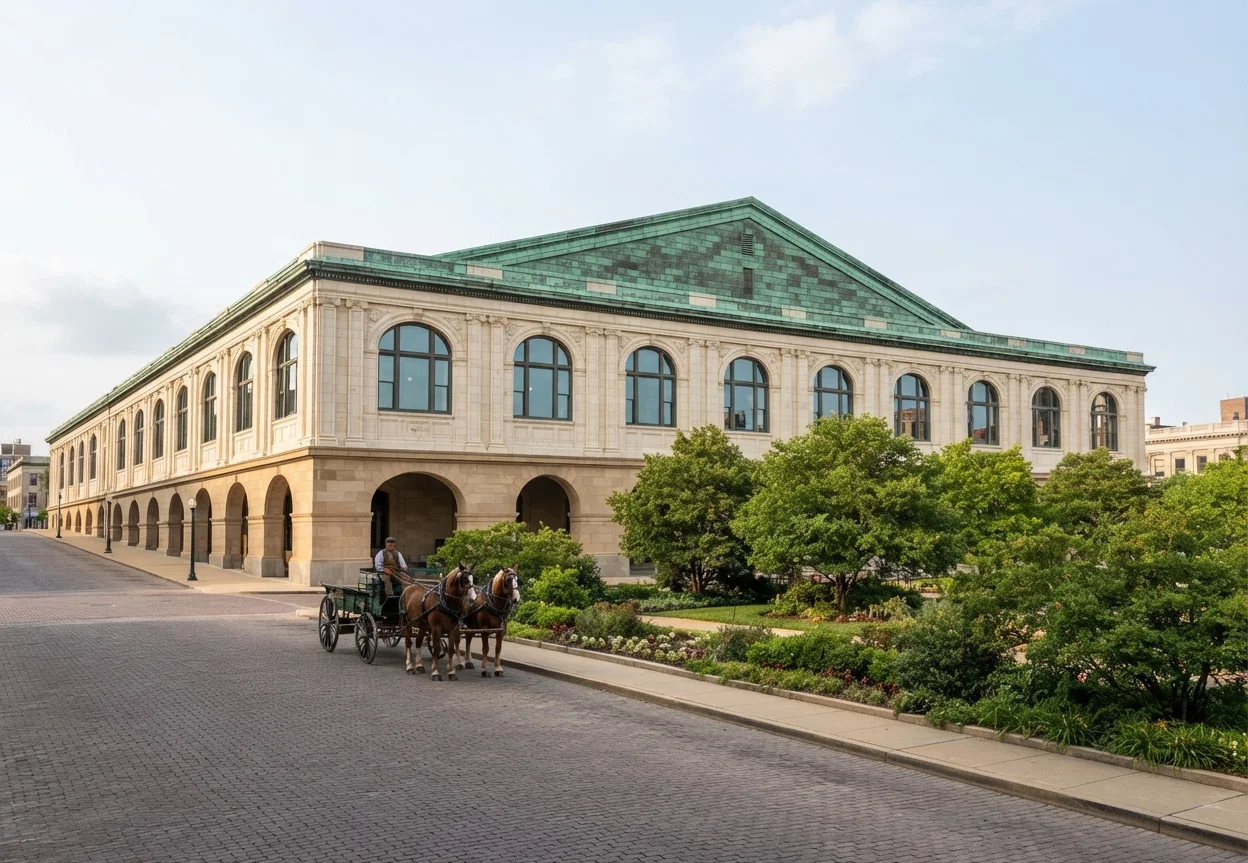
Convention Hall, Kansas City.
It is clear, so far as the statute is concerned, that the defendant has violated the law, and Judge Porterfield ruled as follows:
"If the jury believes that the defendant on Sunday, March 29, performed labor by selling tickets, you should convict the defendant, and assess his punishment to be a fine of not less than $10.00. Selling tickets in a theater on Sunday is labor and is a violation of the law."
When a judge takes oath to enforce the law, he is expected to enforce it just as he finds it; he is not on the bench to make law but to enforce it. But what the mass of the people fail to see is that all such laws as Sunday statutes are religious legislation. They do not see or recognize that the observance of a sabbath or the non-observance of a sabbath is not a question as between man and man, but it is one that should rest wholly between the individual and God.
Unfortunately saloon men, brewers, theater managers, and also all that go to make up the "red-light districts" of our great cities have arrayed themselves against the Sunday law and its enforcement. This enables certain individuals to point the finger of scorn and contempt at all decent people who oppose these measures from principle and conscientious conviction.
Judge Wallace is appealing to the church people of his state on his Sunday-law record as the principal, if not the sole, reason why he should be nominated and elected as governor of Missouri this coming fall. Church federation between both Protestants and Catholics is being urged on every hand, and the central point on which all can unite, it is claimed, is the Sunday question. The confederation of large and powerful religious bodies to influence and control legislation has always been dangerous. When they have the power in their hands, they have invariably persecuted and oppressed those who differed from them.
Christ was put to death by the enforcement of law; the apostles were put to death by the enforcement of law; all the martyrs all thru the ages have been put to death to gratify some spite, and in nearly every case the prosecutor and the persecutor had the civil law on their side.
These facts should put all truly liberty-loving people on their guard; and in saying this we want to repeat and emphasize that we have no sympathy whatever with the clamors of the saloonist, the brewer, and the libertine, to have none of the impediments of law in the way of their iniquitous work. But we fail to see the consistency of giving these demoralizing purveyors of evil the sanction and the dignity of the protection of the law for six days in the week and think to atone for it all by shutting their places up on Sunday.
As the churches combine more and more to insist upon their wishes being enacted into law, the politician who has no ambition higher than to secure office will be a very obsequious and obliging servant. And the prophecies, as is pointed out continually in the pages of this journal, show that the climax will be the cruelest and the bitterest persecution that this world has ever known.