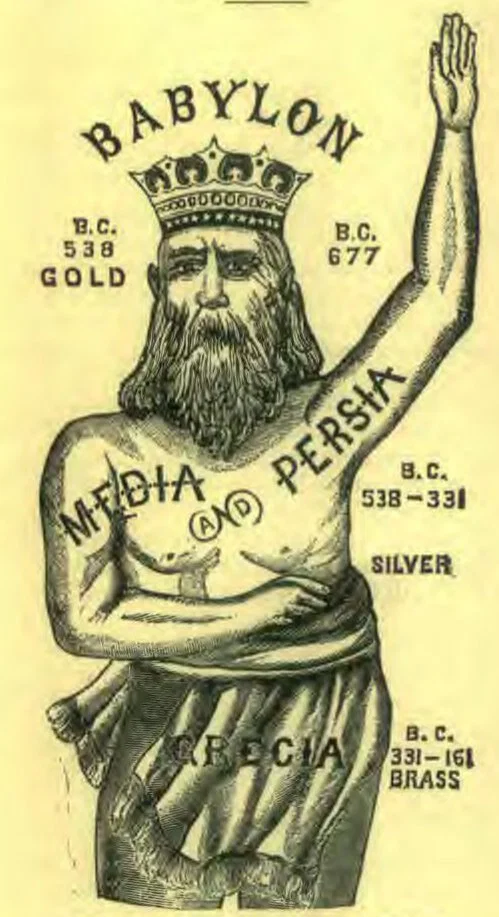
LEAVING for a while the empire of Persia, we turn our attention to that instrument by which this empire was subverted, and upon its ruins another, a third, kingdom erected, which bore rule over all the earth. God had declared by the mouth of the Prophet two hundred and seventy-two years before it happened, that a third kingdom should be erected upon the ruins of the second; and we, from our later stand-point have the privilege of tracing the historical steps by which it was accomplished.
Alexander the great was born at Pella in Macedonia, B. C. 356. This prince and Darius the Persian, were the two principal actors on the stage when the empire of the world for the second time exchanged hands. Of the history of the Greeks therefore, their gradual growth, their wars with the Persians, &c., previous to Alexander's time, we need not particularly speak further than this:—
"Philip, king of Macedon, the father of Alexander, having overthrown the Thebans and Athenians, in a great battle at Chaeronea, made himself thereby in a manner lord of all Greece; and therefore calling together at Corinth an assembly of all the Grecian cities and States, he there caused himself to be chosen captain-general of all Greece for the carrying on of a war against the Persians, and made every city to be taxed at a certain number of men, which each of them was to send and maintain in this expedition." But being slain by one of his guards the next year, just as he was ready to set forward, Alexander his son succeeded him in the kingdom, being then twenty years old. He soon called a general council of all Greece to meet again at Corinth, and there prevailed with them to be chosen also the successor of his father in the same general command which they had conferred on him before his death, for a war against the Persians.
Having by the next spring gotten together his forces, which according to the highest account amounted to no more than thirty thousand foot, and five thousand horse, he commenced, with this small number, his daring career against the throne of Persia. His progress perhaps cannot be better shown than in the following brief synopsis of his course, given by Rollin:
"Alexander set out from Macedonia, which is part of Turkey in Europe, and crossed the Hellespont, or the Strait of the Dardanelles. He crossed Asia Minor, (Natolia,) where he fought two battles, the first at the pass of the river Granicus, and the second near the city of Issus. After this second battle he entered Syria and Palestine; went into Egypt where he built Alexandria on one of the arms of the Nile; advanced as far as Libya, to the temple of Jupiter Ammon; whence he returned back; arrived at Tyre, and from thence marched towards the Euphrates. He crossed that river, then the Tigris, and gained the celebrated victory of Arbela, possessed himself of Babylon, the capital of Babylonia, and Ecbatana, the chief city of Media. From thence he passed into Hyrcania, to the sea which goes by that name, otherwise called the Caspian sea, and entered Parthia, Drangiana, and the country of Paropamusus. He afterwards went into Bactriana and Sogdiana; advanced as far as the river Iaxarthes, called by Q. Curtius, the Tanais, the farther side of which is inhabited by the Scythians, whose country forms a part of great Tartary.
"Alexander, after having gone through various countries, crossed the river Indus, entered India which lies on this side the Ganges and forms part of the grand Mogul's empire, and advanced very near the river Ganges, which he also intended to pass, had not his army refused to follow him. He therefore contented himself with marching to view the ocean, and went down the river Indus to its mouth.
"From Macedonia to the Ganges, which river Alexander nearly approached, is computed at least eleven hundred leagues. Add to this the various turnings in Alexander's marches; first, from the extremity of Cilicia, where the battle of Issus was fought, to the temple of Jupiter Ammon in Libya; and his returning from thence to Tyre, a journey of three hundred leagues at least, and as much space at least for the windings of his route in different places; we shall find that Alexander, in less than eight years, marched his army upwards of seventeen hundred leagues, [or more than fifty-one hundred miles,] without including his return to Babylon."
Ptolemy the Egyptian astronomer begins the reign of Alexander over the East with the building of Alexandria, B. C. 332; but it was not till the battle of Arbela, the year following, that he became, according to Prideaux, "absolute lord of that empire to the utmost extent in which it was ever possessed by the Persian kings." On the eve of this engagement, Darius sent ten of his chief relations to sue for peace for which he had twice sought in vain before; and upon their presenting their conditions to Alexander, he replied, "Tell your sovereign . . . that the world will not permit two suns, nor two sovereigns! Let him therefore choose, either to surrender to-day, or to fight to-morrow." Such was the indomitable pride and haughtiness by which he was governed. Having assembled his general officers and requested them to represent to the soldiers that they were to fight on this occasion not for Phoenicia or Egypt only, but for all Asia, and that the whole empire hung upon the issue, he led them against the army of Darius and gave him an irreparable overthrow. Darius hereon fled towards Media, and was shortly after traitorously slain by his attendants.
Thus ended the reign of Darius, and with it the Persian empire, after it had continued from the taking of Babylon by Cyrus two hundred and seven years.
Alexander, after his conquests in the far East, mentioned above by Rollin, returned to Babylon. While he remained there, which was nearly the space of a year, he gave himself up to the pleasures, luxuries, and drunkenness of the place, till at length he drank himself into a fever of which in a few days after, he died, B. C. 323. After his death, he having left no heir, great confusion arose about the succession. The governments of the empire were at length divided among the chief commanders of the army, who took at first the name of governors, but finally that of kings. Soon after they were settled in their provinces, they warred among themselves, till, after some years, all were destroyed but four; Cassander, who had Macedon and Greece in the west, Lysimachus who had Thrace and the parts of Asia on the Hellespont and Bosphorus, in the north, Ptolemy who had Egypt, Libya, Arabia, Palestine, and Cœle-Syria, in the south, and Seleucus, who had Syria and all the rest of Alexander's dominions in the east.