1 Samuel 11:2
And Nahash the Ammonite answered them, On this condition will I make a covenant with you, that I may thrust out all your right eyes, and lay it for a reproach upon all Israel.
Translations
And Nahash the Ammonite answered them, On this condition will I make a covenant with you, that I may thrust out all your right eyes, and lay it for a reproach on all Israel.
King James Version, KJV Cambridge Paragraph Bible, Webster Bible
And Nahash the Ammonite answered them, On this condition will I make a covenant with you, that I may thrust out all your right eyes, and lay it for a reproach upon all Israel.
Revised Version, American Standard Version
And Nahash the Ammonite said unto them, On this condition will I make it with you, that all your right eyes be put out; and I will lay it for a reproach upon all Israel.
And Nahash the Ammonite saith unto them, 'For this I covenant with you, by picking out to you every right eye — and I have put it a reproach on all Israel.'
And Nahash the Ammonite said to them, On this [condition] will I treat with you, that I thrust out all your right eyes, and lay it for a reproach upon all Israel.
And Nahash the Ammonite said unto them, Hereby, will I solemnise [a covenant] with you by digging out for you, every one’s right eye,—and laying it for a reproach, upon all Israel.
Berean Standard Bible, Majority Standard Bible
But Nahash the Ammonite replied, “ I will make a treaty with you on one condition, that I may put out everyone’s right eye and bring reproach upon all Israel.”
Nahash the Ammonite said to them, “ On this condition I will make it with you, that all your right eyes be gouged out. I will make this dishonor all Israel.”
And Nahash the Ammonite said to them, I will make an agreement with you on this condition, that all your right eyes are put out; so that I may make it a cause of shame to all Israel.
And Nahash ye Ammonite answered them, On this condition will I make a couenant with you, that I may thrust out all your right eies, and bring that shame vpon all Israel.
Douay-Rheims (Challoner revision)
And Naas the Ammonite answered them: On this condition will I make a covenant with you, that I may pluck out all your right eyes, and make you a reproach in all Israel.
Pictures
Cross-references
- 1 Samuel 11:11-15
And it was so on the morrow, that Saul put the people in three companies; and they came into the midst of the host in the morning watch, and slew the Ammonites until the heat of the day: and it came to pass, that they which remained were scattered, so that two of them were not left together.
Israel defeats the Ammonites, and Saul is publicly confirmed as king.
- 1 Samuel 31:11-13
And when the inhabitants of Jabesh-gilead heard of that which the Philistines had done to Saul;
Jabesh repays Saul’s rescue by recovering his body.
Commentary
Each commentary is drawn from primary sources: the writings of Ellen G. White and Adventist pioneers and periodicals. Each commentary is separate. Its own words are not a quotation; follow the references to read the source passages.
Ellen G. White
3 sources
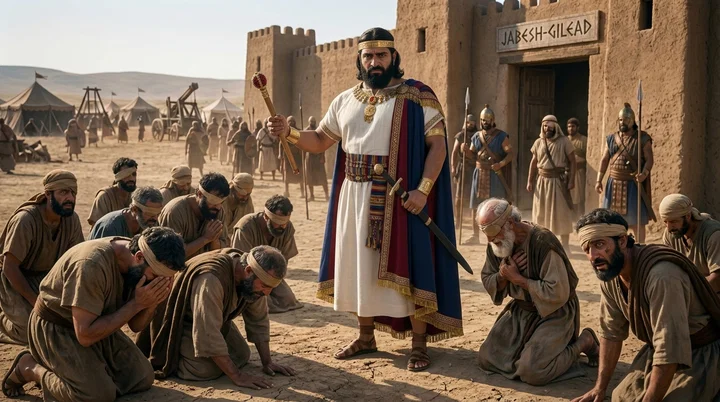
Soon after Saul was chosen king, Nahash the king of the Ammonites invaded the disputed territory east of the Jordan and threatened Jabesh-gilead, a large and powerful city.ST Jul 27, 1882 The inhabitants sought to secure peace by offering to become tributary to the Ammonites.PP 612.2–4ST Jul 27, 1882 Nahash was barbarous and cruel, and he refused to spare them except on condition of thrusting out the right eye of every inhabitant.PP 612.2–4ST Jul 27, 1882 The mutilation was meant to leave its victims as lasting living monuments and witnesses to his power, and to lay reproach upon all Israel.PP 612.2–4ST Jul 27, 1882
The victory at Jabesh-gilead over this threat displayed Saul's energy and military skill, yet Saul was only the agent by whom the Lord wrought Israel's deliverance.ST Aug 10, 1882 The whole nation extolled Saul for the victory and forgot God, and though Saul at first ascribed the glory to God, he afterward took the honor to himself.ST Aug 10, 1882 When first called to the throne Saul was humble and self-distrustful, but this success made him self-confident.ST Aug 10, 1882 That self-confidence prepared the way for his presumption and sacrilege in offering the unbidden sacrifice at Gilgal.ST Aug 10, 1882
Sources
Pioneers and periodicals
5 sources
Soon after Saul was chosen king, the Ammonite king invaded the disputed territory east of the Jordan and threatened the large and powerful city of Jabesh-gilead.ST Jul 27, 1882 The inhabitants tried to secure peace by offering to submit as tributaries, but Nahash in barbarous cruelty would make covenant only on condition of putting out every person's right eye, to leave them as enduring displays of his power.ST Jul 27, 1882 The verse stands in the account of Saul's favorable accession as king, when the Ammonite threat led him to summon Israel and defeat the Ammonites, though the demand to blind the right eye is left unexplained.ST Feb 19, 1885ST Oct 24, 1895 The counter-threat Saul issued in the chapter is a mark of cruelty and a clue to his character as king.ST Feb 19, 1885
The victory at Jabesh-gilead over Nahash's threat displayed Saul's energy and military skill, yet Saul was only the agent by whom the Lord worked Israel's deliverance.ST Aug 10, 1882 The whole nation praised Saul for the victory and forgot God, and though Saul at first gave God the glory he afterward took the honor to himself.ST Aug 10, 1882 Saul when first called to the throne was humble and self-distrustful, but this success made him self-confident and prepared the way for his presumption and sacrilege in offering the unauthorized sacrifice at Gilgal.ST Aug 10, 1882
The deliverance of Jabesh-gilead was a generous and unselfish kindness done forty years before Saul's death, and its memory endured past his death.ST Sep 16, 1889 When the Philistines had fastened the bodies of Saul and his sons to the wall at Beth-shan, the men of Jabesh-gilead in gratitude arose by night to remove them, carried them to Jabesh east of the Jordan, and burned them and buried the bones so no further indignity would be done to them.ST Sep 16, 1889 That lasting gratitude shows that helping others along their pathway scatters light whose influence continues long afterward.ST Sep 16, 1889
Sources