1 Samuel 17:1
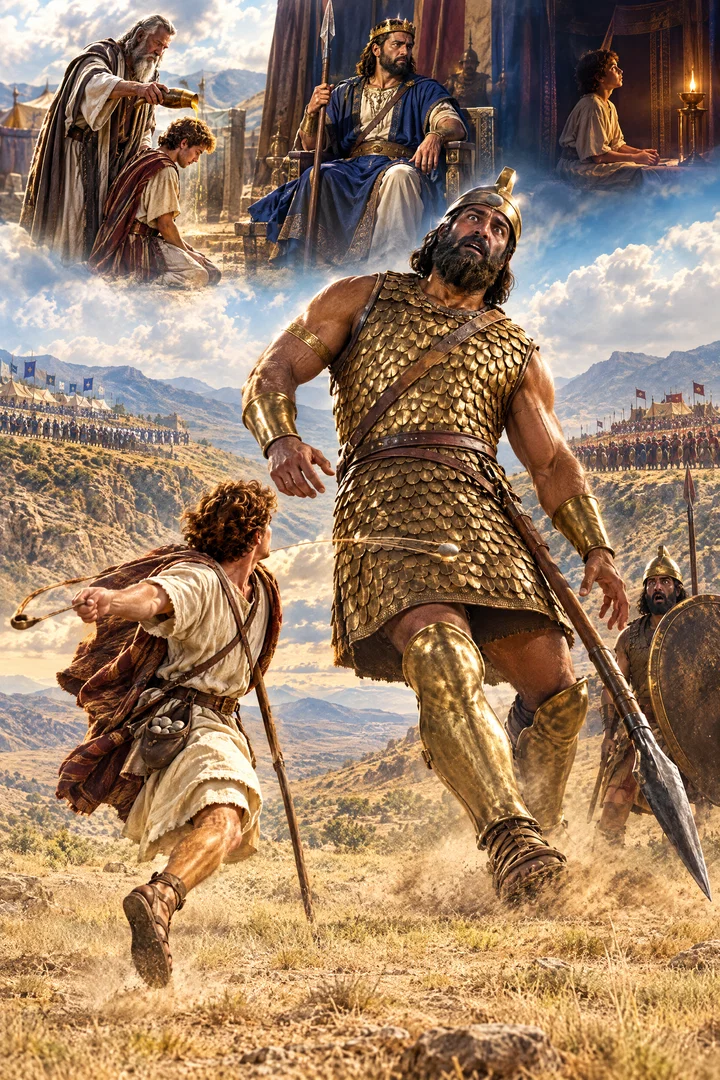
Now the Philistines gathered together their armies to battle, and were gathered together at Shochoh, which belongeth to Judah, and pitched between Shochoh and Azekah, in Ephes-dammim.
Translations
Now the Philistines gathered together their armies to battle, and were gathered together at Shochoh, which belongs to Judah, and pitched between Shochoh and Azekah, in Ephesdammim.
King James Version, KJV Cambridge Paragraph Bible
Now the Philistines gathered together their armies to battle, and were gathered together at Shochoh, which belongeth to Judah, and pitched between Shochoh and Azekah, in Ephes-dammim.
Now the Philistines collected their armies to battle, and were assembled at Shochoh, which belongeth to Judah, and encamped between Shochoh and Azekah, in Ephes-dammim.
Now the Philistines gathered together their armies to battle, and they were gathered together at Socoh, which belongeth to Judah, and pitched between Socoh and Azekah, in Ephes-dammim.
Now the Philistines gathered together their armies to battle; and they were gathered together at Socoh, which belongeth to Judah, and encamped between Socoh and Azekah, in Ephes-dammim.
And the Philistines gather their camps to battle, and are gathered to Shochoh, which [is] to Judah, and encamp between Shochoh and Azekah, in Ephes-Dammim;
And the Philistines assembled their armies to battle, and were gathered together at Sochoh, which belongs to Judah, and encamped between Sochoh and Azekah, in Ephesdammim.
And the Philistines gathered together their hosts, unto battle, and they were gathered together unto Socoh, which belongeth unto Judah,—and they encamped between Socoh and Azekah in Ephes-dammim;
Berean Standard Bible, Majority Standard Bible
Now the Philistines gathered their forces for war at Socoh in Judah, and they camped between Socoh and Azekah in Ephes-dammim.
Now the Philistines gathered together their armies to battle; and they were gathered together at Socoh, which belongs to Judah, and encamped between Socoh and Azekah in Ephesdammim.
Now the Philistines got their armies together for war, and came together at Socoh in the land of Judah, and took up their position between Socoh and Azekah in Ephes-dammim.
Nowe the Philistims gathered their armies to battell, and came together to Shochoh, which is in Iudah, and pitched betweene Shochoh and Azekah, in the coast of Dammim.
Douay-Rheims (Challoner revision)
Now the Philistines gathering together their troops to battle, assembled at Socho of Juda, and camped between Socho and Azeca in the borders of Dommim.
Pictures
Cross-references
- 1 Samuel 17:45-47
Then said David to the Philistine, Thou comest to me with a sword, and with a spear, and with a shield: but I come to thee in the name of the LORD of hosts, the God of the armies of Israel, whom thou hast defied.
David trusts God to save Israel and declares that the battle belongs to the Lord.
- 1 Samuel 17:16
And the Philistine drew near morning and evening, and presented himself forty days.
Goliath repeats his challenge for forty days.
- 1 Samuel 17:37
David said moreover, The LORD that delivered me out of the paw of the lion, and out of the paw of the bear, he will deliver me out of the hand of this Philistine. And Saul said unto David, Go, and the LORD be with thee.
David trusts the Lord to deliver him from the Philistine as from the lion and bear.
- 1 Samuel 17:10-11
And the Philistine said, I defy the armies of Israel this day; give me a man, that we may fight together.
Goliath’s challenge defies Israel and leaves Saul and the army greatly afraid.
- 1 Samuel 17:50-51
So David prevailed over the Philistine with a sling and with a stone, and smote the Philistine, and slew him; but there was no sword in the hand of David.
David defeats Goliath, causing the Philistines to flee.
- 1 Samuel 17:17-18
And Jesse said unto David his son, Take now for thy brethren an ephah of this parched corn, and these ten loaves, and run to the camp to thy brethren;
David bringing food to brothers
- 1 Samuel 17:26
And David spake to the men that stood by him, saying, What shall be done to the man that killeth this Philistine, and taketh away the reproach from Israel? for who is this uncircumcised Philistine, that he should defy the armies of the living God?
David calls Goliath’s challenge defiance of the living God’s armies.
- 1 Samuel 17:13-14
And the three eldest sons of Jesse went and followed Saul to the battle: and the names of his three sons that went to the battle were Eliab the firstborn, and next unto him Abinadab, and the third Shammah.
names the three sons in Saul's army while David stayed home
- 1 Samuel 17:20
And David rose up early in the morning, and left the sheep with a keeper, and took, and went, as Jesse had commanded him; and he came to the trench, as the host was going forth to the fight, and shouted for the battle.
quotes the hosts shouting for battle at David's arrival
- 1 Samuel 17:39
And David girded his sword upon his armour, and he assayed to go; for he had not proved it. And David said unto Saul, I cannot go with these; for I have not proved them. And David put them off him.
David lays aside Saul’s armor because he has not proved it.
Commentary
Each commentary is drawn from primary sources: the writings of Ellen G. White and Adventist pioneers and periodicals. Each commentary is separate. Its own words are not a quotation; follow the references to read the source passages.
Ellen G. White
4 sources
The verse opens a renewed war between Israel under Saul and the Philistines, with army drawn up against army and Israel in peril.PP 644.4–645.11SP 370.1–3SG4 79.2–80.2 The Philistine armies gathered in territory belonging to Judah and camped between Shochoh and Azekah at Ephes-dammim.1SP 370.1–3SG4 79.2–80.2 Israel's transgressions had weakened its trust in God and left the people without the courage to fight in his name.1SP 370.1–3SG4 79.2–80.2 Saul was afraid and had no confidence that God would give special help, leaving the army paralyzed.1SP 370.1–3SG4 79.2–80.2
The Philistines challenged Israel to single combat through the champion Goliath, whose insulting and defiant language filled all Israel with fear.PP 644.4–645.11SP 370.1–3SG4 79.2–80.2 It was the champion's size and strength that terrified the army.SG4 79.2–80.2 His defiance was hurled day after day for forty days.PP 644.4–645.1SG4 79.2–80.2
Three of Jesse's sons had joined Saul's army while David remained at home.PP 644.4–645.1 David afterward came to Saul's camp at his father's direction to carry a message and a gift to his elder brothers and to learn whether they were safe and well, but unknown to his father he had a higher mission under an angel's direction to save his people.PP 644.4–645.1 God would deliver Israel through David rather than through Saul.1SP 370.1–3SG4 79.2–80.2 David was the one God had raised up to rule his people.SG4 79.2–80.2
David was stirred with zeal to preserve the honor of the living God and the credit of his people.PP 644.4–645.1 The account contrasts Goliath's boastful confidence and reliance on his armor with David's humility and trust in God.3T 219.2 Ministers therefore should not provoke debate and then rely on prepared arguments, but should trust God to give truth the victory.3T 219.2
Sources
Pioneers and periodicals
15 sources
The verse places the Philistine armies encamped at Shochoh, which belongs to Judah, pitched between Shochoh and Azekah at Ephes-dammim, in a valley a few miles from Jerusalem.ST Mar 4, 1886ST Aug 26, 1889RH Dec 3, 1867 It opens a familiar war of the Philistines against Israel, whose new and decisive feature was the champion Goliath standing forth to defy the armies of the living God daily for forty days, leaving Israel dismayed and afraid.ST Mar 14, 1906ST Aug 26, 1889ST Aug 25, 1909 Into that setting came young David from Bethlehem, sent by his father with parched corn and loaves for his three eldest brothers and a present for their captain, and there he saw the giant and heard the defiance.ST Mar 14, 1906 The account leads to David's triumph as champion and to the larger contrast between Saul's rashness, weakness, failure and rejection and David's choosing and ever-rising career.ST Apr 11, 1911ST David had to venture in faith, forgetting self to honor God and defend His name, trusting God to make His strength effective in human weakness, and his facing of that proud, boastful enemy shows the hostility to be expected by those loyal to God and the victory they may gain as they clearly see the devil as a real, personal enemy and press on relying on Jesus, though the match is so unequal.ST Mar 4, 1886ST Dec 20, 1910RH Nov 28, 1871ST Sep 17, 1896RH Dec 3, 1867
Setting and Story
The Philistines gathered their armies for battle at Shochoh, which belongs to Judah, and pitched between Shochoh and Azekah at Ephes-dammim.ST Mar 4, 1886ST Aug 26, 1889RH Dec 3, 1867 That encampment lay in a valley a few miles from Jerusalem, the ground where David would later see the giant striding across the valley.ST Mar 4, 1886ST Aug 26, 1889RH Dec 3, 1867 The assembled armies of Israel and the Philistines there provide the setting for David's encounter with Goliath.ST Mar 4, 1886
The gathering was a familiar and unsurprising conflict, one more episode in the Philistines' long enmity against Israel.ST Mar 14, 1906ST Aug 26, 1889 It shows the influence of surrounding nations upon Israel and throws light upon the habits and customs of the people, while God's providence was shaping and molding national events and still remembering the promised Seed.ST Apr 11, 1911 After favor was removed from Saul, Israel had lost courage and was afraid when the Philistine army assembled.ST Aug 26, 1889
The new element in this war was the Philistine champion Goliath standing among them to defy the armies of the living God, his height and spear marking his imposing challenge.ST Mar 14, 1906ST Aug 25, 1909 He defied the men of Israel daily, leaving them dismayed and afraid, and his defiant speech was repeated to the army for forty days.ST Mar 14, 1906 Into this setting came the young man David from his Bethlehem home, sent by his father to bring parched corn and loaves to his three eldest brothers serving as soldiers, with a present for their captain, and there he saw the giant and heard the defiance.ST Mar 14, 1906
The verse begins the account of the Philistine war that leads to Goliath's challenge and David's triumph over him as champion taking the leading part in the victory.ST Apr 11, 1911ST It belongs to the larger contrast between Saul's rashness, weakness, failure, rejection and ever-downward course and David's choosing and ever-rising career.ST Apr 11, 1911 David in this story shows a noble spirit totally unlike Saul's rashness. Saul was physically a giant but lacked bravery, making him small in spirit compared with the youthful David, for true greatness depends on courage and spirit, not bodily size.RH Mar 2, 1905
David's victory over the Philistines and his service to Israel made Saul fear that David was the man God had chosen to take his place as king.ST Sep 20, 1883 The triumph caused the people to meet the returning conquerors with songs and dancing ascribing thousands to Saul and ten thousands to David, giving David greater praise than Saul over the results of the battle.ST Nov 28, 1895 That greater praise made Saul look on David with a jealous eye and began the fierce, unreasoning hatred that followed David at court.ST Nov 28, 1895 Joined to that jealousy was the beginning of the friendship between David and Jonathan, who later defended him.ST Nov 28, 1895 The battle stood some time, perhaps a year, before Saul's open declaration to take David's life.ST Nov 28, 1895
Faith Lessons for Believers
David had to venture in faith when he went out to slay Goliath.ST Sep 17, 1896 His facing of a proud, boastful enemy shows the hostility to be expected by those who are loyal to God and keep His commandments.ST Mar 4, 1886ST Dec 20, 1910 This includes those who defend the truth of the Bible and the seventh-day Sabbath.ST Dec 20, 1910
Like David they must forget self and seek to honor God and to defend His name and truth.ST Mar 4, 1886ST Dec 20, 1910 They must trust God to make His strength effective in human weakness and to bring their efforts to success.ST Mar 4, 1886ST Dec 20, 1910 Success belongs to God and not to human ability, and prosperity can foster pride.ST Dec 20, 1910 The giant stands for an enemy that God's workers can overcome as they press on relying on Jesus, and David's victory illustrates their courage in carrying out their work.ST Dec 20, 1910RH Nov 28, 1871 Christ's coming into the fallen world and enduring Satan's attacks shows how people can overcome.ST Dec 20, 1910
As David clearly saw the giant striding across the valley, so the first work in fighting the Devil is to see him clearly as a real, personal enemy.RH Dec 3, 1867 Nothing is more needed for the battle than open eyes to the Traducer at work on every side.RH Dec 3, 1867 David and Goliath were an unequal match, so unequal that the angel who binds Satan and Satan himself are less unequally matched by comparison.RH Dec 31, 1901
Sources