1 Samuel 17:40
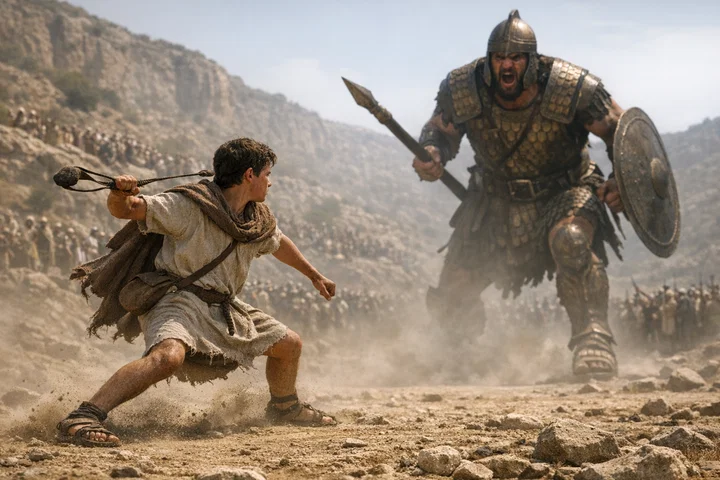
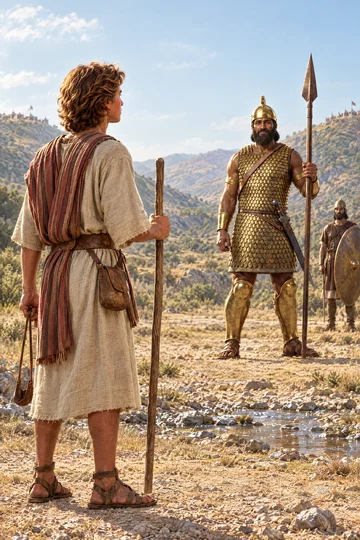
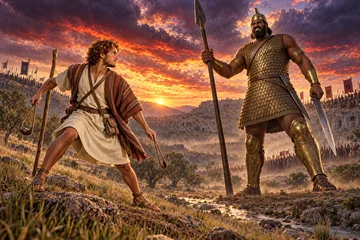
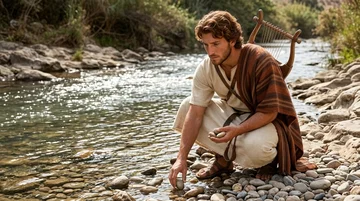
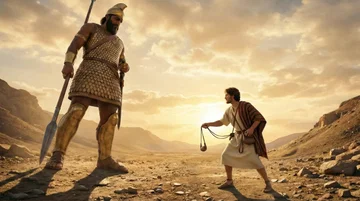
And he took his staff in his hand, and chose him five smooth stones out of the brook, and put them in a shepherd’s bag which he had, even in a scrip; and his sling was in his hand: and he drew near to the Philistine.
Translations
And he took his staff in his hand, and chose him five smooth stones out of the brook, and put them in a shepherd’s bag which he had, even in a money; and his sling was in his hand: and he drew near to the Philistine.
King James Version, KJV Cambridge Paragraph Bible
And he took his staff in his hand, and chose him five smooth stones out of the brook, and put them in a shepherd’s bag which he had, even in a scrip; and his sling was in his hand: and he drew near to the Philistine.
And he took his staff in his hand, and chose him five smooth stones out of the brook, and put them in a shepherd's bag which he had, even in a scrip; and his sling was in his hand; and he drew near to the Philistine.
And he took his staff in his hand, and chose him five smooth stones out of the brook, and put them in the shepherd’s bag which he had, even in his scrip; and his sling was in his hand: and he drew near to the Philistine.
And he took his staff in his hand, and chose him five smooth stones out of the brook, and put them in the shepherd’s bag which he had, even in his wallet; and his sling was in his hand: and he drew near to the Philistine.
And he taketh his staff in his hand, and chooseth for him five smooth stones from the brook, and putteth them in the shepherds' habiliments that he hath, even in the scrip, and his sling [is] in his hand, and he draweth nigh unto the Philistine.
And he took his staff in his hand, and chose him five smooth stones out of the brook, and put them in the shepherd's bag that he had, into the pocket; and his sling was in his hand. And he drew near to the Philistine.
Then took he his stick in his hand, and chose him five smooth stones out of the torrent-bed, and put them in the shepherd’s-pouch which he had—even in the wallet, and had his sling in his hand,—and so drew near unto the Philistine.
Berean Standard Bible, Majority Standard Bible
And David took his staff in his hand, selected five smooth stones from the brook, and put them in the pouch of his shepherd’s bag. And with his sling in hand, he approached the Philistine.
He took his staff in his hand, and chose for himself five smooth stones out of the brook, and put them in the pouch of his shepherd’s bag which he had. His sling was in his hand; and he came near to the Philistine.
Then he took his stick in his hand, and got five smooth stones from the bed of the stream and put them in a bag such as is used by sheep-keepers; and in his hand was a leather band used for sending stones: and so he went in the direction of the Philistine.
Then tooke he his staffe in his hand, and chose him fiue smoothe stones out of a brooke, and put them in his shepheards bagge or skrippe, and his sling was in his hand, and he drewe neere to the Philistim.
Douay-Rheims (Challoner revision)
And he took his staff, which he had always in his hands: and chose him five smooth stones out of the brook, and put them into the shepherd’s scrip, which he had with him, and he took a sling in his hand, and went forth against the Philistine.
Pictures


Cross-references
- 1 Samuel 17:45-47
Then said David to the Philistine, Thou comest to me with a sword, and with a spear, and with a shield: but I come to thee in the name of the LORD of hosts, the God of the armies of Israel, whom thou hast defied.
David trusts in the Lord’s name and declares that the battle belongs to the Lord.
- 1 Samuel 17:49-50
And David put his hand in his bag, and took thence a stone, and slang it, and smote the Philistine in his forehead, that the stone sunk into his forehead; and he fell upon his face to the earth.
David uses a sling and stone to strike down and defeat Goliath.
- 1 Samuel 17:47
And all this assembly shall know that the LORD saveth not with sword and spear: for the battle is the LORD’s, and he will give you into our hands.
David trusts the Lord to win the battle, not human weapons.
- 1 Samuel 18:7
And the women answered one another as they played, and said, Saul hath slain his thousands, and David his ten thousands.
The song after the battle praises David above Saul.
- 1 Samuel 17:50
So David prevailed over the Philistine with a sling and with a stone, and smote the Philistine, and slew him; but there was no sword in the hand of David.
David defeats Goliath with his sling and a stone.
- 1 Samuel 17:10
And the Philistine said, I defy the armies of Israel this day; give me a man, that we may fight together.
Goliath defies Israel and demands a man to fight him.
- 1 Samuel 17:36
Thy servant slew both the lion and the bear: and this uncircumcised Philistine shall be as one of them, seeing he hath defied the armies of the living God.
David compares Goliath to the lion and bear he had already defeated.
- 1 Samuel 17:26
And David spake to the men that stood by him, saying, What shall be done to the man that killeth this Philistine, and taketh away the reproach from Israel? for who is this uncircumcised Philistine, that he should defy the armies of the living God?
David is stirred by Goliath’s defiance of Israel and the living God.
- 1 Samuel 16:18
Then answered one of the servants, and said, Behold, I have seen a son of Jesse the Beth-lehemite, that is cunning in playing, and a mighty valiant man, and a man of war, and prudent in matters, and a comely person, and the LORD is with him.
The passage notes David’s reputation as a mighty and valiant man.
Commentary
Each commentary is drawn from primary sources: the writings of Ellen G. White and Adventist pioneers and periodicals. Each commentary is separate. Its own words are not a quotation; follow the references to read the source passages.
Ellen G. White
13 sources
David laid aside the king's heavy armor because it was untried and unusable to him, and went to meet the giant with only the shepherd's tools he knew — staff in hand, sling ready, and five smooth stones he had picked from the stream bed carried in his bag.PP 646.4–647.11SP 370.1–33T 219.2SG4 80.3–82.1 He drew near to the Philistine on a mission given by God to rescue Israel and vindicate the honor of the living God against defiance.PP 644.4–645.1PP 656.2 His confidence rested not in weapons, strength, or appearance, but in the Lord who had proved faithful in past deliverances and would give the victory.1SP 370.1–3SG4 80.3–82.1GW92 187.1–188.2 The heavy armor stands for reliance on human arguments and self-display, while the sling and stones stand for humble faith that hides self in God, so those who defend truth must not provoke boastful dispute but present truth in meekness under the Holy Spirit.3T 219.2Lt 31d, 1895, par. 2–3 No one can succeed by sinking his individuality in another or copying another's character and methods, but each must serve in the place God designed, using his own God-given ability and judgment.Ms 116, 1898, par. 12–1418MR 4.1–420MR 245.1–2Ms 116, 1898, par. 6–9
David Faces Goliath
David laid aside Saul's heavy armor because he had not proved it and could not wear it.PP 646.4–647.11SP 370.1–3GW92 187.1–188.23T 218.2–219.1Ms 116, 1898, par. 12–14 He refused to go in untried armor rather than in what he knew.PP 646.4–647.11SP 370.1–3SG4 80.3–82.1GW92 187.1–188.23T 218.2–219.1 He went out to meet Goliath with the gear he had chosen and understood, his staff in his hand, his shepherd's bag, even a scrip, his sling in his hand, and five smooth stones he had chosen out of the brook.PP 646.4–647.11SP 370.1–33T 219.2SG4 80.3–82.1GW92 187.1–188.2 With these he drew near to the Philistine.PP 646.4–647.11SP 370.1–33T 219.2SG4 80.3–82.13T 218.2–219.1
This meeting belonged to his divinely directed mission to save Israel.PP 644.4–645.1 When he came to the army, Goliath's repeated challenge stirred him to defend the honor of the living God and His people.PP 644.4–645.1 He defeated Goliath through faith in God, and that victory afterward made him known to the Philistines as the man who had slain their champion.PP 656.2
Faith Over Human Strength
David laid aside Saul's armor and went to meet Goliath with only his staff, his sling, and five smooth stones chosen out of the brook, because his confidence was not in impressive weapons, human strength, or outward appearance but in the Lord to give Israel the victory.1SP 370.1–3SG4 80.3–82.13T 218.2–219.1 He had not tested the armor and refused to wear it, lest any should credit it for the victory, for his trust was in God whom he had proved through earlier victories.GW92 187.1–188.23T 218.2–219.1 He went forth not in armor and human strength but in the name of the God of Israel.1SP 370.1–3GW92 187.1–188.2
Saul's armor stands for prepared human arguments, while David's simple staff, sling, and stones stand for humble faith that makes God its strength and hides behind Jesus.3T 219.2 Ministers are therefore not to defy and provoke discussion after the manner of Goliath, going forth confident and boastful and magnifying themselves, for defying belongs on the side of opposers of truth.3T 219.2 Those who trust their arguments instead of humbling their hearts in faith become elated, lose their balance, fail in discussion, and injure their own souls and the souls of others.3T 219.2
No person can sink his individuality in that of another or succeed by patterning after another man's character, but each must work with his own God-given ability in the place God designed for him, as David with the familiar sling and stone slew the Philistine who defied Israel.18MR 4.1–4 A life consecrated to God is developed and beautified in its own individuality, with each person grafted into one stock in unity in diversity to act the part God assigns.Ms 116, 1898, par. 12–14 All characters are to be fashioned after the Lord's ideal under the molding of the Holy Spirit and not after man's pattern, striving for the fragrance of Christ's character.Ms 116, 1898, par. 12–14 No one is at liberty to demerit and belittle God's workmanship because a fellow worker does not bear his likeness, nor to impose another person's methods upon a fellow worker, but each should use the abilities and judgment God has given.Ms 116, 1898, par. 12–1420MR 245.1–2
No intelligent human being is to lean upon man and make flesh his arm by refusing to impart instruction unless he first learns another's mind, by becoming the transcript of another man's mind, or by voicing another man's sentiments.Ms 116, 1898, par. 6–9 Each person is to lean upon God, breathe out his soul to God, and act in his own capacity according to the ability God has given him, trading with conscientious fidelity upon his own talents.Ms 116, 1898, par. 6–9 The man who seeks to pattern after any man's character will make an utter failure.Ms 116, 1898, par. 6–9
David's small pebbles are the truth used against a proud and boastful opponent like Goliath who defies God's people with falsehood and misrepresenting assertions, and such humble truth brings the opponent's defeat and makes his weakness apparent.Lt 31d, 1895, par. 2–3 Victory in defense of Sabbath truth comes not by sharpness and severity but by presenting the truth with dignity under the guidance of the Holy Spirit, with special prayer and without loss of temper.Lt 31d, 1895, par. 2–3 Such a course leaves a right impression that causes many to favor the truth.Lt 31d, 1895, par. 2–3
Sources
Pioneers and periodicals
47 sources
David took his shepherd's staff in his hand, chose five smooth stones suited for accurate throwing out of the brook, put them in his small leather shepherd's bag or scrip, took his sling in his hand, and drew near to the Philistine as a brave young man and not a little boy.ST Nov 21, 1895 He went out with the familiar tools of a shepherd and refused Saul's armor and sword because they were unfamiliar, untried and untested to him.ST Mar 4, 1886ST Dec 20, 1910ST Aug 26, 1889 His assurance came from confidence in the Lord who had delivered him from the lion and the bear, trusting Israel's God rather than his own skill or strength or fearing the giant, for the battle belonged to the Lord.ST Mar 4, 1886ST Dec 12, 1895RH Sep 30, 1858 God uses plain and simple means to accomplish what human strength and impressive equipment cannot, enabling Christians to trust Him rather than human resources even when what they offer seems small and insignificant.ST Oct 4, 1883RH Apr 2, 1861RH Apr 28, 1874ST Jul 23, 1912 The stones and sling are God's eternal truth and scriptural weapons, which His loyal little band use in His strength alone to defend His Sabbath and uphold His word against boastful learned opposition, without taking Saul's armor of the state's weapons and civil power.ST Mar 4, 1886ST Dec 20, 1910ST Jun 7, 1905RH Jul 1, 1862RH Sep 2, 1852
Stones, Sling, and Staff
David took his staff in his hand and chose five smooth stones out of the brook, put them in his shepherd's bag, even his scrip, with his sling in his hand, and drew near to the Philistine. The scene presents him as a young man going out to confront the giant, not as a little boy.
What he took was his ordinary shepherd's crook.ST Nov 21, 1895 He chose smooth stones because they were best suited for accurate throwing.ST Nov 21, 1895 He put them in a small leather wallet, or scrip, of the kind used for carrying food and small articles.ST Nov 21, 1895 He went out with these familiar tools of a shepherd — staff and sling with stones chosen from the brook — rather than with Saul's armor and sword.ST Mar 4, 1886ST Dec 20, 1910ST Aug 26, 1889 That armor and sword were unfamiliar, untried and untested to him, and he could not use them because he was unused to them and had not tested them.ST Mar 4, 1886ST Dec 20, 1910ST Aug 26, 1889
Place in David's Story
The choosing of the stones belongs to David's victory over the Philistines that made him distinguished and brought him into eminent service to Israel, and that success led Saul to recognize David as the man God had chosen to take his place as king.ST Sep 20, 1883 It belongs to the account of David's choosing and his checkered but ever-rising career set against Saul's rashness, weakness, failure, rejection, and ever-downward course.ST Apr 11, 1911 That contrast shows God's providence shaping and molding national events while still remembering the promised Seed, with incidents that throw light on the habits and customs of the people and the influence of surrounding nations upon them.ST Apr 11, 1911
The youthful David preparing to face the Philistine with the simple tools of a shepherd shows a bravery that Saul, though physically large, lacks.RH Mar 2, 1905 He faces Goliath not with the giant's size or loud, boastful manner.ST Dec 2, 1913 Goliath stands as the supreme example of haughtiness and scornful, arrogant chiding.RH Apr 15, 1873 His imposing appearance and angry boasting frightened Israel, but they could not prevail against the young shepherd's sling.ST Dec 2, 1913
The Goliath episode presents a great, visible enemy in contrast to subtle deceptions that quietly harm, whose danger may be less obvious than a giant enemy at the door.RH Nov 16, 1916 In his apparent strength and temporary success the giant pictures enemies who ridicule and oppose God's truth.ST Mar 4, 1886 Their triumph does not last, and they ultimately fall into the ruin they intended for others.ST Mar 4, 1886
The battle in which David slew Goliath and acted a leading part took place about a year before the secret meeting of David and Jonathan at the rock Ezel.ST Nov 28, 1895 After that slaying Saul kept David permanently at his court at Gibeah, where David behaved wisely and gained the friendship of the people.ST Nov 28, 1895 The people's song over the results of the battle ascribed greater praise to David than to Saul, and Jonathan's friendship with David was sealed.ST Nov 28, 1895
Trusting God Alone
David went to meet Goliath with staff, sling, and stones, and his assurance in the conflict came from confidence in the Lord, whose power he knew.ST Mar 4, 1886ST Dec 12, 1895 He trusted in Israel's God rather than fearing the strength of a giant, because God had delivered him from the lion and the bear.ST Mar 4, 1886RH Sep 30, 1858 He went with a staff and sling rather than Saul's armor and sword, which he could not use because he had not tested them.ST Mar 4, 1886
He did not rely on his own skill or strength.ST Mar 4, 1886 His humble courage was directed toward defending Israel and honoring God.ST Mar 4, 1886 His victory served to humble God's adversaries and to show that the battle belonged to the Lord.ST Mar 4, 1886
His faith made him a stronger force than the larger, better-equipped army around him whose soldiers were afraid.ST Jan 1, 1885 The simple weapons of sling and stones stand in contrast to the armor and weapons of the fearful men around him.ST Jan 1, 1885 With God's Spirit he could rout the Philistines with his sling, while Israel's unconsecrated and fearful army, despite its show of strength, could do nothing.RH Dec 20, 1870
Faith connects people with God's strength, so believers can answer the boldest defiance of unbelief and sin by trusting God even when they cannot understand how He will act.ST Aug 26, 1889 As God opened a way for David with ordinary shepherd's tools rather than human power, He opens a way for those who believe.ST Aug 26, 1889 Living faith joins human weakness to God's power and enables believers, though weak by human measure, to overcome formidable obstacles on the way to the heavenly country.ST Sep 3, 1896
His venturing in faith to slay Goliath belongs with the deeds of valor done through God by persons of faith who asked for great things and ventured much.ST Sep 17, 1896 Numbers and outward strength do not determine who is right or who will prevail, for a young shepherd with simple equipment went out against Goliath and a small minority can stand firm when God is on its side.ST Jul 14, 1887 Going alone to face Goliath is an example of a believer standing alone in faith and courage, yet not truly alone.
His faith did not mean waiting passively for God to act, but taking practical means into battle — staff, stones, shepherd's bag, and sling — and trusting God to bless them.ST Feb 18, 1886 His victory followed a habit of obeying God formed while protecting his father's sheep from a lion and a bear. Those trained in humble work among the sheep, going forward with the simple tools of a shepherd, are thus prepared for future challenges.RH Mar 10, 1903 People should practice obedience in the tasks God gives them now, so they can trust and obey Him in greater trials.
Weak Means, Great Victory
David set aside armor and went against the giant with sling and stone, showing that God can use simple means to accomplish what human strength and impressive equipment cannot.ST Oct 4, 1883RH Apr 28, 1874 Giants are not overcome by human display or elaborate equipment, but by trusting and using what is plain and sufficient, as in proclaiming the plain gospel rather than relying on eloquence.ST Oct 4, 1883RH Apr 28, 1874 His approaching with only sling and stones shows that God enabled him to accept the challenge despite lack of weapons, teaching Christians to trust God rather than human strength or resources.RH Apr 2, 1861 An ordinary smooth stone taken from a brook seems small and insignificant, yet God can use whatever a person offers in His service.ST Jul 23, 1912
He did not need to master the giant's methods of fighting but needed only to use his stone and sling, which he knew how to use effectively, illustrating that God's work can be accomplished through simple means rather than through mastery of an opponent's tactics.ST Oct 10, 1900 The battle of a shepherd's staff and sling against an armed giant means victory through weak and unlikely means against overwhelming armed power.RH Dec 1, 1874 That pattern was repeated when sluggish Spain, with old energies melted away and the last country Europe could have looked to for defiance of the universal conqueror, defied France.RH Dec 1, 1874 England, irresistible on one element, was summoned to begin a new career of triumph and was led step by step to first place of glory on another, bringing with unexpected means and rapid success the deliverance and restoration of Europe, the taking of the monarch of its monarchs as prisoner, and the scattering of the mighty fabric of the French Atheistic Empire with all its malignant pomps and ministers of evil.RH Dec 1, 1874
Defending Present Truth
The smooth stones taken from the brook and the sling that throws them are God's eternal truth, scriptural weapons prepared by God Himself for the defense of the Sabbath truth against opposing arguments.RH Jul 1, 1862RH Sep 2, 1852 Young, inexperienced preachers take up those weapons in the strength of God when they meet more experienced opponents.RH Jul 1, 1862 The pebble and the sling backed by the prayer of faith is the true weapon for meeting the adversary, while Saul's armor is unwieldy and faithless.RH Jan 3, 1907 To spurn simple trust in the Word of God for human strength leaves preaching powerless, breeds doubt of the Word, and empties the church.RH Jan 3, 1907
God's truth upheld by apparent weakness overcomes boastful strength.RH Apr 9, 1872 The opposition is as the Philistine army, jubilant and certain of victory behind a defiant champion like Goliath who trusts in learning and boasting, while God's Sabbath people are as David with weak means.RH Apr 9, 1872 When that champion falls and the absurdity and weakness of his cause are exposed, the triumph of his supporters gives place to wrath, proving the strength and impregnability of truth and that God has chosen weak things to confound the mighty.RH Apr 9, 1872 Laying aside Saul's armor and going out in the strength of Jehovah alone teaches that God's people must fight the battles of the Lord without Saul's armor.ST Jun 7, 1905 A church walking in obedience to God's laws needs no weapons of the state to carry on its work and no man-made armor to shield it from the weapons of its adversary, so to call for Sunday laws and rely on civil power to enforce worship is to go forth clad in Saul's armor and bearing his weapons instead of trusting in God alone.ST Jun 7, 1905
Going with only a staff in hand and a sling and five smooth stones from the brook in a shepherd's bag pictures God's loyal little band who keep all His commandments.ST Mar 4, 1886ST Dec 20, 1910 Many of them are uneducated and never graduated from college, yet with the Bible in hand they stand in defense of God's truth and vindicate His Sabbath trodden beneath lawless feet against proud, boastful, learned men who despise them as Goliath despised David.ST Mar 4, 1886ST Dec 20, 1910 Success comes not by college learning, human armor, or superior ability, but when weak men forget self and seek to honor God and vindicate His name and truth, God makes His strength perfect in their weakness, works mightily with them, and crowns their efforts with success.ST Mar 4, 1886ST Dec 20, 1910 Those who take the glory to themselves become proud and self-sufficient, and prosperity proves their ruin.ST Dec 20, 1910 David's victory in God's name with a shepherd's sling and a few stones pictures the church confronting the giant evil of Romanism with the word of God, and those who cling to God's word can stand against that system of error.ST Feb 19, 1894
Living David's Courage
The account calls young people to become faithful workers for the Lord by taking a humble part in a great struggle instead of waiting for some grand achievement.ST Aug 27, 1896RH Apr 4, 1912 Refusing Saul's untried armor and going out with only a sling and a few stones, David met and killed the mighty champion of the Philistines, and that killing became the signal for a united attack by Israel while the enemy fled in confusion at seeing their leader dead.ST Mar 14, 1906 The lions and bears and giant he killed picture enemies just as formidable facing youth now, such as bad companions, bad books, and intemperance, which must be met and conquered.ST Mar 14, 1906
His victory as a boy and young man is an example to inspire higher ambitions and greater efforts, even though his later greater trials as companion of the king, leader in the army, and king of Israel brought temptations he did not always meet and marred his life record with mistakes and sins, yet his heart was perfect and he was a man after God's own heart.ST Mar 14, 1906 His faith-filled act as a shepherd and son of Jesse brought victory and planted courage among Israel's fearful soldiers, showing that one brave deed produces consequences far greater than might have been expected.ST Jun 7, 1910 God can use humble workers with small and simple means to battle Satan's hosts and rescue perishing souls when they keep humble and maintain a close walk with God in complete unity.RH Sep 17, 1872
No one should refuse to work because he cannot wield a large sword, and in the fast-ripening harvest fields more Davids are needed who will offer their lives for the cause, with victory in the last struggle ending in singing praise to the great Deliverer.RH Sep 17, 1872 Like David with smooth stones from a brook, Bible colporteurs with few resources go ahead of missionaries and prepare the way for later missionary work.RH Mar 30, 1905 Workers reliant on Jesus are chartered as His Davids to slay even the mightiest Philistine giant, so they must press on and keep working though the enemy's laughter sweeps over the valleys, knowing God's patient workers will laugh hereafter when the enemies weep.RH Nov 28, 1871
Going to meet the Philistine with his own equipment rather than Saul's armor shows that a distinct work needs equipment suited to its purpose, as Loma Linda's medical school could not fulfill its mission using only the equipment adequate for other training schools. Going into battle without Saul's heavy armor to carry no encumbering weight and rely on God's protection teaches those fighting sin to lay aside every weight and depend on the Spirit for protection.RH Dec 17, 1901 Approaching with a shepherd's staff, sling, and stones rather than a warrior's weapons like Goliath's great sword, with God to direct him, supplies the image for describing a seemingly outmatched opponent as Goliath and his defeat as victory.RH Sep 17, 1872RH Jan 29, 1867 The same image marks something opponents dismiss as unimportant, and portrays Germany as Goliath against Samoa as a small child without a sling or stone.RH Sep 4, 1860ST Feb 4, 1889
Sources