2 Kings 6:2
Let us go, we pray thee, unto Jordan, and take thence every man a beam, and let us make us a place there, where we may dwell. And he answered, Go ye.
Translations
Let us go, we pray you, to Jordan, and take there every man a beam, and let us make us a place there, where we may dwell. And he answered, Go you.
King James Version, KJV Cambridge Paragraph Bible, Revised Version
Let us go, we pray thee, unto Jordan, and take thence every man a beam, and let us make us a place there, where we may dwell. And he answered, Go ye.
Let us go, we pray thee, to Jordan, and take thence every man a beam, and let us make us a place there, where we may dwell. And he answered, Go ye.
Let us go, we pray thee, unto the Jordan, and take thence every man a beam, and let us make us a place there, where we may dwell. And he answered, Go ye.
let us go, we pray thee, unto the Jordan, and we take thence each one beam, and we make for ourselves there a place to dwell there;' and he saith, 'Go.'
Let us go, we pray thee, to the Jordan, and take thence every man a beam, and let us make us a place there, where we may dwell. And he said, Go.
Let us go, we pray thee, as far as the Jordan, and fetch from thence every man a single beam, and let us make us a place wherein we may sit. And he said—Go ye.
Berean Standard Bible, Majority Standard Bible
Please let us go to the Jordan, where each of us can get a log so we can build ourselves a place to live there.”“ Go,” said Elisha.
Please let us go to the Jordan, and each man take a beam from there, and let’s make us a place there, where we may live.”He answered, “ Go!”
So let us go to Jordan, and let everyone get to work cutting boards, and we will make a living-place for ourselves there. And he said to them, Go, then.
Let vs nowe goe to Iorden, that we may take thence euery man a beame, and make vs a place to dwell in. And he answered, Goe.
Douay-Rheims (Challoner revision)
Let us go as far as the Jordan and take out of the wood every man a piece of timber, that we may build us there a place to dwell in. And he said: Go.
Pictures
Commentary
Each commentary is drawn from primary sources: the writings of Ellen G. White and Adventist pioneers and periodicals. Each commentary is separate. Its own words are not a quotation; follow the references to read the source passages.
Ellen G. White
32 sources
The students found their lodging too small and asked to go to the Jordan where each man would cut a beam and all would build a larger dwelling together, and Elisha told them to go and went with them to encourage and guide the work.PK 260.3ED 217.1–26T 137.2–138.2 Their doing their own building work shows that practical manual labor to supply their needs is an honorable part of student life and training.ED 217.1–2RH Oct 3, 1912CE 61.1–3 Teachers and pupils shared together in that outdoor work, uniting physical labor with mental and spiritual instruction as the pattern for school training.Ms 195, 1903, par. 20–21Ms 2, 1902, par. 68MR 26.2 The schools of the prophets are thus the order and pattern for schools today, to be built up in many places in simple, humble form rather than concentrated in a few large centers.HCSSP 4.1–2RH Jul 2, 19086T 137.2–138.2Lt 104, 1897, par. 3Lt 83, 1897, par. 10 Their aim is to educate learners of all ages in Bible lines, combining physical, mental, and spiritual powers with the Word of God at the foundation, so that they become trustworthy, skillful workers who can teach and help others.HCSSP 35.1Lt 138, 1901, par. 14Lt 16, 1909, par. 74MR 110.1–3Ms 195, 1903, par. 20–21
The Proposal at Jordan
The place where the sons of the prophets lived had become too small for them, and as their community grew they needed expanded facilities for living together in an organized place of instruction.PK 260.36T 137.2–138.2Ms 14, 1894, par. 26Lt 28, 1909, par. 10Lt 93, 1892, par. 24–26 They proposed going to the Jordan and making a larger dwelling there where they could live together, and this planning illustrates the building up of schools modeled on the schools of the prophets.6T 137.2–138.2Ms 69, 1910, par. 5–6Ms 14, 1894, par. 26Lt 28, 1909, par. 10Lt 93, 1892, par. 24–26 Their proposal was for small, locally established communities rather than concentrating in one large center.6T 137.2–138.2Lt 161, 1901, par. 19–20
Their plan was that every man should take a beam from the Jordan, with all gathering timber and building together.PK 260.3ED 217.1–2RH Oct 3, 19126T 137.2–138.2Lt 161, 1901, par. 19–20 They went to the Jordan to cut beams and gather timber to build the place to live, taking part in practical, useful work as part of student life.ED 217.1–2RH Oct 3, 1912RP 26.2–48MR 26.2 This united manual labor in cutting beams and building the dwelling is the ancient pattern for joining physical work with school teaching.RP 26.2–48MR 26.2
Elisha approved the plan, told them to go, and gave them permission to go to the Jordan and build there.PK 260.3ED 217.1–26T 137.2–138.2Lt 28, 1909, par. 10Lt 161, 1901, par. 19–20 He went with them himself, encouraging and instructing them as they worked, with teachers and students uniting together in the labor.PK 260.3RP 26.2–48MR 26.2 When distress arose as they enlarged their dwelling, God helped them, showing that He is an ever-present helper in difficulty and trial.Lt 83, 1896, par. 23–25
Manual Labor in Training
The verse shows the students themselves taking part in practical, useful manual labor to provide their own dwelling, going to the Jordan to gather beams and build a place to live with the prophet's approval, and this honors ordinary labor as a fitting part of student life and training.ED 217.1–2RH Oct 3, 1912CE 61.1–3RP 26.2–4 Pupils in those prophetic schools sustained themselves by such labor, learning farming or a trade by which they could support themselves.RH Oct 3, 1912CE 61.1–3 Manual work in that setting was regarded as honorable rather than degrading.CE 61.1–3
Teachers and students united together in this manual work, combining physical work with mental instruction and training for practical life.Ms 195, 1903, par. 20–21Ms 2, 1902, par. 68MR 26.2 That going to Jordan to cut beams and build a dwelling is the ancient pattern for uniting agricultural and other physical work with school teaching, so that learning is joined with useful employment and students can study even while at the plough and engaged in practical work.Ms 195, 1903, par. 20–218MR 26.2 Publishing houses are to be the same kind of training schools for practical life and work.Ms 2, 1902, par. 6
That united outdoor work gives vigorous exercise in the open air that strengthens the muscles, encourages proper circulation of the blood, helps preserve the body from disease, gives the animal passions a healthy outlet and keeps them in proper bounds, and greatly helps spirituality.8MR 26.2 Such training formed men who were trustworthy, true to principle, and quick of understanding, skillful workmen who could teach others how to work.HCSSP 35.1Ms 2, 1902, par. 6 Apprentices and other workers trained in this way are not to be rushed and hurried with no time to pray, but are to be educated as those youth were educated, so they are prepared to take hold of the work in new places as the sons of the prophets sought to make a place to dwell by Jordan, and to serve others in Bible principles.Lt 138, 1901, par. 147T 147.4Ms 2, 1902, par. 6
Pattern for Present Schools
The schools of the prophets seen in the proposal to go to Jordan are the order and pattern for present schools, including church schools, Christian worker-training schools, conference schools, and training in publishing houses and institutions such as the Review and Herald office.HCSSP 4.1–2RH Jul 2, 19088T 230.1Lt 138, 1901, par. 14Ms 12, 1903, par. 2 Conference schools are to be conducted after that order on a high spiritual plane, and apprentices and other workers are not to be rushed and hurried with no time to pray but are to be educated as the youth in the schools of the prophets were educated so they are prepared to take hold of the work in new places.Lt 138, 1901, par. 144MR 110.1–3 Building schools modeled on them is part of the Lord's instruction and human prohibitions should not hinder that work, for the planning of a dwelling by the Jordan illustrates the building up of such schools.Lt 383, 1908, par. 3–4Ms 69, 1910, par. 5–6
The account supports establishing modest, small, locally established schools in many places rather than concentrating educational facilities in a few large centers, with teachers who are missionaries educating children in different localities.6T 137.2–138.2Lt 104, 1897, par. 3 Schools formed after that pattern are established in a simple style with humble buildings rather than in an elaborate way.Lt 83, 1897, par. 10 A true school after this order does not copy the plan of many schools in introducing worldly customs and ideas, does not give a worldly training, and does not require study of many things required by the world's schools.Lt 16, 1909, par. 7Ms 195, 1903, par. 20–21 It combines physical, mental, and spiritual powers, joins learning with useful employment so that students can study while at the plough and engaged in practical work, gives the study of the Bible a large place, lays God's Word at the foundation, has its precepts and principles prayerfully and daily studied, teaches facts and doctrines with a plain Thus saith the Lord every day, has students learn the lower steps before attempting advanced studies, and prepares teachers and students for the higher school in the heavenly courts.Lt 16, 1909, par. 74MR 110.1–3Ms 195, 1903, par. 20–21Ms 54, 1903, par. 21Lt 2, 1899, par. 48–49
Teachers in such schools are to be God-fearing, self-denying, consecrated missionaries and doers of the Word who commune with God and answer with It is written.HCSSP 4.1–2Lt 104, 1897, par. 3Lt 83, 1897, par. 10 Only a sufficient number of salaried teachers and instructors is to be kept, not a long list or too many, distributed according to need rather than concentrated disproportionately in one place while other places where the work is just as essential lack helpers and directors and watchmen and teachers.Lt 142, 1901, par. 2–8 The purpose is to educate children, youth, and older learners in Bible lines to understand the Word so they can teach others and do all-sided missionary work.8T 230.1Lt 192, 1899, par. 10Lt 2, 1899, par. 48–49 Students are prepared through connection with God and purification from sin, with every effort of attention fixed upon Jesus Christ and unseen things rather than letting visible things absorb the mind, and missionary work for the fallen, degraded, wounded, bruised, perishing and ready to perish is always connected with the school.Lt 28, 1898, par. 13Lt 83, 1897, par. 10Ms 14, 1894, par. 26 Success requires self-sacrificing, intelligent, devoted, interested effort by teachers and all connected with the school, with the help and cooperation of the churches under God's blessing and the Spirit of God resting in large measure upon teachers and students.Lt 192, 1899, par. 10Lt 28, 1898, par. 13
Sources
Pioneers and periodicals
18 sources
The sons of the prophets at Jericho under Elisha found their dwelling too small, so they asked leave to go to the Jordan where each man would take a beam and build a larger place to live, and Elisha answered Go ye and went with them.RH Mar 18, 1915RH Mar 18, 1915RH Nov 26, 1903 The plan meant the students themselves with their teachers would cut and carry their own timber and do their own building as practical work alongside their studies.ST Oct 22, 1894RH Nov 26, 1903 Their doing such work proves that faithful men of God are not above manual labor, but support themselves by tilling the soil and mechanical trades and learn to value everyday duties.ST Jan 18, 1916RH Oct 3, 1912ST Oct 22, 1894RH Mar 24, 1904 These schools of the prophets are the pattern for church schools and intermediate schools to train young people to work with God in saving others and for missionary service.RH Jul 2, 1908RH Nov 26, 1903RH Aug 31, 1916 That pattern calls for students to help cut timbers and build their own school homes, while mature workers and youth gather for short periods of religious instruction in industry and soul-winning and then go out to labor.RH Mar 17, 1903ST Sep 20, 1883ST Dec 2, 1913
Setting and Story
The account belongs to one of the later schools of the prophets established after Samuel's day, beyond the two schools at Ramah and Kirjath-jearim in Samuel's day.RH Mar 18, 1915RH Mar 18, 1915 That school was at Jericho under Elisha's oversight, and its place had become too strait for the sons of the prophets to dwell in.RH Mar 18, 1915RH Nov 26, 1903RH May 15, 1900 They proposed to go to the Jordan and each take a beam from there to make a larger place to dwell there near the Jordan, and Elisha answered Go ye, approving the plan and agreeing to go with them.RH Mar 18, 1915RH Nov 26, 1903RH May 15, 1900RH Nov 26, 1903 The request reflected the growth of the school and its need for more room, and their initiative both provided room and joined practical work to study.RH Nov 26, 1903RH May 15, 1900RH Nov 26, 1903
The proposal meant the students themselves, with their teachers, would cut and carry their own timber and do the building work themselves.ST Oct 22, 1894RH Nov 26, 1903 Each man was to cut a beam at the Jordan and build the dwelling place, carrying out the work as part of industrial training and as practical work alongside their studies.RH Nov 26, 1903
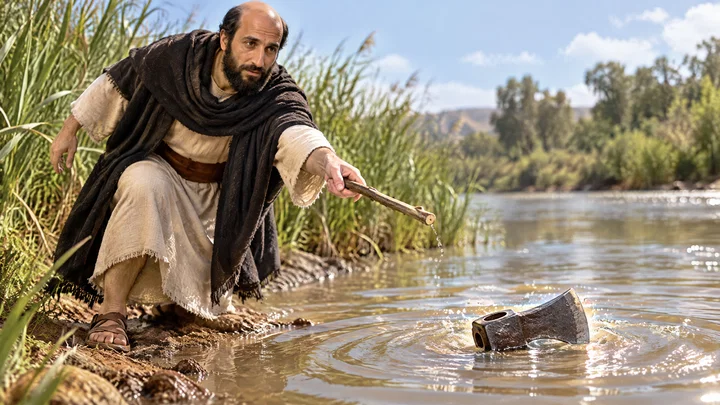
The verse opens the chapter-six account that continues into the loss of a borrowed ax head in the stream and its miraculous recovery.ST Jan 18, 1916ST Jul 13, 1904ST Feb 10, 1904 The company was building a place for a school on the bank of the Jordan under Elisha's direction and instruction when one worker's ax head came off the handle and fell into the water.ST Jan 18, 1916ST Feb 10, 1904 Elisha made an effort to retrieve it, possibly by thrusting a cut pole into the water to catch it through the eye, and God wrought a miracle to save the borrowed ax from loss.ST Jan 18, 1916ST Jul 13, 1904 In this God honors the work of the everyday toiler and works with feeble human efforts rather than despising them.ST Jan 18, 1916ST Jul 13, 1904
Dignity of Labor
The cutting and carrying of their own timber to build their own dwelling shows that true men of God before Christ were not above manual labor.ST Oct 22, 1894 Manual work was not held in degradation and left to slaves, but was done faithfully by the wise-hearted and diligent.ST Oct 22, 1894 The Spirit of God is the spirit of earnest, faithful, honest labor wherever duty calls, and God has no lazy children.ST Oct 22, 1894
The pupils in the schools of the prophets supported themselves through their own labor, including tilling the soil and mechanical work.RH Mar 24, 1904 Those schools were agricultural in character, like the school in Eden.RH Mar 24, 1904 The members of the prophetic school took part in practical labor by going to the Jordan to gather beams and build a place to live, and students there learned useful trades so that they could support themselves by manual labor.RH Oct 3, 1912 God honors the work of the everyday toiler, even working a miracle to save from loss the borrowed ax used by students building a house for themselves with their own hands, and the story teaches children and youth to value everyday duties and manual labor.ST Jan 18, 1916
The students’ proposal to move to the Jordan and build larger quarters themselves because their place was too small reflected energy, independence, and cooperation in support of their education and preparation for the Lord’s work.RH Nov 26, 1903 Their willingness to fell trees and build together provided both room for the school and practical work alongside their studies, illustrating cooperation in preparing for service.RH Nov 26, 1903RH Nov 26, 1903 That building was done under Elisha’s direction and instruction, with his approval of their plan and his agreement to go with them.RH Nov 26, 1903ST Feb 10, 1904 As Elisha would not let the worker go ahead with only the handle when the ax head fell into the stream but restored the ax by miracle because the ax was the important part, so the miracle of conversion is the important part that must be wrought before the student can properly begin or successfully carry on restoring the moral image of God in himself.ST Feb 10, 1904 When the student sees and feels his need of Jesus and cries for mercy, forgiveness of sins, cleansing from all unrighteousness, and the Holy Spirit, God is just as ready to work a miracle for him upon confession.ST Feb 10, 1904
Pattern for Schools
The account is a model for establishing church schools, Christian schools, and intermediate schools.RH Jul 2, 1908RH Nov 26, 1903RH Aug 31, 1916RH Jan 21, 1904 Those schools train young people to work with God in saving others and for missionary service, and the education given to the young molds the whole social fabric.RH Nov 26, 1903RH Aug 31, 1916RH Jan 21, 1904 Schools in ancient Israel were regarded as an effective means of promoting the nation's righteousness.RH Nov 26, 1903 The students' proposal to move to the Jordan and build a larger dwelling by gathering beams themselves, with Elisha's approval, shows both room for the school and practical work alongside study, and their willingness to build together illustrates cooperation in preparing for service.RH Nov 26, 1903RH Aug 31, 1916
The pattern means schools should be patterned more closely after the schools of the prophets.RH Mar 17, 1903 When more buildings were needed, the students themselves went out and cut timbers with which to construct their dwellings, doing the building work themselves.RH Mar 17, 1903 They were to go even further and help raise the money to buy material for construction.RH Mar 17, 1903
The school was a missionary school for training workers for the cause of God.ST Sep 20, 1883 Mature men and women with the burden of the work and matured judgment, as well as youth and young men, gathered under the direction of Elisha and of pastors, priests, ministers, and prophets for religious study and preparation for ministry.ST Sep 20, 1883ST Dec 2, 1913 They received instruction for a short period and then went out to labor, returning again when deficient and unqualified.ST Sep 20, 1883 There they were taught habits of industry, the art of reaching hearts, and the best manner of instructing people in the things of God, including how to hold Bible readings and to do colporteur work and home missionary work adapted to the wants of the people.ST Sep 20, 1883
Such intermediate schools are highly essential and must be established.RH Jan 21, 1904 Many parents do not know how to care properly for the church in their homes.RH Jan 21, 1904 Fathers and mothers have become indifferent to their obligations to God and unmindful of their duty to their children.RH Jan 21, 1904 The verse is a precedent for building a place for a school of prophets in mission work, as in a proposed mission center in India that would likewise give workers a place to gather, recover their strength, and prepare for service. The same move from a home that was too cramped applies when, rather than going to the Jordan, the need is met by going into the woods and felling a beam to make a place to live.RH May 19, 1859
Sources