2 Timothy 4:13
The cloke that I left at Troas with Carpus, when thou comest, bring with thee, and the books, but especially the parchments.
Translations
The cloak that I left at Troas with Carpus, when you come, bring with you, and the books, but especially the parchments.
King James Version, KJV Cambridge Paragraph Bible, Webster Bible
The cloke that I left at Troas with Carpus, when thou comest, bring with thee, and the books, but especially the parchments.
The cloke that I left at Troas with Carpus, bring when thou comest, and the books, especially the parchments.
The cloak that I left at Troas with Carpus, bring when thou comest, and the books, especially the parchments.
the cloak that I left in Troas with Carpus, coming, bring thou and the books — especially the parchments.
The cloak which I left behind [me] in Troas at Carpus's, bring when thou comest, and the books, especially the parchments.
The cloak that I left in Troas, with Carpus, when thou comest, bring; and the scrolls, especially, the parchments.
Berean Standard Bible, Majority Standard Bible
When you come, bring the cloak that I left with Carpus at Troas, and my scrolls, especially the parchments.
Bring the cloak that I left at Troas with Carpus when you come— and the books, especially the parchments.
The coat which I did not take from Troas and which is with Carpus, get when you come, and the books, specially the papers.
The cloke that I left at Troas with Carpus, when thou commest, bring with thee, and the bookes, but specially the parchments.
Douay-Rheims (Challoner revision)
The cloak that I left at Troas, with Carpus, when thou comest, bring with thee, and the books, especially the parchments.
Pictures
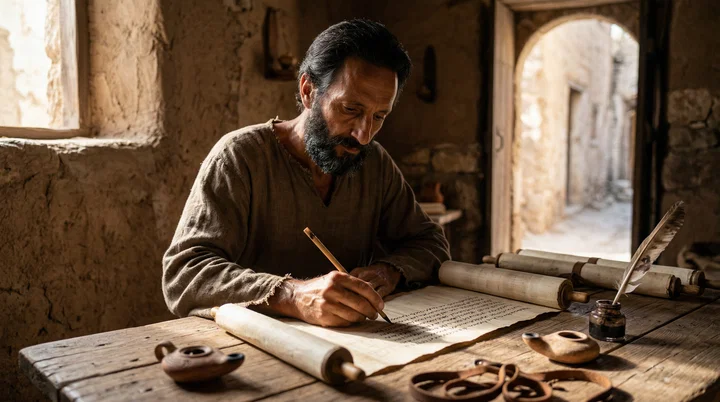
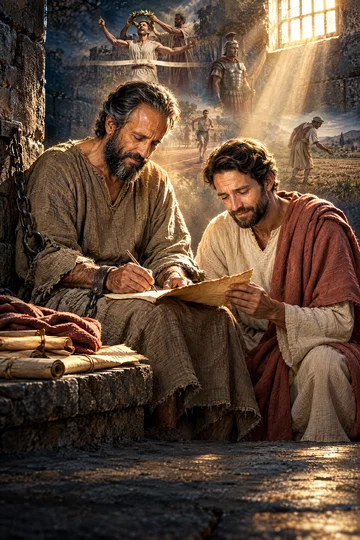
Commentary
Each commentary is drawn from primary sources: the writings of Ellen G. White and Adventist pioneers and periodicals. Each commentary is separate. Its own words are not a quotation; follow the references to read the source passages.
Ellen G. White
2 sources
Paul asks Timothy to bring the cloak he had left with Carpus at Troas, along with his books and especially his parchments.SLP 327.1–2 He had left them behind because he had been taken away at his second arrest so suddenly that he could not gather them.SLP 327.1–2 With winter approaching, he expected to suffer from the cold in his damp prison cell.SLP 327.1–2 He had no money for another garment and, though his end might be near, did not want the church to bear expense for him.SLP 327.1–2 The verse belongs to Paul's solemn charge to Timothy, to be read together with his doctrine, manner of life, persecutions and deliverances and his call to continue in the holy Scriptures that make wise unto salvation.Lt 400, 1906, par. 7
Sources
Pioneers and periodicals
16 sources
Paul wrote in his last letter, a final farewell from his second imprisonment at Rome when aged, forsaken, and facing death by beheading just before winter, asking Timothy to bring the cloak, books, and especially parchments he had been forced to leave behind with Carpus at Troas when suddenly seized and hurried away.ST Oct 20, 1909RH Jan 7, 1873 The cloak was an ordinary outer great-coat for bodily protection, which he needed for warmth and comfort in a cold, damp prison cell because winter was coming and he was penniless and would not burden the church, not a Eucharistic vestment.RH Jun 25, 1901ST Jan 20, 1881RH Feb 4, 1862RH Aug 29, 1871 The books were the Old Testament Scriptures and the parchments his own notebooks for memory and for the church, which even this aged, learned, experienced apostle still wanted so he could keep reading, learning, and improving his mind to the very end.RH Jul 25, 1912RH Dec 7, 1916ST Apr 20, 1888 That such a small domestic need stands in Scripture given for all ages shows ordinary personal matters are not too trivial for inspiration, and that God takes account of little things and cares whether his children are cold or warm.RH Oct 25, 1870RH Oct 28, 1909RH Oct 25, 1870 His poverty, cold, self-renunciation, and faithful humanity encourage poor and persecuted believers, the more because his earthly want and coming execution stand beside the crown of righteousness, heavenly welcome, and resurrection life awaiting him.RH Oct 28, 1909RH Oct 25, 1870RH Oct 25, 1870
Setting and Wording
This is Paul's closing chapter, his last epistle and final tender farewell to Timothy, his beloved son in the gospel, written from a Roman prison under distressing circumstances during his second and last imprisonment.ST Oct 20, 1909ST Jan 9, 1912 He was aged and abandoned, close to death and facing martyrdom, expecting beheading every day and knowing his end might come at any moment within a few months.RH Oct 25, 1870RH Oct 25, 1870 He wrote just before winter, urging Timothy to come to him before winter.RH Oct 25, 1870
The cloak and the books, but especially the parchments, had been left at Troas with Carpus, hundreds of miles away.RH Jan 7, 1873 At his second arrest he had been seized and hurried away so suddenly that he had no opportunity to gather them or even to take his cloak.
Winter was coming on and he faced cold in his damp prison cell and dungeon at Rome, needing the cloak for warmth and comfort and bodily protection.ST Apr 20, 1888RH Jan 7, 1873 He was penniless with no money to buy another garment, revealing poverty and bodily hardship after a life of hardship and service for Christ.RH Feb 4, 1862RH Oct 25, 1870RH Oct 25, 1870 With self-forgetfulness and fear to burden the church he desired that no expense be incurred on his account.
The cloak was an ordinary outer garment and great-coat, of the kind provided to clothe a poor boy in need and still worn in the Holy Land, whose continuing use illustrates the lasting accuracy of the account.ST Jan 20, 1881RH Aug 29, 1871RH Jan 7, 1873 It was not a Eucharistic vestment, and to treat it and the parchments as a vestment or a copy of the liturgy is an absurd ritualistic interpretation.ST Apr 20, 1888 The books were the books of the Old Testament and certainly not profane books, for he had no leisure for such books and no liking for them. The parchments were notebooks of his own collecting, things he had written for the help of his memory and for the benefit of the church, on which he could write epistles.ST Apr 20, 1888
The Greek word apoleipo in the verse means left behind here with us, not something future, proving that remaineth means something left in the present. The touching little personal request for a cloak and books, especially the parchments, has a striking parallel in the letter of the martyr William Tyndale from the damp cell of his prison at Vilvorde in the winter before his death.ST Mar 3, 1914 There he begged for something to patch his leggings, a woolen shirt and a warmer cap, and above all his Hebrew Bible, grammar, and dictionary so he could study.ST Mar 3, 1914
Instruction and Encouragement
Paul in Rome near death still asked for books and especially parchments to be brought to him, because reading and study remained means of gaining knowledge and improving the mind even at the end of life.RH Jul 25, 1912RH Dec 7, 1916 He made that request as an aged minister and prisoner expecting beheading daily within a few months of his end, held where study was hard, yet still wanting to keep reading and learning. He did so despite education, years of preaching, revelations, and experience, which shows the Scriptures to be so vast and deep that even an inspired apostle who had already read much could not fathom them and must keep studying them to the end.RH Jul 25, 1912 The books sought were the books of the Old Testament and certainly not profane books, for he had no leisure for such books and no liking for them, while the parchments were notebooks of his own collecting, things he had written for the help of his memory and for the benefit of the church. That pattern of earnest study to the end rebukes any minister who thinks he knows enough, has studied enough, or is too old to learn.
The request for cloak and writings is a domestic, ordinary personal detail, yet it is not too trivial for divine inspiration to include in Scripture.RH Oct 25, 1870 Its place in the Scriptures given for the guidance of the church in all ages gives a vivid, tangible glimpse of the apostle's ministry, life, need, and circumstances near the end of life, conveying spiritual instruction with unusual force and showing that ordinary personal matters can belong in an inspired account.RH Oct 25, 1870RH Oct 28, 1909RH Oct 25, 1870 Its preservation there shows that God takes the little things of life into account.RH Oct 28, 1909 He cared whether Paul was cold or warm, and he cares the same for his children today, looking with sympathy on every thinly clad shivering form and sorrowing for the famine-stricken and distressed, with all that grieves his creatures awakening a response in his great heart of love.RH Oct 28, 1909
The request reveals poverty, cold and physical need even after a life of hardship and service for Christ, and makes vivid self-renunciation, humanity, tenderness, faithful service, and sympathy.RH Oct 25, 1870RH Oct 25, 1870 It offers encouragement and an example to poor and persecuted believers.RH Oct 25, 1870RH Oct 25, 1870 His earthly need for a cloak and coming execution and martyrdom, abandoned by people and suffering from cold, contrast with the crown of righteousness and heavenly glory and welcome and resurrection life awaiting him.RH Oct 25, 1870RH Oct 25, 1870
A minister is expected to make practical provision for his needs as work and circumstances require, and ministers were not permanently required to travel without money or adequate clothing.RH Jun 25, 1901 Paul showed care for the body by sending hundreds of miles to Troas for his great-coat for bodily protection long before modern express delivery.RH Jan 7, 1873 The body is the candlestick that holds the burning candle and the handle that lets the sharp sword do its work, meaning God gives every man a certain amount of work and does not want him to do more, so men who toil with the brain must slow down, avoid exhausting night work, and look after the body.RH Jan 7, 1873
Sources