Exodus 35:34
And he hath put in his heart that he may teach, both he, and Aholiab, the son of Ahisamach, of the tribe of Dan.
Translations
And he has put in his heart that he may teach, both he, and Aholiab, the son of Ahisamach, of the tribe of Dan.
King James Version, KJV Cambridge Paragraph Bible
And he hath put in his heart that he may teach, both he, and Aholiab, the son of Ahisamach, of the tribe of Dan.
And he hath put in his heart that he may teach, both he and Aholiab, the son of Ahisamach, of the tribe of Dan.
Revised Version, American Standard Version
And he hath put in his heart that he may teach, both he, and Oholiab, the son of Ahisamach, of the tribe of Dan.
'And to direct He hath put in his heart, he and Aholiab, son of Ahisamach, of the tribe of Dan;
and he has put in his heart to teach, he and Aholiab, the son of Ahisamach, of the tribe of Dan:
To teach also, hath he put in his heart, [the heart of] him, and of Oholiab—son of Ahisamach, of the tribe of Dan;
Berean Standard Bible, Majority Standard Bible
And the LORD has given both him and Oholiab son of Ahisamach, of the tribe of Dan, the ability to teach others.
He has put in his heart that he may teach, both he and Oholiab, the son of Ahisamach, of the tribe of Dan.
And he has given to him, and to Oholiab, the son of Ahisamach, of the tribe of Dan, the power of training others.
And he hath put in his heart that hee may teach other: both hee, and Aholiab the sonne of Ahisamach of the tribe of Dan:
Douay-Rheims (Challoner revision)
He hath given in his heart: Ooliab also the son of Achisamech of the tribe of Dan:
Pictures
Cross-references
- Exodus 31:6
And I, behold, I have given with him Aholiab, the son of Ahisamach, of the tribe of Dan: and in the hearts of all that are wise hearted I have put wisdom, that they may make all that I have commanded thee;
God gives Aholiab and the other craftsmen wisdom for the tabernacle work.
- Exodus 36:1
Then wrought Bezaleel and Aholiab, and every wise hearted man, in whom the LORD put wisdom and understanding to know how to work all manner of work for the service of the sanctuary, according to all that the LORD had commanded.
The workers carry out the tabernacle work with God-given wisdom.
- 2 Chronicles 2:14
The son of a woman of the daughters of Dan, and his father was a man of Tyre, skilful to work in gold, and in silver, in brass, in iron, in stone, and in timber, in purple, in blue, and in fine linen, and in crimson; also to grave any manner of graving, and to find out every device which shall be put to him, with thy cunning men, and with the cunning men of my lord David thy father.
Huram is a skilled craftsman descended from Dan.
- Exodus 35:21
And they came, every one whose heart stirred him up, and every one whom his spirit made willing, and they brought the LORD’s offering to the work of the tabernacle of the congregation, and for all his service, and for the holy garments.
Both describe willing hearts consecrated to work.
Commentary
Each commentary is drawn from primary sources: the writings of Ellen G. White and Adventist pioneers and periodicals. Each commentary is separate. Its own words are not a quotation; follow the references to read the source passages.
Ellen G. White
25 sources
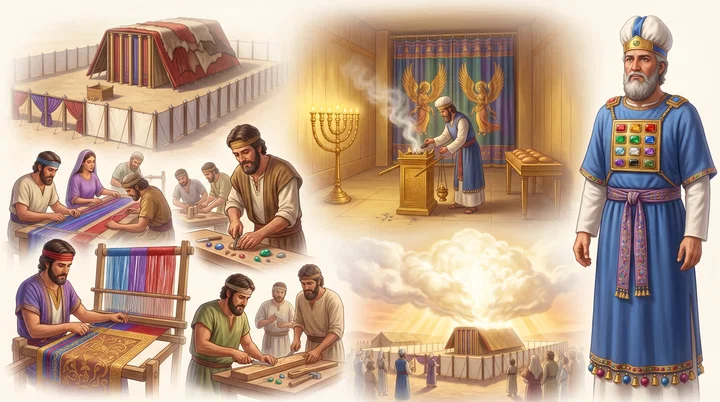
God put in the hearts of both Bezalel and Aholiab the ability to teach others the skilled work needed for the tabernacle.SSP 5.2–6.1Lt 41, 1899, par. 12–15Ms 97, 1899, par. 3–4 Bezalel was of the tribe of Judah and Aholiab was the son of Ahisamach of the tribe of Dan, men specially chosen and endowed by God for this work.SSP 5.2–6.1STB 780.2–781.1RH Jan 4, 1906 Their wisdom, understanding, knowledge, tact and skill in all manner of workmanship were gifts from God beyond the natural, and filled with the Spirit of God they were educated by Him and not left to their own human wisdom.SSP 5.2–6.1SG4 154.3RH Jan 4, 1906 Heavenly intelligences cooperated with these workmen whom God Himself chose, so the work was done under His direction and supervision.SSP 5.2–6.1PK 62.2STB 780.2–781.1 Teaching ability is a gift from God to be developed as people learn from Him and cooperate with Him, and the Lord will give the same tact, skill and wisdom today to all who have a part in His cause as they wholly depend upon Him and walk and work as accountable to God.Lt 41, 1899, par. 12–15Ms 8a, 1894, par. 12Ms 76, 1902, par. 2Ms 156, 1901, par. 54–55
Chosen Teachers for Tabernacle
God put in the hearts of both Bezalel and Aholiab the ability to teach others the skilled work required for the tabernacle.SSP 5.2–6.1Lt 41, 1899, par. 12–15Ms 97, 1899, par. 3–4STB 780.2–781.1SG4 154.3 Teaching skill itself was a gift placed within them for carrying out that work, developed as they learned from Him and cooperated with Him.Lt 41, 1899, par. 12–15Ms 97, 1899, par. 3–4 Bezalel was of the tribe of Judah and Aholiab was the son of Ahisamach of the tribe of Dan, men specially chosen and endowed by God for building the wilderness tabernacle.STB 780.2–781.1RH Jan 4, 1906
Their wisdom, understanding, knowledge, tact, and skill in all manner of workmanship were gifts from God beyond the natural.SSP 5.2–6.1RH Jan 4, 1906SG4 5.1 They were filled with the Spirit of God in wisdom, in understanding, and in knowledge, and in all manner of workmanship, with wisdom of heart to work as engravers, cunning workmen, embroiderers, weavers, and devisers of cunning work.SG4 154.3RH Jan 4, 1906 He educated them for the work and did not leave them to their own human wisdom, having called men who already had qualifications of character and giving them aptitude and skill.20MR 345.3–4Lt 103, 1900, par. 23–24 Heavenly intelligences cooperated with these workmen whom God Himself chose, and the building of the tabernacle with its furnishings and embroidery was carried out under His direction and supervision.SSP 5.2–6.1PK 62.2STB 780.2–781.1RH Jan 4, 1906Ms 8, 1894 [Copy 1], par. 14
That demanding craft work was done with heart, soul, mind, and strength as an expression of love to God and devoted service for His honor.Ms 8a, 1894, par. 12STE 94.1Ms 8, 1894 [Copy 1], par. 14 Their skill and instruction came under divine direction, and what they did with heart and strength was for God's honor.Ms 8a, 1894, par. 12STE 94.1
Working Together in Order
God required exactitude, skill, tact, wisdom and perfection in building the earthly tabernacle according to the pattern shown to Moses in the mount, and He requires that same perfection in every line of work done in His service.Ms 109, 1899, par. 1–4 Workers are to train their minds to do the very highest service and to desire mental strength to do everything according to that pattern.Ms 109, 1899, par. 1–4 They are to feel an interest in every line of work and to communicate to fellow workers the foresight, capability and knowledge God has given them, so that beauty and harmony and solidarity are seen in every part.Ms 109, 1899, par. 1–4
In building the tabernacle different lines of work were assigned to different workers, all laboring under God's supervision.Lt 111, 1903, par. 17–18 The Lord gives talents that enable special lines of work, and each one is to be allowed to do the special work for which he is fitted, so that part fits perfectly to part.Lt 111, 1903, par. 17–18 Varied gifts must be brought in, workers cannot be expected to work in exactly the same way, and unity in diversity is the Lord's plan.Lt 111, 1903, par. 17–18 No man can be a criterion for all other men, varied trusts are proportioned to varied capabilities, and each worker is to give his fellow workers the respect he wishes to have shown to himself.Lt 111, 1903, par. 17–18
The instruction connected with the tabernacle's construction is a model of education in which God gave people ability and purpose to teach.Ms 92, 1899, par. 6–8 In that model teaching is organized, practical and shared, with each person given a part.Ms 92, 1899, par. 6–8 Israel's journey through the wilderness also taught order and discipline, and Christ was their Teacher.Ms 92, 1899, par. 6–8 God put the ability to teach useful skills into the hearts of those appointed for the work, showing that practical trades can be taught and that industrial training is a worthy part of education.RP 26.2–4
Legacy and Present Application
The skill given to Bezalel and Aholiab was inherited in large degree by their descendants in the tribes of Judah and Dan, who were regarded as especially cunning in the finer arts.STB 780.2–781.1SSP 6.2PK 62.3 Later, some who inherited that God-given talent used it for selfish ends and in the service of heathen kings, dishonoring their Maker.SSP 6.2PK 62.3 Huram, Solomon's master workman, descended from Aholiab on his mother's side.SSP 6.3–7.1
The Lord will give the same tact, skill, and wisdom today to all who have a part in His cause to do His work.Ms 76, 1902, par. 2Ms 156, 1901, par. 54–55 This is received as they wholly depend upon Him, are willing to be controlled and guided by Him, and walk and work as accountable to God.Ms 76, 1902, par. 2Ms 156, 1901, par. 54–55 Teaching ability is a gift from God to be developed as people learn from Him and cooperate with Him, and He educated the tabernacle craftsmen for their work.Lt 41, 1899, par. 12–15Ms 8a, 1894, par. 12
The tabernacle's construction was a special representation of God's power and majesty and the exalted character of His service, and it also represented the sacredness of the human temple.CH 280.220MR 345.3–4Lt 103, 1900, par. 23–24 Buildings erected for Him are to honor His name through faithfulness, stability, and fitness in every part.CH 280.2 Ability for the most skillful work gives artisans no reason to become exalted because of skill and aptitude, and working men need refinement and true Christian courtesy.20MR 345.3–4Lt 103, 1900, par. 23–24 The same divine help equips workers controlled by the Holy Spirit with tact and intelligence for practical work, including making health foods and building up the body as God's dwelling place, for God can communicate wisdom to His people to do His will.CH 280.2CH 539.4CH 527.4
Sources
Pioneers and periodicals
18 sources
God set apart Bezalel of Judah and Aholiab son of Ahisamach of Dan with other devoted workers to build the wilderness tabernacle according to the pattern shown to Moses, in the work of preparing, building, setting up and inaugurating the sanctuary that followed the events of Exodus 19-32 and the instructions of Exodus 25-31.RH Jan 4, 1906ST Jan 27, 1909ST Jan 31, 1911ST Dec 10, 1896 He put wisdom in their hearts not only to perform the skilled work themselves but to teach others how to do it.ST Aug 16, 1910ST Feb 17, 1890 That ability to teach was part of His filling them with the Spirit of God in wisdom, understanding, knowledge and all manner of workmanship, fitting former slaves to serve as engravers, embroiderers, weavers and devisers of cunning work, with heavenly intelligences cooperating with those He chose.ST Aug 16, 1910ST Jan 27, 1909 The work was done by willing hearts bringing abundant free-will offerings until Moses commanded them to stop, and it stands as the model for consecrated, willing service in sacred building and for skilled workers to train the young without seeking pay as their inducement.RH May 27, 1902RH May 27, 1902RH Aug 21, 1856
Tabernacle Setting and Gift
Exodus 35:34 stands within the account of preparing and fitting the tabernacle in Exodus 35-40, more broadly the building, setting up and inaugurating of the sanctuary in Exodus 33-40.ST Jan 31, 1911ST Dec 10, 1896 That section came in chronological order after the events of Exodus 19-32 and immediately after the instruction about the sanctuary God gave to Moses on the mount in Exodus 25-31.ST Jan 31, 1911ST Dec 10, 1896 The work was carried out according to the definite pattern and instructions given to Moses on the mountain.ST Jun 10, 1908 The surrounding account describes the building and inauguration and presents God's glory as showing His acceptance of the people's repentance.ST Jan 31, 1911
The verse names the appointed, chosen craftsmen for the construction of the wilderness tabernacle, Bezalel of the tribe of Judah and Aholiab son of Ahisamach of the tribe of Dan, together with other devoted workers.RH Jan 4, 1906ST Jan 27, 1909 God put into their hearts wisdom and the ability, purpose and charge to teach others the skilled work needed for the sanctuary and its furnishings.ST Aug 16, 1910ST Feb 17, 1890ST Apr 2, 1902RH Jan 6, 1853 They were thus qualified not only to do the sacred work themselves but to instruct others in it.ST Feb 17, 1890ST Jan 27, 1909RH Jan 6, 1853 Their skill was God-given.ST Apr 2, 1902
This teaching gift was part of God's special endowment of the workers who built the sanctuary according to the divine pattern. He filled them with the Spirit of God in wisdom, in understanding, and in knowledge, and in all manner of workmanship.RH Jan 4, 1906 He taught them how to do the particular work assigned to them and gave inspiration for skilled work.ST Feb 27, 1896RH Sep 4, 1855 He thereby prepared men from a nation of former slaves to perform delicate, varied craftsmanship for the tabernacle as engravers, cunning workmen, embroiderers, weavers, and devisers of cunning work, while heavenly intelligences cooperated with the workmen He Himself chose.RH Jan 4, 1906ST Aug 16, 1910 His Spirit thus equips consecrated workers for practical, material tasks as well as for spiritual work.ST Jan 27, 1909
Skill in work and aptness to teach belong together, for the mechanics who built the tabernacle were not only filled with the Spirit of God in all manner of workmanship but had it put into their hearts by the Lord to teach.RH Aug 18, 1904 Hearts stirred up and spirits made willing join them.RH Aug 18, 1904 The same divine wisdom and Holy Spirit enable people to learn, teach, and devise and plan for right work, whether in practical workmanship or in thought.RH Jun 10, 1902
Willing Service and Application
Exodus 35 presents the building of the tabernacle as work done by willing people.RH May 27, 1902 It shows the zeal with which the children of Israel engaged in the work and the readiness with which they sacrificed their treasures and brought free-will offerings for the service of the Lord.RH Aug 21, 1856 Those offerings were so abundant that Moses gave commandment to desist because the material was sufficient for all the work and too much.RH Aug 21, 1856 That example asks whether young men today would freely offer their services for God's work, without first asking what pay they would receive.RH May 27, 1902
As a sacred work, that account is a model for sacred building such as college building.RH May 27, 1902 Work for such a sacred project should be offered in a spirit of service, not undertaken because wages are an inducement.RH May 27, 1902 The appeal therefore remains that young men freely give themselves to God's work in the same willing spirit.RH May 27, 1902
The tabernacle was funded without entertainments or ticketed festivals, in contrast to indirect fundraising.ST Jan 27, 1890 Moses called Bezalel and Aholiab to serve in that work, and its free offerings stand against methods that raise means by such devices.ST Jan 27, 1890 The spirit of sacrifice seen there should remain in the church of God no less than the gifts of the Holy Spirit.RH Aug 21, 1856
Skill in work and aptness to teach belong together, through hearts stirred up and spirits made willing.RH Aug 18, 1904 The mechanics who built the tabernacle were not only filled with the Spirit of God in all manner of workmanship but had it put into their hearts by the Lord to teach.RH Aug 18, 1904 Skilled workers should therefore consecrate their skill and understanding to training young men and women for the Lord's service.RH Aug 18, 1904
The verse belongs to Moses' command about offerings for the tabernacle.RH May 16, 1871 God put the ability and charge to teach into the hearts of Bezalel and Aholiab alongside their work on the sanctuary.RH May 16, 1871 It does not support a claimant's personal authority.RH May 16, 1871
Sources