Ezekiel 46:2
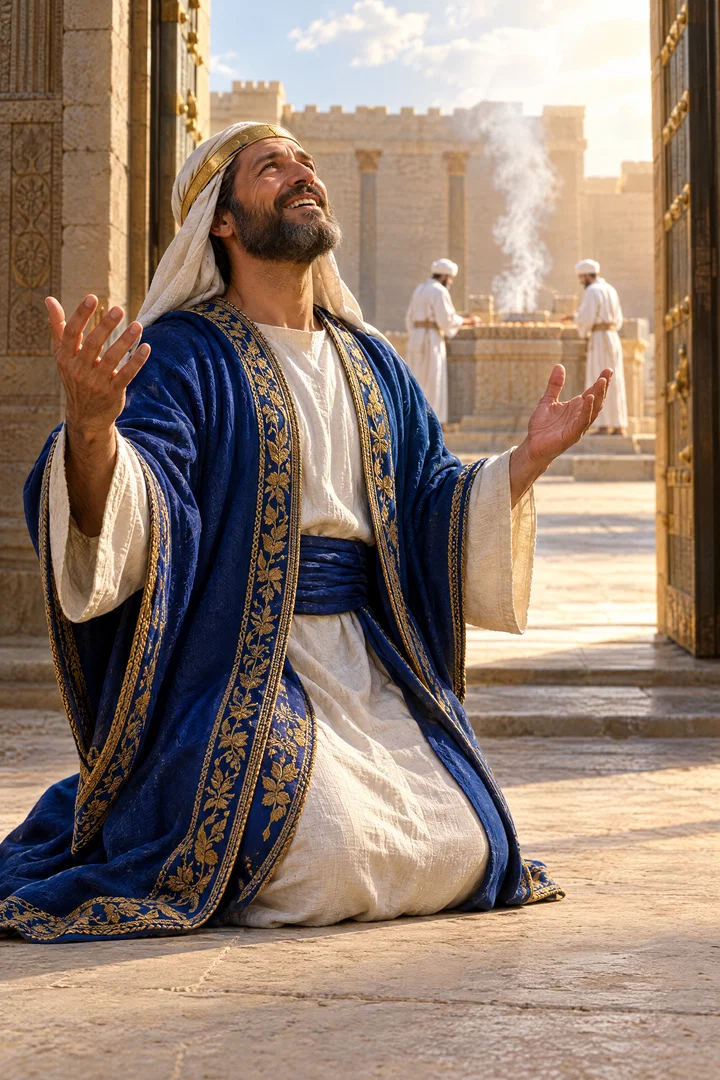
And the prince shall enter by the way of the porch of that gate without, and shall stand by the post of the gate, and the priests shall prepare his burnt offering and his peace offerings, and he shall worship at the threshold of the gate: then he shall go forth; but the gate shall not be shut until the evening.
Translations
American King James Version, King James Version, KJV Cambridge Paragraph Bible
And the prince shall enter by the way of the porch of that gate without, and shall stand by the post of the gate, and the priests shall prepare his burnt offering and his peace offerings, and he shall worship at the threshold of the gate: then he shall go forth; but the gate shall not be shut until the evening.
And the prince shall enter by the way of the porch of that gate without, and shall stand by the post of the gate, and the priest shall prepare his burnt-offering and his peace-offerings, and he shall worship at the threshhold of the gate: then he shall go forth; but the gate shall not be shut until the evening.
And the prince shall enter by the way of the porch of the gate without, and shall stand by the post of the gate, and the priests shall prepare his burnt offering and his peace offerings, and he shall worship at the threshold of the gate; then he shall go forth: but the gate shall not be shut until the evening.
And the prince shall enter by the way of the porch of the gate without, and shall stand by the post of the gate; and the priests shall prepare his burnt-offering and his peace-offerings, and he shall worship at the threshold of the gate: then he shall go forth; but the gate shall not be shut until the evening.
and come in hath the prince the way of the porch of the gate at the outside, and he hath stood by the post of the gate, and the priests have made his burnt-offering, and his peace-offerings, and he hath bowed himself by the opening of the gate, and hath gone forth, and the gate is not shut till the evening.
And the prince shall enter by the way of the porch of [ that] gate from without, and shall stand by the post of the gate, and the priests shall offer his burnt-offering and his peace-offerings, and he shall worship at the threshold of the gate, and shall go forth: but the gate shall not be shut until the evening.
The prince therefore shall enter by way of the porch of the gate without and shall stand by the post of the gate, and the priests shall offer his ascending-sacrifice and his peace offerings, and he shall bow down upon the threshold of the gate and then go forth, but the gate shall not be shut until the evening;
Berean Standard Bible, Majority Standard Bible
The prince is to enter from the outside through the portico of the gateway and stand by the gatepost, while the priests sacrifice his burnt offerings and peace offerings. He is to bow in worship at the threshold of the gate and then depart, but the gate must not be shut until evening.
The prince shall enter by the way of the porch of the gate outside, and shall stand by the post of the gate; and the priests shall prepare his burnt offering and his peace offerings, and he shall worship at the threshold of the gate. Then he shall go out, but the gate shall not be shut until the evening.
And the ruler is to go in through the covered way of the outer doorway outside, and take his place by the pillar of the doorway, and the priests will make his burned offering and his peace-offerings and he will give worship at the doorstep of the doorway; then he will go out, and the door will not be shut till the evening.
And the prince shall enter by the way of the porch of that gate without, and shall stande by the post of the gate, and the Priests shall make his burnt offring, and his peace offrings, and he shall worship at the threshold of the gate: after, he shall go foorth, but the gate shall not be shut till the euening.
Douay-Rheims (Challoner revision)
And the prince shall enter by the way of the porch of the gate from without, and he shall stand at the threshold of the gate: and the priests shall offer his holocaust, and his peace offerings: and he shall adore upon the threshold of the gate, and shall go out: but the gate shall not be shut till the evening.
Pictures
Cross-references
- Ezekiel 45:22
And upon that day shall the prince prepare for himself and for all the people of the land a bullock for a sin offering.
The prince prepares a sin offering for himself and all the people.
- Ezekiel 40:1-48
In the five and twentieth year of our captivity, in the beginning of the year, in the tenth day of the month, in the fourteenth year after that the city was smitten, in the selfsame day the hand of the LORD was upon me, and brought me thither.
The temple vision establishes the sanctuary and sacrificial setting for the gate service.
- Hebrews 10:10
By the which will we are sanctified through the offering of the body of Jesus Christ once for all.
Christ’s once-for-all offering contrasts with Ezekiel’s animal offerings.
- Ezekiel 43:18-27
And he said unto me, Son of man, thus saith the Lord GOD; These are the ordinances of the altar in the day when they shall make it, to offer burnt offerings thereon, and to sprinkle blood thereon.
Describes altar offerings and worship in the sanctuary that includes this gate service.
- Ezekiel 44
Then he brought me back the way of the gate of the outward sanctuary which looketh toward the east; and it was shut.
The sanctuary’s worship includes this gate service.
- Ezekiel 45:17
And it shall be the prince’s part to give burnt offerings, and meat offerings, and drink offerings, in the feasts, and in the new moons, and in the sabbaths, in all solemnities of the house of Israel: he shall prepare the sin offering, and the meat offering, and the burnt offering, and the peace offerings, to make reconciliation for the house of Israel.
Both describe the prince’s offerings for the people, including Sabbath offerings.
- Ezekiel 46:12
Now when the prince shall prepare a voluntary burnt offering or peace offerings voluntarily unto the LORD, one shall then open him the gate that looketh toward the east, and he shall prepare his burnt offering and his peace offerings, as he did on the sabbath day: then he shall go forth; and after his going forth one shall shut the gate.
paired as Sabbath allusions in same offer
- Hebrews 8:3-5
For every high priest is ordained to offer gifts and sacrifices: wherefore it is of necessity that this man have somewhat also to offer.
Earthly offerings were shadows of Christ’s sacrifice.
- Ezekiel 44:15
But the priests the Levites, the sons of Zadok, that kept the charge of my sanctuary when the children of Israel went astray from me, they shall come near to me to minister unto me, and they shall stand before me to offer unto me the fat and the blood, saith the Lord GOD:
Both describe the Levites serving as priests.
- Ezekiel 43:26-27
Seven days shall they purge the altar and purify it; and they shall consecrate themselves.
Discussed as part of the same temple-service prophecy.
- Hebrews 9:9-10
Which was a figure for the time then present, in which were offered both gifts and sacrifices, that could not make him that did the service perfect, as pertaining to the conscience;
Animal offerings belonged to the former sacrificial order and could not perfect the conscience.
- Numbers 28:9-10
And on the sabbath day two lambs of the first year without spot, and two tenth deals of flour for a meat offering, mingled with oil, and the drink offering thereof:
Both describe Sabbath sacrifices as typical.
- Isaiah 56:7
Even them will I bring to my holy mountain, and make them joyful in my house of prayer: their burnt offerings and their sacrifices shall be accepted upon mine altar; for mine house shall be called an house of prayer for all people.
Both describe worship at God’s house, a house of prayer for all nations.
- Jeremiah 17:25
Then shall there enter into the gates of this city kings and princes sitting upon the throne of David, riding in chariots and on horses, they, and their princes, the men of Judah, and the inhabitants of Jerusalem: and this city shall remain for ever.
Both describe princes entering Jerusalem through its gates.
- Hebrews 10:1
For the law having a shadow of good things to come, and not the very image of the things, can never with those sacrifices which they offered year by year continually make the comers thereunto perfect.
The law’s sacrifices are a shadow and cannot perfect worshipers.
Commentary
Each commentary is drawn from primary sources: the writings of Ellen G. White and Adventist pioneers and periodicals. Each commentary is separate. Its own words are not a quotation; follow the references to read the source passages.
Pioneers and periodicals
38 sources
The verse shows the prince coming in through the porch of the outer gate, standing by its post while the priests make ready his burnt offering and peace offering, bowing in worship at the threshold and then going out, with the gate left open until evening.RH May 25, 1876ST Aug 2, 1910ST Apr 20, 1915 It belongs to the temple vision of Ezekiel 40-48, which set a glorious cleansed sanctuary at the center of a restored Jerusalem to hold the presence of God called Jehovah-shammah.RH Jan 19, 1860ST Sep 3, 1902ST Sep 17, 1902 That sanctuary was offered to captive Israel on condition of shame for sin and turning from iniquity, and because the people did not meet it the house described was never built and never will be.RH May 25, 1876ST Apr 8, 1889RH Jan 20, 1853 Its burnt offerings and peace offerings belonged to the time when the Levitical priesthood and animal sacrifices were in force as types of Christ's atonement, and they cannot be renewed after His once-for-all sacrifice without making that sacrifice void; the prince himself, needing a sin offering for himself and living under marriage and death, was a frail mortal ruler before Messiah came, not Jesus in His future glory.RH Jan 19, 1860ST Oct 1, 1896ST Apr 8, 1889RH Sep 11, 1856ST Aug 12, 1875 The gate standing open until evening shows the day ending at sunset from which Sabbath time is reckoned, while in its spiritual aspect what failed for earthly Jerusalem will be grandly realized for the true Israel in the new heavens and new earth.ST Oct 21, 1908RH Dec 9, 1852ST Mar 3, 1909ST Oct 26, 1904RH Dec 15, 1863
Worship at the Gate
The prince comes in by way of the porch of the outer gate and takes his place beside the post of the gate while the priests make ready his burnt offering and his peace offerings, and there at the threshold of the gate he bows in worship before going out again, with the gate left open until the evening.RH May 25, 1876ST Aug 2, 1910ST Apr 20, 1915ST Aug 2, 1910 That prescribed entrance and service shows a ruler appointed to stand before Israel until the Messiah should come, and the whole order of sacrifices and oblations and priesthood as of old belongs to the time before the Messiah came.ST Aug 2, 1910ST Aug 2, 1910 The sanctuary service so described was offered to Israel in the past but was never built because the people did not meet its conditions, and its sacrifices are not acceptable under the present dispensation.RH May 25, 1876ST Apr 20, 1915 The prophecy seems to predict the building of a greater temple, though it does not explain how that building would be carried out.
The verse belongs to the temple vision of Ezekiel 40-48, also described as Ezekiel 36-48 and Ezekiel 40-46, setting forth a city and sanctuary with prince and priests and sacrifices, together with the division of the land and the future kingdom of God and the Messiah's peaceful kingdom on earth as it then was.RH Jan 19, 1860ST Aug 12, 1875ST May 21, 1902ST Aug 30, 1905 Its sacrificial system was part of a conditional promise to Israel, not a system to be restored after Christ's heavenly ministry has ended, but types pointing forward to Christ's atonement.RH Jan 19, 1860 Had the conditions been met it would have been fulfilled literally in the Mosaic dispensation when circumcision and divorce and distinction in meats and offerings of beasts and the Jubilee and the Levitical priesthood were in force.ST Aug 12, 1875 It was never built and never will be built because it was offered on condition that Israel be ashamed of their iniquities and put them away, which Israel did not do, and it does not describe the future glorified state, since there Christ is Prince and Shepherd over Israel while the prince here is a poor frail mortal who must offer a sin offering for himself, and its regulations assume marriage and divorce and widowhood and death which will be unknown in the age to come.ST Aug 12, 1875ST May 21, 1902
Within the offer God made to the Hebrews while captive in Babylon to restore them to their own land and give them again a city and a temple under circumstances of wonderful glory, the verse stands among several allusions to the Sabbath of the Lord and to the festivals of the Hebrews.RH Jan 21, 1862 That offered glory was never inherited by them because the condition of the offer was disregarded.RH Jan 21, 1862 It is one of three mentions of the Sabbath in Ezekiel 46, and Ezekiel and Amos are the only other Old Testament books that speak of the Sabbath.RH Jan 12, 1860
The vision presents a glorious temple at the center of a restored Jerusalem, a new city grander than old Jerusalem with a temple finer than Solomon's, cleansed of commercialism and unholiness, to hold the Shekinah glory of God's presence.ST Sep 3, 1902ST Sep 17, 1902ST Aug 2, 1910 Its teaching is that Jehovah is there, whose presence would bring healing and life to barren land and salt marshes and impure waters.ST Sep 3, 1902 Jerusalem was never restored in this way and the temple was never built because Israel would not yield fully to God and put away their sins and be ashamed of all they had done, so God could not dwell among them, and the later temple built after the return from Babylon fell far short of Ezekiel's pattern.ST Sep 3, 1902ST Aug 2, 1910 That grand temple at Jerusalem would ultimately be a house of prayer for all nations, and wherein the promise failed for old earthly Jerusalem it will be grandly realized in the New City for the true Israel of God whose name is Jehovah is there, after four hundred years without prophet or inspired record until John and the Gospel of the Son of God.ST Sep 17, 1902ST Aug 2, 1910
Conditional Promise to Israel
The sanctuary, city, and restoration set forth in Ezekiel 40-48 were offered to Israel while captive in Babylon on the condition that the people be ashamed of their iniquities, recognize and turn from their sins, and put them away.RH May 25, 1876RH Jan 20, 1853ST Aug 12, 1875ST Feb 22, 1910ST Feb 27, 1907 Because Israel did not meet that condition and continued in apostasy, the sanctuary described was never built and never will be built.RH May 25, 1876ST Apr 8, 1889RH Jan 20, 1853ST Aug 12, 1875ST Feb 27, 1907 The detailed plan of sanctuary, city, and land division would have been fulfilled literally if they had met his conditions.ST Feb 22, 1910 The vision was given to call Israel to repentance, but because they did not turn, the promised restoration and temple were not fulfilled for them.ST Feb 27, 1907
Because the people failed, the promises received only a feeble, partial, lesser-shadow fulfillment in the temple built by Zerubbabel after the return from Babylon.ST Nov 24, 1909ST Dec 1, 1914ST Sep 3, 1902ST Sep 20, 1910 That later temple fell far short of Ezekiel's pattern and was far inferior to Solomon's temple.ST Sep 3, 1902ST Sep 20, 1910ST Apr 20, 1915 The return involved only about forty thousand people, fewer than fifty thousand, while their northern foes persecuted them instead of being destroyed.ST Sep 21, 1915ST Apr 20, 1915 Jerusalem was never restored in the glorious way described, because Israel would not yield fully to God so that God could dwell among them.ST Sep 3, 1902 That partial return pointed to a greater fulfillment in the glory of Christ's second coming and related events, not to a return of the local conditions described in Ezekiel's day.
Had the conditions been met the details would have been fulfilled literally in the Mosaic dispensation when circumcision, divorce, distinction in meats, offerings of beasts, the Jubilee, and the Levitical priesthood were in force.ST Aug 12, 1875 That fulfillment would have gathered scattered Israel home to their own land with sins forgiven, new hearts given, waste cities built up, and Israel and Judah joined in one nation under the seed of David.ST Apr 20, 1915 It would have included destruction of northern foes, resurrection, subjection of enemies, healing power, lengthened life, and God's glory resting on the city called Jehovah-shammah.ST Sep 20, 1910ST Jan 31, 1911ST Apr 20, 1915 The promise centered in the sanctuary and division of the land was of unsurpassable and inconceivable glory for restored Palestine, with the character of a true-hearted people taking hold upon the animals and the manifest presence of God constantly seen with no hurt nor destroying in all His holy mountain.ST Jan 31, 1911
Sacrifices Ended at Christ
The burnt offerings and peace offerings prepared by the priests for the prince, including offerings made by the sons of Levi, show that this sanctuary belonged to a time when sacrificial worship and the Levitical priesthood were in force under the first covenant and the Mosaic dispensation.RH May 25, 1876RH Jan 19, 1860RH Sep 11, 1856ST Nov 24, 1909RH Jan 20, 1853 Those offerings are not acceptable under the present dispensation or after Christ's sacrifice.RH May 25, 1876ST Nov 24, 1909ST Aug 9, 1910RH Jan 20, 1853 The vision's sacrificial system was part of a conditional promise to Israel, not a system to be restored after Christ's heavenly ministry has ended.RH Jan 19, 1860ST Apr 8, 1889ST Nov 24, 1909 Because the people continued in apostasy its promises were only weakly realized in the temple built by Zerubbabel, and its sanctuary was never built and never will be built.ST Apr 8, 1889ST Nov 24, 1909ST Aug 9, 1910
The offerings were types and shadows pointing forward to Christ's atonement and to Christ as the great sin offering and great High Priest.RH Jan 19, 1860ST Oct 1, 1896RH Sep 4, 1856 They cannot mean that animal sacrifices will be renewed, because Christ's offering was once for all and the earlier offerings were shadows pointing to him.RH Jan 19, 1860ST Oct 1, 1896ST Apr 8, 1889 To continue or renew them now would annul and make void the sacrifice Christ offered.ST Apr 8, 1889ST Nov 24, 1909ST Aug 9, 1910 If they were renewed, they would imply another Messiah to atone for sins after his one sacrifice, and though an angel from heaven preach any other gospel let him be accursed.ST Apr 8, 1889RH Sep 4, 1856ST Nov 24, 1909ST Aug 9, 1910
When Christ was crucified and ascended on high the law of the priesthood changed: Levi is no longer priest, but Christ became a priest forever after the order of Melchisedek with an unchangeable priesthood which passes not from one to another.ST Apr 8, 1889 When his priesthood ends there is no more probation, and that priesthood and the everlasting gospel are contemporary, for Christ is the great High Priest and the gospel is his gospel.ST Apr 8, 1889 That temple with its service was therefore not to be built in any period after the opening of the Christian dispensation and is never to be built.ST Apr 8, 1889
The prince's required offerings for himself, including a sin offering and various burnt and peace offerings, show that he is a poor frail mortal ruler, not Jesus.RH Sep 11, 1856ST Aug 12, 1875RH May 25, 1876 The sacrifices belong to a setting in which the Levitical priesthood and animal offerings were in force, not to Christ's future reign or the gospel age, and they belong to the Mosaic system that ended at Christ's death.RH Sep 11, 1856RH May 25, 1876 The vision does not describe the future glorified state, for there Christ is Prince and Shepherd over Israel, while its regulations assume marriage, divorce, widowhood and death which will be unknown in the age to come.RH Sep 11, 1856ST Aug 12, 1875RH May 25, 1876 Had the conditions been met it would have been fulfilled in the Mosaic dispensation when circumcision, divorce, distinction in meats, offerings of beasts, the Jubilee and the Levitical priesthood were in force.ST Aug 12, 1875
The prince's prescribed entrance by the way of the porch of the outer gate, standing by the post of the gate while the priests prepare his offerings, worshiping at the threshold and then going forth, show that he was to stand before Israel until the Messiah came.ST Aug 2, 1910ST Aug 2, 1910 With its sacrifices and oblations and priesthood as of old the whole order belonged to the time before Messiah came.ST Aug 2, 1910ST Aug 2, 1910
Sabbath Timing and Worship
The leaving of the gate unshut until the evening shows that the Sabbath ended at evening and the working days began then.RH Dec 9, 1852 This proves that the day ends at sunset and that time is reckoned from sunset, so that the Sabbath must be begun and ended at sunset.RH Dec 9, 1852RH Dec 15, 1863
The chapter distinguishes the Sabbath from the six working days.RH Aug 13, 1857 The Sabbath is included in the worship of the new temple as a time for worship with prescribed offerings, with the priests preparing offerings and the prince worshiping at the gate.RH Aug 13, 1857
Those who held it taught that the preparing by the priests of burnt offerings and peace offerings for the prince to worship with at the threshold of the gate on the seventh-day Sabbath shows that sacrifices belonged to the seventh-day Sabbath not excepted.RH Jul 1, 1862 Since all those sacrifices pointed forward to the one great sacrifice and great high priest, the seventh-day Sabbath is a shadow of things to come whose body is Christ, and like all Sabbaths made and blessed and sanctified by God it reaches to Christ the substance and then terminates.RH Jul 1, 1862 On the opposite reading, the mention of offerings made on the Sabbath does not show that the seventh-day Sabbath was ceremonial.RH Aug 13, 1857
Future Spiritual Fulfillment
The temple arrangement with its sacrifices will never be fulfilled literally in the form described, and not every detail as written will occur.ST Apr 8, 1889ST Oct 26, 1904ST May 16, 1911ST Aug 2, 1905ST Aug 1, 1911 The promises concerning true Israel will still be fulfilled in the future, but according to later revelations rather than the specific details of Ezekiel 46 or Ezekiel 39, and the faithful will receive the promised immortal inheritance.ST Oct 26, 1904 That temple with its service, in which Levite priests prepare the prince's offerings, was not to be built in any period after the opening of the Christian dispensation and is never to be built.ST Apr 8, 1889ST Aug 2, 1905ST Aug 1, 1911 Its fulfillment in the form described depended on Israel yielding to God and meeting the conditions of faith, obedience, acceptance, repentance and shame for iniquity, and because Israel failed to repent fully it was never built.ST Oct 26, 1904ST May 16, 1911ST Aug 2, 1905ST Aug 1, 1911 When Christ was crucified and ascended on high the law of the priesthood changed, so Levi is no longer priest, but Christ became a priest forever after the order of Melchisedek with an unchangeable priesthood which passes not from one to another.ST Apr 8, 1889 When the priesthood of Christ ends there is no more probation, and that priesthood and the everlasting gospel are contemporary, for Christ is the great High Priest and the gospel is His gospel, and though an angel from heaven preach any other gospel let him be accursed.ST Apr 8, 1889
In its spiritual aspect the vision stands as a prophecy of greater things the Lord would do for His people through Christ.ST Oct 21, 1908ST Mar 3, 1909ST Sep 20, 1910ST Jan 31, 1911 It was a conditional promise of a temple with its ceremonies, rites, offerings, worship and sacrifices, a new division of the land, resurrection, subjection of enemies and healing power, offered to Israel if they returned wholeheartedly from the Babylonian captivity, put away wickedness and were ashamed of iniquities.ST Oct 21, 1908ST Sep 20, 1910 Because Israel was unwilling, was not ashamed and did not put away iniquities, the glorious temple described was never built and the sanctuary was never rebuilt in greater glory as part of Israel's restoration.ST Oct 21, 1908ST Mar 3, 1909ST Sep 20, 1910 Only a temple with a shadow of its greatness was erected by Zerubbabel, a smaller temple that was only a partial fulfillment and a faint counterpart to the vision.ST Sep 20, 1910 That temple with its sacrifices never will be built, because the death of Jesus Christ on the cross fulfilled all sacrifices, whose typical offerings pointed forward to Christ.ST Sep 20, 1910ST Aug 1, 1911
All those promises are faintly typical of what God will restore in the new heavens and new earth by His mighty power, faintly typifying God's general promises to His people at the second coming.ST Mar 3, 1909ST Sep 20, 1910 The prophecy points to a greater fulfillment in the glory of Christ's second coming and related events, not to a return of the local conditions described in Ezekiel's day and not in every detail.ST Mar 3, 1909 Wherein it failed for old earthly Jerusalem it will be grandly realized under far greater conditions in the New City for the true Israel of God, with more or less of the former detail eliminated.ST Oct 26, 1904ST Jan 31, 1911 There it will leave absolute joy and peace and harmony among all God's creatures.ST Jan 31, 1911
That promised glory was centered in the sanctuary and the division of the land, with unsurpassable and inconceivable glory for restored Palestine and the Jews.ST Sep 20, 1910ST Jan 31, 1911ST Apr 20, 1915 It presented a glorious temple at the center of a restored Jerusalem, teaching that Jehovah is there, with God's glory resting on the city called Jehovah-shammah and His manifest presence constantly seen with no hurt nor destroying in all His holy mountain.ST Sep 3, 1902ST Jan 31, 1911ST Apr 20, 1915 His presence would bring healing and life to barren land, salt marshes and impure waters, with healing power, lengthened life, and the character of a true-hearted people taking hold upon the animals themselves.ST Sep 3, 1902ST Sep 20, 1910ST Jan 31, 1911 It belonged to what God would have done if scattered Israel had fully complied with His conditions after being gathered home to their own land, with sins forgiven, new hearts given, waste cities built up, Israel and Judah joined in one nation under the seed of David, and northern foes destroyed.ST Apr 20, 1915 Because Israel failed and did not comply, Jerusalem was never restored in this way, the promise received only the feeblest fulfillment with fewer than fifty thousand returning and a temple far inferior to Solomon's and far short of Ezekiel's pattern, while their northern foes persecuted them instead of being destroyed.ST Sep 3, 1902ST Apr 20, 1915
The prophecy is cited as seeming to predict the building of a greater temple, though it does not explain how that building would be carried out. Its prophetic pattern includes a prince entering through the outer gate, standing at its post while the priests prepare offerings, worshiping at the threshold, and then departing while the gate remains open until evening.
Sources