Ezra 3:2
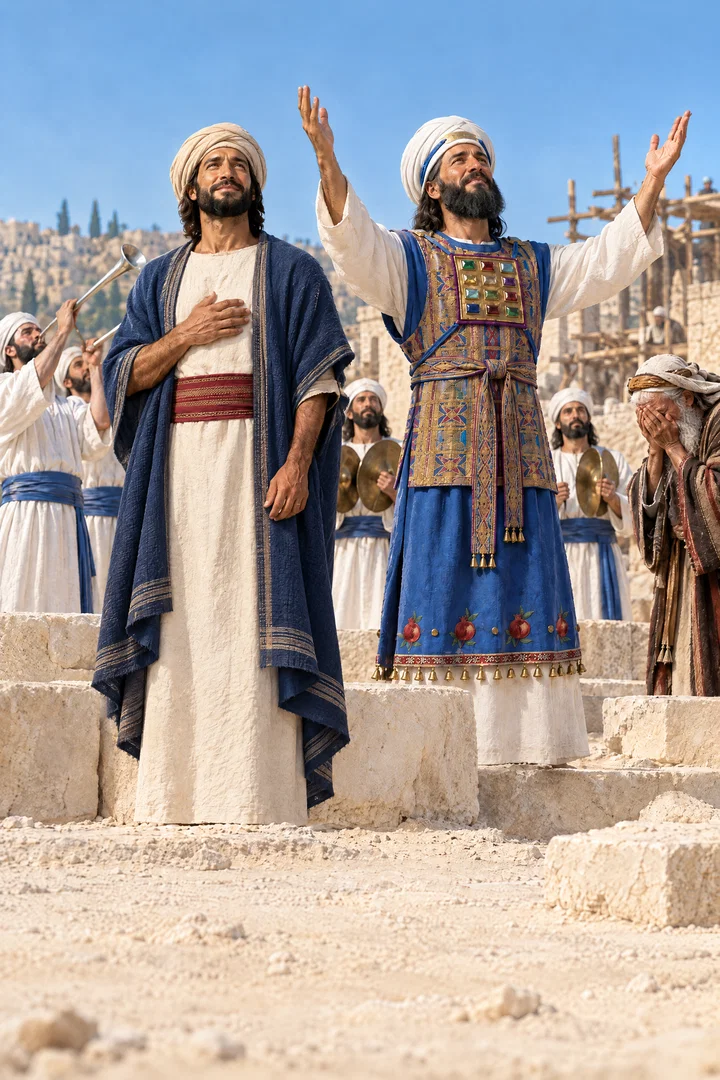
Then stood up Jeshua the son of Jozadak, and his brethren the priests, and Zerubbabel the son of Shealtiel, and his brethren, and builded the altar of the God of Israel, to offer burnt offerings thereon, as it is written in the law of Moses the man of God.
Translations
Then stood up Jeshua the son of Jozadak, and his brothers the priests, and Zerubbabel the son of Shealtiel, and his brothers, and built the altar of the God of Israel, to offer burnt offerings thereon, as it is written in the law of Moses the man of God.
King James Version, KJV Cambridge Paragraph Bible, Revised Version
Then stood up Jeshua the son of Jozadak, and his brethren the priests, and Zerubbabel the son of Shealtiel, and his brethren, and builded the altar of the God of Israel, to offer burnt offerings thereon, as it is written in the law of Moses the man of God.
Then stood up Jeshua the son of Jozadak, and his brethren the priests, and Zerubbabel the son of Shealtiel, and his brethren, and built the altar of the God of Israel, to offer burnt-offerings on it as it is written in the law of Moses the man of God.
Then stood up Jeshua the son of Jozadak, and his brethren the priests, and Zerubbabel the son of Shealtiel, and his brethren, and builded the altar of the God of Israel, to offer burnt-offerings thereon, as it is written in the law of Moses the man of God.
And rise doth Jeshua son of Jozadak, and his brethren the priests, and Zerubbabel son of Shealtiel, and his brethren, and they build the altar of the God of Israel, to cause to ascend upon it burnt-offerings, as it is written in the law of Moses, the man of God.
Then stood up Jeshua the son of Jozadak, and his brethren the priests, and Zerubbabel the son of Shealtiel, and his brethren, and built the altar of the God of Israel, to offer up burnt-offerings on it, as it is written in the law of Moses the man of God.
Then arose—Jeshua son of Jozadak and his brethren the priests, and Zerubbabel son of Shealtiel and his brethren, and built the altar of the God of Israel,—to offer thereon ascending-sacrifices, as it was written in the law of Moses, the man of God.
Berean Standard Bible, Majority Standard Bible
Then Jeshua son of Jozadak and his fellow priests, along with Zerubbabel son of Shealtiel and his associates, began to build the altar of the God of Israel to sacrifice burnt offerings on it, as it is written in the Law of Moses the man of God.
Then Jeshua the son of Jozadak stood up with his brothers the priests and Zerubbabel the son of Shealtiel and his relatives, and built the altar of the God of Israel, to offer burnt offerings on it, as it is written in the law of Moses the man of God.
Then Jeshua, the son of Jozadak, and his brothers the priests, and Zerubbabel, the son of Shealtiel, with his brothers, got up and made the altar of the God of Israel for burned offerings as is recorded in the law of Moses, the man of God.
Then stoode vp Ieshua rhe sonne of Iozadak, and his brethren the Priests, and Zerubbabel the sonne of Shealtiel, and his brethren, and builded the altar of the God of Israel, to offer burnt offerings thereon, as it is written in ye Lawe of Moses the man of God,
Douay-Rheims (Challoner revision)
And Josue the son of Josedec rose up, and his brethren the priests, and Zorobabel the son of Salathiel, and his brethren, and they built the altar of the God of Israel that they might offer holocausts upon it, as it is written in the law of Moses the mall of God.
Pictures
Cross-references
- Haggai 2:3-4
Who is left among you that saw this house in her first glory? and how do ye see it now? is it not in your eyes in comparison of it as nothing?
Haggai encourages the leaders and people rebuilding the temple to be strong and continue the work.
- Haggai 1:1-8
In the second year of Darius the king, in the sixth month, in the first day of the month, came the word of the LORD by Haggai the prophet unto Zerubbabel the son of Shealtiel, governor of Judah, and to Joshua the son of Josedech, the high priest, saying,
The call to build the temple continues the work begun with the altar.
- Ezra 5:1-2
Then the prophets, Haggai the prophet, and Zechariah the son of Iddo, prophesied unto the Jews that were in Judah and Jerusalem in the name of the God of Israel, even unto them.
God's people resume rebuilding the temple despite opposition.
- Ezra 1:1-4
Now in the first year of Cyrus king of Persia, that the word of the LORD by the mouth of Jeremiah might be fulfilled, the LORD stirred up the spirit of Cyrus king of Persia, that he made a proclamation throughout all his kingdom, and put it also in writing, saying,
Cyrus’s decree permitted the return and rebuilding of the temple.
- Ezra 4:4-5
Then the people of the land weakened the hands of the people of Judah, and troubled them in building,
Opponents weakened and frustrated the rebuilding work begun after the return.
- Ezra 6:14
And the elders of the Jews builded, and they prospered through the prophesying of Haggai the prophet and Zechariah the son of Iddo. And they builded, and finished it, according to the commandment of the God of Israel, and according to the commandment of Cyrus, and Darius, and Artaxerxes king of Persia.
Temple rebuilding prospered through Haggai’s prophesying.
- Haggai 1:12-14
Then Zerubbabel the son of Shealtiel, and Joshua the son of Josedech, the high priest, with all the remnant of the people, obeyed the voice of the LORD their God, and the words of Haggai the prophet, as the LORD their God had sent him, and the people did fear before the LORD.
Describes Zerubbabel and Joshua leading the people in the work.
- Exodus 29:38-42
Now this is that which thou shalt offer upon the altar; two lambs of the first year day by day continually.
Prescribes regular morning and evening offerings.
- Ezra 3:8-10
Now in the second year of their coming unto the house of God at Jerusalem, in the second month, began Zerubbabel the son of Shealtiel, and Jeshua the son of Jozadak, and the remnant of their brethren the priests and the Levites, and all they that were come out of the captivity unto Jerusalem; and appointed the Levites, from twenty years old and upward, to set forward the work of the house of the LORD.
Names Zerubbabel and Joshua in the rebuilding work.
- Ezra 2
Now these are the children of the province that went up out of the captivity, of those which had been carried away, whom Nebuchadnezzar the king of Babylon had carried away unto Babylon, and came again unto Jerusalem and Judah, every one unto his city;
list of returnees preceding the building work
- Isaiah 44:28
That saith of Cyrus, He is my shepherd, and shall perform all my pleasure: even saying to Jerusalem, Thou shalt be built; and to the temple, Thy foundation shall be laid.
Cyrus is named as the one who would help rebuild Jerusalem and its temple.
- Zechariah 4:9
The hands of Zerubbabel have laid the foundation of this house; his hands shall also finish it; and thou shalt know that the LORD of hosts hath sent me unto you.
Names Zerubbabel as completing the temple work.
- Zechariah 6:11-12
Then take silver and gold, and make crowns, and set them upon the head of Joshua the son of Josedech, the high priest;
Connects Joshua with the promised restoration.
- Zechariah 4:6
Then he answered and spake unto me, saying, This is the word of the LORD unto Zerubbabel, saying, Not by might, nor by power, but by my spirit, saith the LORD of hosts.
The rebuilding work would be accomplished by God’s Spirit, not human might.
- Jeremiah 29:10-11
For thus saith the LORD, That after seventy years be accomplished at Babylon I will visit you, and perform my good word toward you, in causing you to return to this place.
foretold the return fulfilled when altar was set up
- Ezra 4:7-24
And in the days of Artaxerxes wrote Bishlam, Mithredath, Tabeel, and the rest of their companions, unto Artaxerxes king of Persia; and the writing of the letter was written in the Syrian tongue, and interpreted in the Syrian tongue.
later stopping of the work begun in the verse
- Ezra 3:11
And they sang together by course in praising and giving thanks unto the LORD; because he is good, for his mercy endureth for ever toward Israel. And all the people shouted with a great shout, when they praised the LORD, because the foundation of the house of the LORD was laid.
The people praise God as the temple foundation is laid.
Commentary
Each commentary is drawn from primary sources: the writings of Ellen G. White and Adventist pioneers and periodicals. Each commentary is separate. Its own words are not a quotation; follow the references to read the source passages.
Ellen G. White
4 sources
Soon after the return from exile, the people gathered together in Jerusalem in the seventh month.RH Mar 28, 1907 Jeshua son of Jozadak stood up with his brethren the priests, together with Zerubbabel son of Shealtiel with his brethren and associates, and set the altar upon its base on the former site where the temple altar had stood.PK 559.2–560.2RH Mar 28, 1907 They rebuilt the altar of the God of Israel to offer burnt offerings upon it as written and prescribed in the law of Moses the man of God, thus restoring the sacred services that had been interrupted by the destruction of Jerusalem, with sacrifices offered morning and evening.PK 559.2–560.2RH Mar 28, 1907 Fear of the peoples surrounding them did not prevent them from restoring worship.RH Mar 28, 1907
The daily burnt offerings cheered the faithful remnant among the returned exiles.PK 559.2–560.2 They valued the approval and forgiveness of God above the restoration of property and privileges, and they longed for a lasting token of His presence among them.PK 559.2–560.2 The restoration of the altar strengthened their hope of beholding the glory of God in the temple yet to be rebuilt.PK 559.2–560.2
The verse calls upon God's people to rise up at once and without delay to build a house for the Lord where He has directed them to locate it.Ms 175, 1897, par. 67–69 Such a building is to show honor to Him, providing a place where they may worship God in humbleness of mind and kneeling, and serve Him fittingly and in order, undertaken in faith and haste.Ms 175, 1897, par. 67–69 It is to be dedicated to God as a witness to the truth they believe.Ms 175, 1897, par. 67–69 The rebuilding was God-appointed work that those not in harmony with God tried to hinder and counterwork.Lt 194, 1902, par. 5–7 To attempt to hinder such good work, even by those who have received light from God, offends God, and He will not endorse, approve, or countenance it.Lt 194, 1902, par. 5–7
Sources
Pioneers and periodicals
18 sources
After the Babylonian captivity ended, the decree of Cyrus of Persia in 536 B.C. opened the way for Zerubbabel the descendant of David and governor of Judea and Jeshua the high priest to lead more than forty-two thousand exiles back in 535 B.C.RH Sep 14, 1916ST Jun 10, 1913 Jeshua with his brethren the priests and Zerubbabel with his brethren stood up and rebuilt the altar of the God of Israel upon its base to offer burnt offerings morning and evening as written in the law of Moses.RH Mar 28, 1907ST Dec 26, 1892ST Mar 26, 1902ST Mar 13, 1893ST Feb 11, 1886 This restoring of the altar and its offerings was their first work when gathered at Jerusalem in the seventh month, before the temple itself was rebuilt and before its foundation was laid.ST Mar 26, 1902ST Mar 13, 1893ST Jun 10, 1913 They put the worship of God first before fortifications or alliances, setting the altar in place and seeking Him for protection despite their fear of the surrounding peoples.ST Mar 26, 1902ST May 10, 1910ST Dec 26, 1892ST Dec 26, 1892 Their careful conformity to the written law showed the conviction learned through captivity and hardship that national and temporal success depended on obedience, making them especially precise because of fear.ST May 10, 1910
Return and Altar Rebuilding
After the Babylonian captivity ended, return became possible through the decree of Cyrus of Persia in 536 B.C.RH Sep 14, 1916ST Jun 10, 1913 The return was led by Zerubbabel, a direct descendant of David and governor of Judea, together with Jeshua or Joshua the high priest, at the head of over forty-two thousand exiles.RH Sep 14, 1916ST Jun 10, 1913 This setting up of the altar belongs to the first year of the return, reckoned as 535 B.C., the second year after captivity ended.RH Sep 14, 1916
Then Jeshua the son of Jozadak with his brethren the priests, and Zerubbabel the son of Shealtiel with his brethren and associates, stood up and rebuilt the altar of the God of Israel.RH Mar 28, 1907ST Dec 26, 1892ST Feb 11, 1886 They set it on its base and foundations to offer burnt offerings thereon morning and evening, as written in the law of Moses the man of God.RH Mar 28, 1907ST Dec 26, 1892ST Feb 11, 1886 The people were gathered in Jerusalem, and this rebuilding of the altar and restoring of burnt offerings was their first work before the temple itself was rebuilt and before its foundation was laid.ST Mar 26, 1902ST Mar 13, 1893ST Jun 10, 1913ST Feb 11, 1886 These offerings were begun at the start of the seventh month.ST Mar 26, 1902
Work on the temple foundations was begun two years later.RH Sep 14, 1916 That work was soon stopped by bitter opposition from adversaries and surrounding peoples under Artaxerxes.RH Sep 14, 1916ST Jun 2, 1909 It was then left at a standstill for fourteen years until Haggai and Zechariah in 520 B.C. called the people to arise and rebuild the sanctuary.RH Sep 14, 1916ST Jun 2, 1909 The work was resumed under Darius and finished, with the temple dedicated in four years in 516 B.C.RH Sep 14, 1916
Obedient Worship Under Fear
After the return from exile the leaders and people put the worship of God first, building the altar and preparing to offer sacrifices according to the law of Moses before fortifying themselves against hostile neighbors or securing themselves by alliances.ST Dec 26, 1892ST Dec 26, 1892 God was thus given first place, and worship was ordered to follow His direction and instruction.ST Dec 26, 1892ST Dec 26, 1892 They trusted God rather than first securing themselves, acting in faith though hostile peoples were nearby.ST Dec 26, 1892ST Dec 26, 1892
They set the altar on its foundations and upon its base and restored worship despite fear of the surrounding peoples and fear of trouble from them.RH Mar 28, 1907ST Mar 26, 1902ST May 10, 1910 Fear did not prevent them from restoring worship, for though they feared their enemies in the land they earnestly sought God for protection.RH Mar 28, 1907ST Dec 26, 1892 The people gathered in Jerusalem in the seventh month, and Jeshua with the priests and Zerubbabel with his associates and companions rebuilt the altar of Israel's God to offer burnt offerings morning and evening as prescribed in the written law.RH Mar 28, 1907ST Mar 26, 1902 Their careful conformity to God's written law reflected a growing conviction, shaped by captivity and hardship, that their national and temporal success depended on obedience, and their fear made them especially precise in obeying God.ST May 10, 1910
The altar allowed them to observe the appointed offerings and festivals beginning at the start of the seventh month, even before the temple itself was rebuilt.ST Mar 26, 1902 Yet without a temple they could not keep the Day of Atonement in due order.ST Mar 26, 1902
Prophecy and Scripture Links
The altar-building belongs to the account of rebuilding the temple after the return from exile, a work that afterward languished while Jerusalem lay in ruins and the people grew discouraged.ST Aug 23, 1899 That languishing and discouragement provides the historical setting for Haggai's messages to encourage the builders to resume their task.ST Aug 23, 1899 Zerubbabel and Joshua were the servants raised up to restore Judah and Jerusalem after the desolation brought by the kingdoms represented by the four horns.ST Apr 12, 1883 The temple-building work itself is presented as a type of God's work and its completion.ST Aug 23, 1899
The establishment of religious services and the laying of the temple foundations belong to the work set in motion by the decree to restore Jerusalem.RH Feb 7, 1907 That restoration begun under Cyrus is distinct from the later, fuller decree to restore and build Jerusalem that marks the start of Daniel's prophetic period.ST Feb 25, 1886 The altar and its burnt offerings according to the law of Moses were part of that earlier Cyrus restoration, not the starting point of Daniel's period.ST Feb 25, 1886
In its seventh-month context the altar-building helps show that observances connected with the seventh month are recorded in Scripture.RH Dec 10, 1861 Ezra 3:1-6 records festival observances in the seventh month, including the Feast of Tabernacles.RH Oct 31, 1854 That recorded observance stands in contrast with the absence of any recorded observance of the Day of Atonement.RH Oct 31, 1854 The rebuilding by Zerubbabel after the captivity marks the end of the period beginning with Solomon's reign and the beginning of the period running to the close of the Old Testament and the sending out of the twelve disciples by Christ.RH Jan 6, 1910 It thus belongs among the principal historical events from creation to the apostles, connecting the two dispensations and showing their close relation.RH Jan 6, 1910
Sources