Galatians 5:19
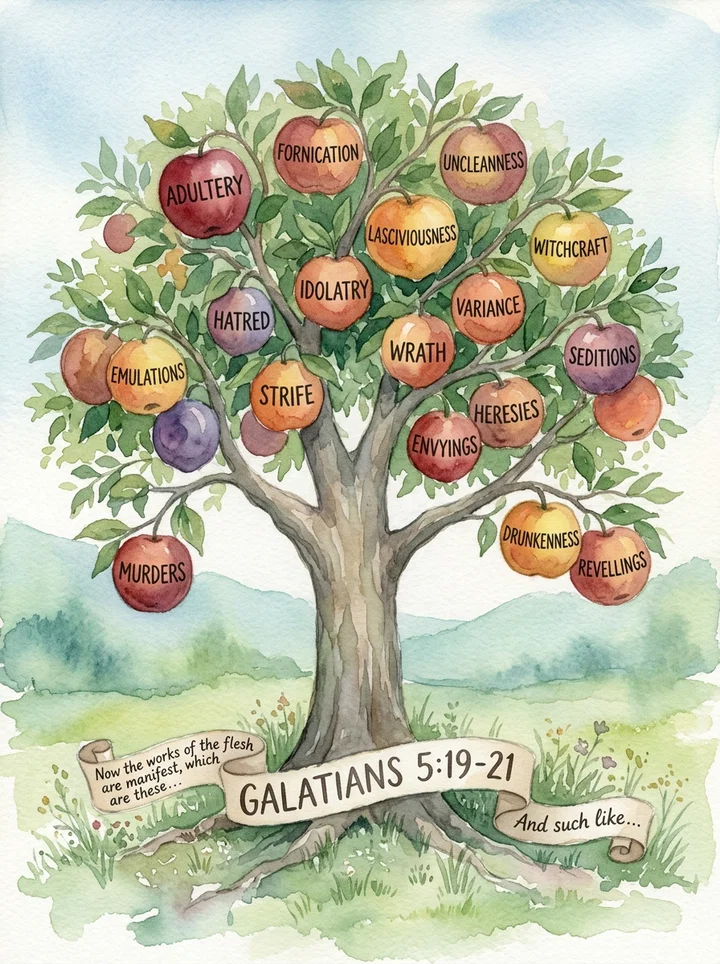
Now the works of the flesh are manifest, which are these; Adultery, fornication, uncleanness, lasciviousness,
Translations
American King James Version, King James Version, KJV Cambridge Paragraph Bible
Now the works of the flesh are manifest, which are these; Adultery, fornication, uncleanness, lasciviousness,
Now the works of the flesh are manifest, which are these, Adultery, fornication, uncleanness, lasciviousness,
Now the works of the flesh are manifest, which are these, fornication, uncleanness, lasciviousness,
Now the works of the flesh are manifest, which are these: fornication, uncleanness, lasciviousness,
And manifest also are the works of the flesh, which are: Adultery, whoredom, uncleanness, lasciviousness,
Now the works of the flesh are manifest, which are fornication, uncleanness, licentiousness,
Manifest, however, are the works of the flesh, which, indeed, are—fornication, impurity, wantonness,
The acts of the flesh are obvious: sexual immorality, impurity, and debauchery;
The acts of the flesh are obvious: adultery, sexual immorality, impurity, and debauchery;
Now the deeds of the flesh are obvious, which are: adultery, sexual immorality, uncleanness, lustfulness,
Now the works of the flesh are clear, which are these: evil desire, unclean things, wrong use of the senses,
Moreouer the workes of the flesh are manifest, which are adulterie, fornication, vncleannes, wantonnes,
Douay-Rheims (Challoner revision)
Now the works of the flesh are manifest, which are fornication, uncleanness, immodesty, luxury,
Pictures
Cross-references 20 of 44
- Romans 8:7
Because the carnal mind is enmity against God: for it is not subject to the law of God, neither indeed can be.
It explains the fleshly mind behind these works as hostile to God and unable to submit to his law.
- Mark 7:21-23
For from within, out of the heart of men, proceed evil thoughts, adulteries, fornications, murders,
Both list sins that come from within the human heart.
- Romans 1:29-31
Being filled with all unrighteousness, fornication, wickedness, covetousness, maliciousness; full of envy, murder, debate, deceit, malignity; whisperers,
Both texts catalogue sins produced by the carnal heart.
- Galatians 5:24
And they that are Christ’s have crucified the flesh with the affections and lusts.
Christ’s followers crucify the flesh and its lusts, rejecting the works of the flesh.
- Galatians 6:8
For he that soweth to his flesh shall of the flesh reap corruption; but he that soweth to the Spirit shall of the Spirit reap life everlasting.
Sowing to the flesh, including its works, brings corruption.
- Romans 8:13
For if ye live after the flesh, ye shall die: but if ye through the Spirit do mortify the deeds of the body, ye shall live.
The Spirit enables believers to put the flesh’s sinful deeds to death.
- Romans 8:6
For to be carnally minded is death; but to be spiritually minded is life and peace.
Being carnally minded is death.
- 1 John 2:16
For all that is in the world, the lust of the flesh, and the lust of the eyes, and the pride of life, is not of the Father, but is of the world.
Names worldly lusts as the source of corrupt deeds.
- Matthew 5:28
But I say unto you, That whosoever looketh on a woman to lust after her hath committed adultery with her already in his heart.
Jesus teaches that lustful looking is adultery in the heart.
- Romans 7:23
But I see another law in my members, warring against the law of my mind, and bringing me into captivity to the law of sin which is in my members.
The law of sin in the members portrays the flesh’s power toward sin.
- Romans 8:1
There is therefore now no condemnation to them which are in Christ Jesus, who walk not after the flesh, but after the Spirit.
Those in Christ walk by the Spirit rather than the flesh and have no condemnation.
- Matthew 15:19
For out of the heart proceed evil thoughts, murders, adulteries, fornications, thefts, false witness, blasphemies:
Both texts list sinful deeds arising from within.
- 1 Corinthians 6:9-10
Know ye not that the unrighteous shall not inherit the kingdom of God? Be not deceived: neither fornicators, nor idolaters, nor adulterers, nor effeminate, nor abusers of themselves with mankind,
Both name sinful practices and warn that those who practice them will not inherit God's kingdom.
- Ephesians 2:3
Among whom also we all had our conversation in times past in the lusts of our flesh, fulfilling the desires of the flesh and of the mind; and were by nature the children of wrath, even as others.
Both describe the unregenerate life as ruled by fleshly lusts.
- John 3:6
That which is born of the flesh is flesh; and that which is born of the Spirit is spirit.
Birth of the flesh is the condition behind the works of the flesh.
- Romans 7:14
For we know that the law is spiritual: but I am carnal, sold under sin.
The spiritual law contrasts with the flesh, which is in bondage under sin.
- Ephesians 5:3-5
But fornication, and all uncleanness, or covetousness, let it not be once named among you, as becometh saints;
Both name uncleanness and sexual sins, and warn that the unclean have no inheritance in God’s kingdom.
- Exodus 20:14
Thou shalt not commit adultery.
The seventh commandment forbids adultery, one of the works of the flesh.
- 1 Thessalonians 4:7
For God hath not called us unto uncleanness, but unto holiness.
Both describe God’s people as called away from uncleanness toward holiness.
- Romans 8:8
So then they that are in the flesh cannot please God.
Those who live in the flesh cannot please God.
Commentary
Each commentary is drawn from primary sources: the writings of Ellen G. White and Adventist pioneers and periodicals. Each commentary is separate. Its own words are not a quotation; follow the references to read the source passages.
Ellen G. White
39 sources
The works of the flesh are open and evident in the life, beginning with sexual immorality, impurity and sensuality in its forms of adultery, fornication, uncleanness and lasciviousness.Ms 8a, 1888, par. 1–3Lt 43, 1888, par. 23–25Lt 77, 1893, par. 26–30Ms 20, 1888, par. 20–27Lt 252, 1908, par. 6–7 The same list goes on to include idolatry, witchcraft, hatred, variance, emulations, wrath, strife, seditions, heresies, envyings, murders, drunkenness, revellings and everything like them.Lt 106a, 1896, par. 21Lt 156, 1900, par. 11–13Ms 20, 1888, par. 20–27 They stand in direct contrast to the fruit of the Spirit, which is love, joy, peace, longsuffering, gentleness, goodness, faith, meekness and temperance.Ms 8a, 1888, par. 1–3Lt 77, 1893, par. 26–30Lt 252, 1908, par. 6–7 Those who practice such works will not inherit the kingdom of God, and hatred, envy, wrath, strife and jealousy will as surely shut the guilty out of heaven as adultery, murder and drunkenness.Lt 106a, 1896, par. 21Ms 10a, 1898, par. 11–13Lt 43, 1888, par. 23–255T 244.2 Those who are Christ's have crucified the flesh with its affections and lusts, and victory comes only by walking in the Spirit and through the Spirit putting to death the deeds of the body.Ms 10a, 1898, par. 11–13Lt 77, 1893, par. 26–30Lt 156, 1900, par. 11–13Lt 252, 1908, par. 6–7CH 472.1
Manifest List Explained
The works of the flesh are manifest, meaning open, evident, and known by what appears in the life.Lt 77, 1893, par. 26–30Ms 20, 1888, par. 20–27Lt 252, 1908, par. 6–7ST Jul 4, 18991T 188.1 They become visible in selfishness, covetousness, pride, and evil passions that show evil powers control the heart, while divine truth leads instead to good works and a generous, noble character.1T 188.1TBC1882 43.1–2 The wider list is applied to envy, hatred, jealousy, evil surmising, rivalry, strife, and bitterness as fruits of a corrupted spiritual life, and to harmful conduct and feelings that damage relationships and can shape the life of a family.Ms 20, 1888, par. 20–27TBC1882 43.1–2
The verse names four sexual evils as works of the flesh: adultery, fornication, uncleanness, and lasciviousness, meaning sexual immorality, impurity, and sensuality.Ms 8a, 1888, par. 1–3Lt 43, 1888, par. 23–25Lt 156, 1900, par. 11–13ST Jan 14, 1913 These belong to the same sinful class as hatred, emulation, wrath, strife, seditions, heresies, envy, drunkenness, and murder.ST Jan 14, 1913 Its list continues through the following verses to include idolatry, witchcraft, hatred, variance, emulations, wrath, strife, seditions, heresies, envyings, murders, drunkenness, revellings, and everything like them.Lt 106a, 1896, par. 21Lt 156, 1900, par. 11–13Ms 20, 1888, par. 20–27Lt 252, 1908, par. 6–7Lt 11, 1887, par. 7
Living after the flesh means allowing sensual appetites, lust, and the evil passions of the carnal nature to rule the being.Ms 10a, 1898, par. 11–131SP 395.4 It is bondage to the lower nature and to every appetite and passion and to any hereditary or cultivated habit or tendency to wrong.CH 472.1 When such lust and evil passions rule, they damage the moral affections and encourage skepticism about Christian truth, with doubt wrongly treated as a virtue.1SP 395.4
The verse belongs to a warning against self-indulgence and defilement opposed to purity of character, with idolatry, drunkenness, and similar conduct given as examples of such fleshly lust.BS 26.2CH 69.2CH 22.2 God's people must remain untainted by these corruptions in the last days, keeping the body holy and the spirit pure under the Spirit's control in preparation to receive immortality.CH 22.2 Apart from specifying its particular sins, it identifies conduct opposed to Christian character.Lt 17, 1894, par. 11
Contrast with Spirit's Fruit
The works stand in direct contrast to the fruit of the Spirit, which is love, joy, peace, longsuffering, gentleness, goodness, faith, meekness, and temperance, against which there is no law.Ms 8a, 1888, par. 1–3Lt 77, 1893, par. 26–30Lt 252, 1908, par. 6–7 Kindly words and deeds show the change wrought by grace and fellowship with Christ in place of those works.Ms 8a, 1888, par. 1–3 Idolatry, drunkenness and similar conduct are forms of fleshly lust set against that fruit, including temperance.BS 26.2CH 69.2 Against the defiling works stands love that is pure and unadulterated, proceeding from the heart of Christ, not love-sick sentimentalism nor a beastly, defiling element that destroys all that is pure in mind or body and is death to both soul and body.Lt 106a, 1896, par. 21
Those who are Christ's have crucified the flesh with its affections and lusts.Lt 77, 1893, par. 26–30Lt 252, 1908, par. 6–7BS 26.2CH 69.2 The flesh lusts against the Spirit and the Spirit against the flesh, and they are contrary to one another so that people cannot do the things they would.Lt 156, 1900, par. 11–13 Walking in the Spirit keeps from fulfilling the lust of the flesh, and those led by the Spirit are not under bondage to the law.Lt 156, 1900, par. 11–13CH 69.2 Those who live in the Spirit must also walk in the Spirit, not seeking vainglory by provoking and envying one another, but restoring one overtaken in fault in meekness and bearing one another's burdens.Lt 77, 1893, par. 26–30Lt 252, 1908, par. 6–7
The works are known by what appears in the life, revealing whether justice and purity and truth abide in the heart, for membership in the church does not make a person a Christian.Lt 77, 1893, par. 26–30 Separation from Christ causes division, discord, contention, prejudice of brother against brother, desire for vainglory, provoking one another and envying one another, with continual contradiction and variance with one another and strife, envy and jealousy as ruling elements.Lt 77, 1893, par. 26–30Ms 2, 1881, par. 11 Union with Christ is the secret of unity, with believers approaching one another just in proportion as they approach Christ the center.Lt 77, 1893, par. 26–30 A heart ruled by God's Spirit produces harmony, peace, love, meekness, benevolence, kindness, mercy and unity, for God is benevolence, mercy and love, and a person's fruit reveals which influence is at work, testing professed followers by what they bear.Ms 2, 1881, par. 11CT 90.3TBC1882 11.25T 28.2
Fanaticism is a work of the flesh, produced when Satan's power is brought to bear upon the carnal mind.LS 96.1–3 It seeks to clothe itself to resemble truth and righteousness, but it falls infinitely short of counterfeiting the work of God, which the work of high heaven he cannot imitate.LS 96.1–3 When carried out and ripened into bitterness, its terrible fruit stands in contrast to the fruit of the work and Spirit of God, as wide as Beelzebub with Christ and perdition with terror and blackness of despair with the glories of the kingdom of God.LS 96.1–3 The road of the flesh leads to death and lies in the opposite direction from the road to life, not side by side with it, and the two must not be mixed as if both came from heaven, nor must the pure work of God be called Satan's work because fanaticism has appeared beside it.LS 96.1–3
Shut Out from Kingdom
Those who practice the manifest works of the flesh will not inherit the kingdom of God.Lt 106a, 1896, par. 21Ms 10a, 1898, par. 11–13Lt 43, 1888, par. 23–25Lt 156, 1900, par. 11–13Ms 20, 1888, par. 20–27 Those works are open and evident, beginning with adultery, fornication, uncleanness and lasciviousness, and continuing with idolatry, witchcraft, hatred, variance, emulations, wrath, strife, seditions, heresies, envyings, murders, drunkenness, revellings and everything like them.Lt 106a, 1896, par. 21Lt 156, 1900, par. 11–13Ms 20, 1888, par. 20–27Lt 252, 1908, par. 6–7 Persisting in them and keeping on indulging them bars the doer from the kingdom, so the warning calls for waking up and for honest self-examination with no excuses about whether one is approaching any such sin.Ms 10a, 1898, par. 11–13Ms 20, 1888, par. 20–27
Hatred, emulation, wrath, strife, seditions, heresies and envyings are as truly works of the flesh as lasciviousness, adultery, drunkenness and murder.5T 244.2ST Jan 14, 1913 Trying to correct the faults of others by indulging hatred and contention commits sins equally great.5T 244.2 Each of these will as surely shut the guilty out of heaven and close its gate against them.5T 244.2ST Jan 14, 1913
Jealousy of one another is a manifest work of the flesh, and those who hold it will never reach heaven, for nothing of that kind will be there.Ms 13, 1886, par. 9 In its place there must be the likeness of Christ in the heart right at home, a little heaven on earth now, with tenderness for one another and love that is not crushed when hearing of another's errors.Ms 13, 1886, par. 9 The works of the flesh are untruthfulness, impurity and unrighteousness, an evil nature that cannot inherit the kingdom of God and cannot enter heaven, though a great price has been paid for redemption from that condition.16MR 273.3 Every person must make Christ a personal Saviour and become true and pure and holy, for if sin is not destroyed in the sinner the sinner himself must be destroyed, because sin left remaining will destroy the sinner just as designed.16MR 273.3
Hatred Division and Corruption
Trying to correct the faults of others by indulging hatred and contention commits sins equally great as lasciviousness, adultery, drunkenness and murder, for hatred, emulation, wrath, strife, seditions, heresies and envyings are as truly works of the flesh, and they will as surely shut the guilty out of heaven.5T 244.2 Envy, strife, jealousy, variance, hatred, rivalry, evil surmising, emulation and bitterness are the unholy fruit of a heart not in harmony with Christ, the work of Satan seen among his children and acts of obedience to Satan rather than Christ.Ms 2, 1881, par. 11AAP 8.3TBC1882 43.1–25T 28.2 They grow from a divided heart open to his suggestions as he sows dissension to ruin souls and bodies, break up families, and produce sedition and murder, and they stand opposite to the harmony, peace, love, meekness, benevolence, kindness, mercy and unity produced when God's Spirit rules the heart.Ms 2, 1881, par. 115T 28.24SP 327.1–2 Bearing that fruit means cherishing evil and being separated from God, going astray and standing guilty, forsaking the Fountain of living waters for broken cisterns that can hold no water and corrupting the way before God, so that those who bear it will not heed corrective testimony nor see their perverse ways and be converted to be healed.5T 63.2 Pride, vanity, frivolity, worldliness, greed, unkindness and faultfinding likewise reveal companionship with an evil spirit.AAP 8.3
Fanaticism also is a work of the flesh produced when Satan's power bears upon the carnal mind, clothed to resemble truth and righteousness yet falling infinitely short of counterfeiting God's work, which high heaven's work he cannot imitate.LS 96.1–3 When carried out and ripened into bitterness its terrible fruit contrasts with the fruit of God's work and Spirit as widely as Beelzebub with Christ and perdition with terror and blackness of despair with the glories of the kingdom, for the road of the flesh leads to death in the opposite direction from the road to life, not side by side with it, and the two must not be mixed as if both came from heaven.LS 96.1–3 Hatred, emulation, jealousy and deadly strife mark the ungodly even when they look united, for their oneness is only in opposition to God's will and truth, a deceptive harmony that only partly hides a perpetual discord dividing them on every other point.5T 101.1 Division and variance among believers are not fruits of righteousness but come from the evil one, and selfishness that prevents fellowship likewise obstructs the progress of the church.STGC 85.1
The warning applies to widespread lawlessness, corruption and lust in society and within professedly Christian families, where unhappy jealousies and differences are the greatest detriment to the churches, bringing them into weakness and disfavor with God.Lt 11, 1887, par. 7ST Jul 4, 1899 Satan intrudes into every household, every city street, the churches, the national councils and the courts of justice to perplex, deceive, seduce, ruin the souls and bodies of men, women and children and break up families, sowing hatred, emulation, strife, sedition and murder, evils not appointed by God to exist and be accepted though ignorance of his devices leads the Christian world to regard them so.4SP 327.1–2GC 508.1 The same manifest works appear as selfishness, rivalry and separation of interests that break harmony and create disunion, Satan's studied plan imbued into humanity under pretense of necessity when it is not needful, dimming perception by worldly policy so it cannot be discerned as a hateful, poisonous root springing up to defile the whole man.Ms 176, 1901, par. 3–4 That selfishness displeases God, corrupts the experience of every soul admitting it, shows the human ruling actions far more than the divine, brings in principles God hates, and has corrupted principal institutions including every publishing establishment.Ms 176, 1901, par. 3–4
The works become visible as selfishness, covetousness, pride and evil passions, revealing that evil powers control the heart, whereas divine truth leads to good works and a generous, noble character.1T 188.1 Selfishness is a sin held as a natural family besetment that is rebuked but not confessed, and the natural ways and habits of the flesh are made manifest in alienation between relatives, which must be changed by grace so that God's Spirit rules the heart.LJAHS 15.2Ms 63, 1896, par. 23 They are openly manifest also in laboring for the esteem and applause of men, in vainglory, in dissatisfaction at not standing first in every calling and work, in envy and jealousy, in demeriting the one envied, in magnifying any fault in him, and in seeking to injure his reputation by picking at others.Lt 11, 1887, par. 10 These are crowded into the heart by Satan to steal away humility and meekness, love and patience, they prove a person is exercised by another spirit than that of meekness and love, and they are hateful in the sight of a holy God but pleasing to the devil.Lt 11, 1887, par. 10 The works spread when people are taught they need not obey God and when divine precepts are set aside, so that sin no longer appears sinful and righteousness no longer seems desirable, producing lust and other vice alongside envy, hypocrisy, strife and betrayal of sacred trusts, damaging family and social life and bringing lawlessness and licentiousness of the kind that brought judgment on the heathen.ST Aug 27, 1885ST Aug 27, 1885
Call to Victory Living
Christ has bought the souls, minds, and bodies of all His creatures, and He is dishonored when any precious soul corrupts the mind or the body by these manifest works.Lt 106a, 1896, par. 21 Souls enfeebled by selfish degrading passions can be remedied only by the life-giving power of the gospel, the aid of God as Great Physician, and the quickening power of the Holy Spirit to restore the moral image of God in man.Ms 10a, 1898, par. 11–13 Victory over every inherited or cultivated tendency to wrong is not gained by battling evil in finite human strength but through power God imparts to rule every appetite and passion.Ms 10a, 1898, par. 11–13CH 472.1
The warning calls for honest self-examination with no excuses to see if one is approaching the committing of any such sin.Ms 20, 1888, par. 20–27Lt 11, 1887, par. 7 Membership in the church does not make a person a Christian, but whether justice and purity and truth abide in the heart is revealed by fruit, and professed followers are tested by what fruit they bear.Lt 77, 1893, par. 26–301T 188.1TBC1882 11.25T 28.2 The works become visible in the life, including selfishness, covetousness, pride, evil passions, variance, envy, strife, and jealousy, which show what spirit is at work as opposed to the harmony, love, and unity created when God's Spirit rules the heart.1T 188.1TBC1882 11.25T 28.2
The verse warns to wake up and instead walk in the Spirit and through the Spirit mortify the deeds of the body so the lust of the flesh is not fulfilled, purifying the mind by obedience to truth.Ms 10a, 1898, par. 11–13 God's people must keep the body holy and the spirit pure under the Spirit's control as they prepare to receive immortality, remaining untainted by the defilement and corruption opposed to purity of character.CH 22.2 Becoming thorough students of the Bible and doers of the Word through obedience to all requirements lays a sure foundation.Lt 252, 1908, par. 6–7 Every person must make Christ a personal Saviour to become true and pure and holy.16MR 273.3
The change wrought by grace and fellowship with Christ is shown in kindly words and deeds.Ms 8a, 1888, par. 1–3 The natural ways and habits that produce alienation, especially between relatives, must be changed by grace so the Spirit rules the heart.Ms 63, 1896, par. 23 In place of jealousy there must be the similitude of Christ in the heart right at home, a little heaven on earth now, with tenderness for one another and love that is not crushed when hearing of another's errors.Ms 13, 1886, par. 9
Sources
Pioneers and periodicals
149 sources
The works of the flesh are open and plainly visible in conduct, evident to all in what people do.ST Jun 24, 1886ST Jul 15, 1886 The verse begins a connected list that runs through the following verses, naming sexual impurity first and then idolatry, hatred, strife, envy, drunkenness, reveling and the rest, with its closing words showing it was never meant as an exhaustive code.ST Feb 27, 1893ST Jul 15, 1880RH May 15, 1856ST May 6, 1880RH Jun 23, 1868 They are the spontaneous outworking of the corrupt unconverted heart, growing by themselves like weeds, proving that by nature humanity is hostile to God, unable to submit to His law, and subject to death.RH May 15, 1856ST Apr 20, 1904RH Nov 1, 1870RH May 9, 1871ST Jul 7, 1890 They stand in direct opposition to the fruit of the Spirit, which is love, joy, peace, long-suffering, kindness, goodness, faithfulness, meekness and temperance; there are only these two kinds of fruit, and walking by the Spirit keeps a person from fulfilling the lust of the flesh.RH Mar 7, 1871ST Oct 7, 1897RH Feb 16, 1860RH Mar 18, 1858RH Jul 6, 1868 Those who practice such things are voluntary transgressors of God's moral law and shall not inherit the kingdom of God, for whatever is sown to the flesh is reaped as corruption, decay and death.ST Jun 24, 1886ST Feb 27, 1893ST Mar 3, 1914ST Dec 11, 1884ST Jul 15, 1886
Wording and Enumeration
The works of the flesh are open, evident, plainly visible and recognizable in conduct, which is the force of the word manifest.ST Jun 24, 1886ST Jul 15, 1886ST Jun 17, 1889RH Mar 18, 1858 They are the visible outworking of the natural heart, the opposite of the fruit of the Spirit in verses 22-23, and those who practice them will not inherit the kingdom of God.ST Jun 24, 1886RH Mar 18, 1858ST Dec 1, 1887 The verse begins a connected list that continues through the following verses, naming adultery, fornication, uncleanness and lasciviousness first and then idolatry, witchcraft, hatred, variance, emulations, wrath, strife, seditions, heresies, envyings, murders, drunkenness, revelings and other evils, seventeen sins in all.ST Feb 27, 1893RH May 15, 1856ST Nov 29, 1899RH Jul 10, 1916 Wrath belongs within that larger catalogue as one of the excluding sins, witchcraft and the rest of verses 20-21 belong to the same list, and walking by the Spirit keeps a person from fulfilling the lust of the flesh so that those led by the Spirit are not under the law.ST Feb 27, 1893RH May 15, 1856ST May 6, 1880RH Dec 11, 1855
The list is not exhaustive and was never meant as a complete code of duty.ST Jul 15, 1880RH Jun 23, 1868 Its closing words and such like leave it open and include other sins, including violations of the rest of the Ten Commandments.ST Jul 15, 1880RH Jun 23, 1868 Sabbath-breaking is not made permissible by not being named separately, and the same reasoning would wrongly make blasphemy, dishonoring parents and coveting permissible.ST Jul 15, 1880 Unlike the ten commandments, which are a finished, entire and perfected law to which nothing was added, this catalogue is only a partial sample.RH Jun 23, 1868
Adultery, fornication, uncleanness and lasciviousness are different forms of adultery and related forms of sexual sin.RH Sep 25, 1900RH Sep 25, 1900ST Jan 8, 1902ST Oct 30, 1879 Adultery begins in unclean thought and lustful desire, and the command against it reaches even to lust in the heart.RH Sep 25, 1900 Lasciviousness means loose, wanton, lewd and lustful, tending to excite or produce voluptuous or lewd emotions.ST Jan 8, 1902 It works through art, literature, dress, theatricals, balls, banquets, plays, games, amusements and a thousand other subtle, insidious, beguiling influences with that tendency, and the whole world is a festering mass of corruption on this point.ST Jan 8, 1902ST Oct 30, 1879 This evil can never be stopped by legislation, regulated by law, or checked by popular indignation until the majority are born from above, but purity is cultivated by thinking on what is true, honest, just, pure, lovely and of good report and by reflecting heaven's purity and peace so sinners are convicted, led to repentance, and obtain pardon and purity from the Lord Jesus.ST Jan 8, 1902
Adultery in the verse includes adultery arising from divorce on grounds other than fornication.ST Dec 23, 1908 Such divorce includes the trivial claim of incompatibility and reflects base, lustful marital desires.ST Dec 23, 1908 It also includes spiritual turning of the heart from faithful allegiance to the Lord toward the world, which is the primary element of apostasy and a violation of the seventh commandment.ST Aug 5, 1886 As Eve's heart and longings turned from her allegiance before she ate the forbidden fruit, so inward disloyalty paves the way for deliberate violation of other commandments.ST Aug 5, 1886 Flesh in the verse means the carnal nature opposed to the Spirit within the same person, not flesh as food, and spirit means the spiritual nature.ST Oct 9, 1907RH Feb 20, 1872 In the natural condition spiritual desires are in bondage to the flesh, but when a person yields to God the spiritual nature triumphs as Christ dwells in the heart and unites His Spirit with it.ST Oct 9, 1907
Fallen Nature Revealed
The works are the spontaneous outworking of every corrupt unconverted heart, unholy, impure, selfish and exceedingly sinful, growing by themselves like weeds without sowing or planting and needing no supernatural root, while every pure holy thought and act requires the Holy Spirit implanted by regeneration.RH Nov 1, 1870RH May 9, 1871ST Nov 4, 1930ST Jul 8, 1897ST Dec 16, 1889 They rise from the passions of the flesh and naturally grow upon the carnal heart, proving that the natural tendency of mortal flesh is to sin and that sin brought mortality.RH May 9, 1871ST Jul 7, 1890 No one heart is necessarily guilty of every one of them, yet each person has more or less of them, and they are the fruit of corrupt human nature as bad fruit comes from a corrupt tree.RH May 9, 1871ST Nov 4, 1930 In the natural unregenerate state people cannot produce good deeds or keep the righteous law by their own power, but must first be made righteous through faith by a changed heart.ST Dec 16, 1889 Even so, divine compassion and mercy pitied, helped and sought to save sinners in this terrible filthy condition before they showed any repentance or turning.RH May 9, 1871
They describe the universal natural condition of humanity, incarnate in all mortals, where the carnal mind is hostile to God, cannot submit to His law and cannot please Him, so that by nature people are transgressors, children of wrath, born of the flesh and subject to death.RH May 15, 1856ST Apr 20, 1904ST Feb 7, 1906ST Nov 25, 1908ST Oct 25, 1910 The same evil tendencies are present in everyone though more developed in some, and he who follows the flesh will inevitably manifest the listed deeds whose end is death.ST Apr 20, 1904ST Apr 23, 1896 There may be no open adultery but consuming lust may be present, and drunkenness may not be manifest but hatred and strife may be enthroned, for all are fruits of the same flesh.ST Apr 20, 1904 They prevail wherever the flesh and its desires have not been subdued by grace, and the flesh must be crucified for the Spirit's fruits to abound.RH May 15, 1856 He who will not accept this fundamental fact of his own inherent sinfulness and innate corruption will never receive Christ as his only personal Saviour and will not be saved.ST Apr 20, 1904
They inhere in the carnal mind, which is enmity against God and not subject to His law, even when a person has not outwardly committed every listed crime.RH Feb 16, 1860RH Jul 14, 1874ST Oct 5, 1882ST Oct 7, 1875 They are often restrained more by circumstances than by the will, and only divine goodness and grace keep anyone from committing the outward act.RH Jul 14, 1874ST Apr 30, 1902 Restraint may come from cold pride, early instruction, Christian heritage, lack of temptation, God's providence, fear of consequences or desire for approval, while the root nature remains the same.ST Apr 30, 1902ST Oct 7, 1875 Sin restrained in form is unchanged in root: lust unrestrained becomes adultery and hatred unrestrained becomes murder, with pride leading to envy and envy to hatred and hatred to murder, and self-righteous pride itself being idolatry of self.ST Apr 30, 1902 In divine sight there is little difference between shades of sin, for judgment measures not by social standards but sees selfishness, envy, hatred and lust as the same blackness as the outward deed.ST Apr 30, 1902
The listed deeds are fruits and evidence of what is within, laying bare a perverted diseased heart when uncovered by the Spirit, showing sexual impurity, idolatry and witchcraft, hatred, discord and division, envy and murder, drunkenness and reveling and similar evils dwelling within.ST Nov 7, 1892ST Mar 25, 1880ST Feb 11, 1889ST Dec 5, 1892ST Jun 1, 1904 They are the necessary fruit of a diseased corrupt nature coming from the carnal heart and inherent in sinful flesh, expressing the mind of the flesh opposed to God, so that a man with such a nature can bear no other fruit.ST Dec 5, 1892ST Jun 1, 1904 Even his best deeds come short of glory, for a corrupt tree cannot bring forth good fruit.ST Jun 1, 1904 Preventing them requires putting away the selfish longings, unholy passions and unlawful desires that produce them, for the need is a changed condition and removal of the disease itself, not merely changed deeds or that a sinful act not be repeated, but such a heart and power that he will never repeat it.ST Feb 11, 1889ST Jun 1, 1904 The picture given still scarcely equals the absence of the godly and upright man as created.ST Nov 7, 1892
So long as a person is in the flesh those works will show themselves in spite of the laws of both God and men, and cannot be hidden by outward forms or profession.ST Jun 9, 1890 Not even the law of God itself can regenerate a single soul, so human laws enacting Christianity and compelling conformity cannot regenerate anyone, and grace through faith is the only means of establishing His law in sinful hearts.ST Jun 9, 1890 They grow out of selfish sensual desires and motives and the worldly spirit, from living by self as the highest law with no higher standard than oneself, and people in a sinful world may regard their pleasures and jealous or envious feelings as innocent without recognizing their true character.ST Nov 25, 1889ST Nov 19, 1902 They are not healthy natural fruit but the product of decay and death, the evil fruits produced when the life that comes from God is perverted by sin and ruled by the carnal heart, springing from the evil heart and leading toward death and destruction.ST Dec 5, 1895 Those alienated from God do not know His life in its normal working.ST Dec 5, 1895
Contrast with Spirit
The works of the flesh stand in direct opposition to the fruit of the Spirit, which is love, joy, peace, long-suffering, kindness, goodness, faithfulness, meekness and temperance, against which there is no law.ST Feb 27, 1893RH Feb 16, 1860RH Jul 11, 1865ST Oct 5, 1882ST Jul 29, 1889 They are the visible expression of a spirit that leads to transgression of God's law, belonging to the evil one and to the carnal mind which is enmity against God and is not subject to His law.RH Mar 7, 1871ST Oct 7, 1897RH Feb 16, 1860ST Oct 5, 1882 They prevail wherever the flesh has not been subdued by grace, and conversion brings the heart into harmony with God's law so that the converted no longer do these works but bear the Spirit's fruits which are in harmony with the law.RH Feb 16, 1860RH Jul 11, 1865ST Oct 5, 1882ST Jul 29, 1889 Where the gospel is accepted the old works pass away and love even for enemies appears in their place.RH Mar 7, 1871
There are only two kinds of fruit recognized by the gospel, of the flesh or of the Spirit.RH Mar 18, 1858RH Jul 6, 1868RH Apr 20, 1869RH May 7, 1872 There are not many different good fruits in which each church or sect develops its own peculiar trait of Christian character; all fruit is either of the Spirit or of the flesh.RH Mar 18, 1858RH Jul 6, 1868 Those found with the works of the flesh reap corruption, and those bearing the fruit of the Spirit reap life everlasting.RH Mar 18, 1858RH Apr 20, 1869RH May 7, 1872 Doing these works while professing to serve God and even to obey His law is neglecting known duty and knowingly practicing what is wrong, denying faith in practice, falsifying the truth, deceiving self and others, misrepresenting God's work, robbing God, and doing really the work of Satan.RH Apr 20, 1869 People who are baptized without truly dying to sin remain children of Adam and continue to bear the fruits of the flesh, in contrast to the good fruit borne by those who have died to sin and have the mind of Christ.RH May 7, 1872
The flesh lusts against the Spirit and the Spirit against the flesh, and the two are contrary to one another.ST Feb 27, 1893ST Nov 29, 1899ST Oct 21, 1908ST Mar 1, 1905 Fallen people therefore cannot do the good they would, for sin rules the flesh and makes it hostile to the law, while the Spirit lifts the soul above the flesh's power.ST Feb 27, 1893ST Nov 29, 1899ST Jan 30, 1901 The flesh's desires oppose the things of the Spirit, which are God's commandments, and its service is service to sin.ST Nov 29, 1899ST Apr 30, 1896 Being born after the flesh means birth in the bondage of sin, as illustrated by Ishmael born of the unregenerate bondwoman, and those who live in those works cannot please God.ST Nov 29, 1899ST Mar 1, 1905 Christ shows that the Spirit can rule over the same sinful human flesh.ST Apr 30, 1896
Those led by the Spirit obey God and bring forth fruit in harmony with the law.RH Sep 1, 1868RH Feb 1851RH May 19, 1859ST Dec 5, 1895 They are not under the law, meaning not under its condemnation and judgment, for the law has nothing against those who bear such fruit.RH Sep 1, 1868RH Feb 1851RH May 19, 1859RH Feb 28, 1854 To be dead to the law by the body of Christ is to be justified through Christ from past sins and then to live in obedience so that the law has no condemning power, which does not kill or abolish the law but releases from it as a conditional covenant of life since life despite transgression comes only through Christ while God's standard of purity is unaltered.RH Feb 1851RH May 19, 1859 Walking by the Spirit keeps a person from fulfilling the lust of the flesh and frees from the law of sin and death.ST Feb 27, 1893ST Jan 30, 1901RH Jul 25, 1854 The liberty in this chapter is freedom from sin, and the comparison of the works with the fruit places the listed works within that continuing moral-law discussion, not a shift to the Levitical law.RH Feb 28, 1854RH Jul 25, 1854
Violation of God's Law
The works are open and recognizable in conduct, beginning with adultery, fornication, uncleanness and lasciviousness, and they are voluntary transgressions of God's moral precepts and disobedience to His law.ST Mar 3, 1914ST Jul 15, 1886ST May 13, 1886 They are what is done by nature while serving the flesh apart from Christ, belonging to the fleshly life opposed to walking in the Spirit and to the old man that passes away when a person becomes new in Christ.ST Dec 11, 1884ST Oct 7, 1897ST May 13, 1886 The law stands against such works, exposes them as sin, condemns those who practice them and places them under its sentence of death, contrary both to the commandments of God and to the gospel.ST Jul 15, 1886ST May 13, 1886RH Oct 25, 1853 This visible expression comes from a spirit at enmity with God that is not subject to His law, while those led by the Spirit cherish the Spirit's fruit in harmony with the law, are welcomed as loyal subjects, and are not under the law's penalty and condemnation.ST Mar 3, 1914ST Dec 11, 1884ST Jul 15, 1886ST Oct 7, 1897
In Galatians the list belongs to the foundation principles of the gospel as promised to Abraham and fulfilled in Christ, given because false teachers were perverting the gospel.ST Jun 19, 1907 The law condemns all and shows all by nature under the law, and being under the law means being under its condemnation, so its condemnation leads to Christ to be justified by faith, with pardoning grace removing condemnation without permitting sin but bringing into harmony with God's law.ST Jun 19, 1907ST Feb 20, 1912 Those who try to justify themselves by their own works are in bondage as Hagar was, while those who trust in Christ for justification are children of the free woman and, whether Jew or Greek, bond or free, are all one in Christ Jesus, leaving behind the works of the flesh and bearing in Christ the fruits of the Spirit which are in harmony with His holy law.ST Jun 19, 1907 To be after the flesh and to live after the flesh is to mind the things of the flesh, which is death, cannot please God and ends in death, for to be born of the flesh is to be born in the bondage of sin as the son born of the bondwoman was after the flesh because his mother was a bondwoman unregenerate, and so was her son.ST Apr 11, 1900 That arrangement with Hagar that produced the son after the flesh is a figure of the covenant of Sinai which genders to bondage, where Israel promised in the power and wisdom of the flesh to do God's will, with the same element of self-salvation as Abraham's human device with Hagar.ST Apr 11, 1900
The yoke of bondage is the law of commandments contained in ordinances, not the law of God, with circumcision belonging to the law of Moses and not to the ten commandments, so that taking circumcision binds a person to the whole law of Moses with its offerings and rejects the one offering of Jesus Christ as the only ground of justification.RH Feb 1851 To be dead to the law by the body of Christ is to be justified through Christ from past sins and then to live in obedience so that the law has no condemning power, and dying to the law does not kill or abolish the law.RH May 19, 1859 This is release from the law as a conditional covenant of life, meaning no one enters life on the ground of obedience alone, since all have been disobedient transgressors and life despite transgression comes only through the remedy provided in Christ, while God's standard of purity and holiness is not altered.RH May 19, 1859 Those who live after the flesh are therefore under the law as transgressors and are in bondage, unlike children of the new covenant who have God's law written in their hearts and walk at liberty, and those led by the Spirit are not under the law because there is no law against those who bring forth the fruit of the Spirit.RH Feb 1851 The law is the delight of the saints, and love is the fulfilling of the law because love to God is obedience to the commandments of duty to Him and love to neighbor is obedience to the commandments of duty to him, including the new commandment to love one another even as Christ loved, so love does not make void the law but fulfills it and is the end and design of the commandments.RH Feb 1851
Keeping God's law is not itself a work of the flesh, for the manifest works named are adultery, fornication, uncleanness and lasciviousness, not works of God's law.RH May 27, 1852 The law is not carnal, but holy, just, good and spiritual, while the carnal mind is opposed to it.RH May 27, 1852 Christ kept the law without sin, and the law teaches duty and sin, leading to seeking pardon and forgiveness through Christ, so that under grace its righteousness can be fulfilled.RH May 27, 1852RH May 27, 1852
Judgment and Exclusion
Those who keep doing such things will not inherit the kingdom of God, and the warning reaches sexual sins, impurity, hatred, contention, envy, drunkenness, murder and every other work named in the list, which will as surely shut the guilty out of heaven.ST Jun 24, 1886ST Feb 27, 1893ST Mar 3, 1914ST Dec 11, 1884 The works of the flesh are evident in conduct, beginning with adultery, fornication, uncleanness and lasciviousness and continuing with idolatry, sorcery, enmities, strife, jealousies, wraths, factions, divisions, heresies, envyings, drunkenness, revelings and such like, in contrast to the fruit of the Spirit which is love, joy, peace, long-suffering, kindness, goodness, faithfulness, meekness and temperance, against which there is no law.ST Feb 27, 1893ST Mar 3, 1914RH Mar 7, 1871 They are voluntary transgressions of God's moral precepts, deeds of the old man that pass away when a person becomes new in Christ, belonging to the evil one and opposed to the good fruit borne by the righteous.ST Mar 3, 1914ST Dec 11, 1884RH Mar 7, 1871 Those led by the Spirit and cherishing its fruits are welcomed as loyal subjects and are not under the law's penalty, while those who practice the flesh are denied entry; walking by the Spirit keeps a person from fulfilling the lust of the flesh, for the flesh lusts against the Spirit and the Spirit against the flesh, and those who are Christ's have crucified the flesh with its passions and lusts and must also walk by the Spirit.ST Feb 27, 1893ST Mar 3, 1914 All have been contaminated by sin, but sinners are called to turn from wickedness and live, with Christ ready to help those who trust Him to forsake sin and obey God.RH Mar 7, 1871
To do these things is to sow to the flesh, and by the moral law continually shown in nature, whatever is sown is reaped to its own body, so he who sows to the flesh reaps corruption, decay and death.RH Sep 17, 1857ST Nov 29, 1899ST Oct 21, 1908ST Sep 15, 1909 The works are open and known, visible acts beginning with adultery, fornication, uncleanness and lasciviousness and including idolatry, witchcraft, hatred, variance, emulations, wrath, strife, seditions, heresies, envyings, murders, drunkenness, revelings and such like, defining sowing to the flesh.ST Nov 29, 1899ST Oct 21, 1908ST Sep 15, 1909 Those who do them eat of the fruit of their own way and are filled with their own devices, abiding in death and having no part in the kingdom unless born again, for inner evil sown in the heart surely grows into outward evil deeds.ST Sep 15, 1909RH Dec 20, 1906RH Apr 26, 1870 That harvest is not everlasting conscious misery but corruption ending in the second death and the destruction of the wicked.RH Sep 17, 1857RH Apr 26, 1870
Sin is hard work whose wages are death, and the seventeen sins listed are works of the flesh beginning with sexual sins.ST Jul 17, 1901 The works are fruit borne to self and not to the Lord, the fruit of the vine of the earth, the empty vine and strange vine that brings forth wild grapes, whose outwardly beautiful pleasures of the world are bitter and empty within.ST Jan 18, 1916 When these clusters are fully ripe, when the wicked have filled up their cup of iniquity, they will be gathered and cast into the great winepress of the wrath of God.ST Jan 18, 1916 Any nature still possessed at the close of probation of disobedience, theft, adultery, murder and the like is shut out, because such character would spoil the plan for a complete, symmetrical, perfect family in righteousness and love, foreordained before the foundation of the world as a decision beforehand about character rather than individuals, made perfect only by righteousness in Christ Jesus.ST Aug 17, 1915 Those who manifest that spirit are among the wicked who will be destroyed, and only the saints will dwell in the New Jerusalem.RH Sep 11, 1856
The works choke and root out the fruit of the Spirit, and their rank growth marks professed churches that keep an outward form of godliness while denying its power.ST Feb 6, 1901RH Apr 7, 1874ST Oct 7, 1897RH Dec 19, 1871 They are the natural fruits of the unregenerate heart in every age, showing what happens when people disregard God's law and treat sin as less hateful.ST Oct 28, 1889ST Feb 6, 1901 The peril is not merely that they occur among worldly people, but that they are tolerated within the church and abound among professed Christians following natural inclinations instead of God's word, making the spiritual condition perilous and the times perilous.ST Oct 28, 1889ST Feb 6, 1901ST Oct 7, 1897RH Dec 19, 1871 When the church loses its power to uphold a standard, restraint against sin and crime is weakened.ST Oct 7, 1897
Particular Sins Exposed
Witchcraft or sorcery named in the list is a real, existing evil and not mere superstition, a forbidden practice condemned in both Testaments and not made acceptable in the Christian era.RH Dec 3, 1857ST Jul 24, 1884ST Jul 17, 1879ST Jul 17, 1879 Consulting spirits and communicating with the dead belong to it, showing the error of modern spiritualism, and those who practice such things will not inherit the kingdom of God.ST Jul 17, 1879RH Jul 21, 1874 It stands among the works of the flesh alongside sexual sins, envy, hatred, drunkenness and murder as a grave sin that excludes the guilty from heaven.RH Dec 3, 1857ST Jul 24, 1884
Murder is the ultimate outcome of any of these works beginning with hatred, and hatred itself is murder.RH Sep 25, 1900RH Sep 25, 1900 Hatred is the root of variance, emulations, wrath, strife, seditions, heresies, envyings and murders, so the command against killing forbids anger, insulting speech and all roots and expressions of hatred.RH Sep 25, 1900RH Sep 25, 1900 Drunkenness and revelings as forms of intemperance amount to idolatry and bring many other evils in their train.RH Sep 25, 1900
Envy belongs to the list as a work of the flesh arising from fallen human nature and the carnal mind, and those who practice it will not inherit the kingdom of God.ST Apr 20, 1888RH Dec 24, 1867RH Oct 12, 1869 It is a wholly base passion compounded of pride, selfishness and cruelty, unhappy at another's prosperity or honor, begrudging blessings and prompting people to pull others down and spoil their happiness so as to feel superior.ST Apr 20, 1888RH Dec 24, 1867RH Oct 12, 1869 It moved Joseph's brothers to sell him into Egypt, and in its developed form it attacks the righteous and innocent through insinuation, slander, misrepresentation, falsehood and underhanded efforts to undermine them, seeking another's place and reputation for oneself.ST Apr 20, 1888RH Nov 23, 1911 Love which fulfills the law is its antidote, for love does not envy, seek its own or do harm to a neighbor, and believers are to put on Christ rather than provide for the flesh; malice, envy and variance enter the heart when Christians take others as their standard, absorb indifference and doubt, and excuse their own failures by pointing to others' wrongs.RH Nov 23, 1911RH Dec 24, 1867RH Dec 21, 1911
Hatred, rivalry, wrath, strife, variance, war, the spirit to dominate, rule over others or use others for own profit, selfishness and self-service at others' expense are works of the flesh produced by the natural heart ruled by selfishness and never produced by the Spirit of God.ST Jan 5, 1915ST Sep 8, 1898ST Feb 26, 1902ST Aug 23, 1899 They have always marked humanity and fuel national and racial enmity, and in latter times their intensity, worldwide reach and the speed and force with which nations can act on them have increased, so there is no true peace in the world even where Christianity is professed.ST Jan 5, 1915ST Sep 8, 1898ST Aug 23, 1899 Prize-fighting and other brutal, bloodthirsty violence, including football brutality, hazing, militarized youth groups and armed crusades, belong to the flesh and lead to corruption, while Christ's servants fight not against people but against evil in thought, passion and imagination to win people rather than defeat them.ST Apr 1, 1897 Eating flesh fosters and propagates the fighting, striving and self-exalting spirit and ministers to that end, which is contrary to the spirit and teachings of Christ and toward darkness, so the only wise and consistent course for Christians who are not in the world to fight, strive and exalt self is to abandon a practice that feeds the works of the flesh.ST Feb 26, 1902 Adversarial play and gambling plant the germs of hatred and contention in childhood, conflict arises because sinful people resent conduct that condemns their wrongdoing, and where the gospel is accepted as the foundation of new life the old works pass away and the peace of God begets love even for enemies.ST Sep 8, 1898ST Oct 20, 1887
Idolatry is a work of the flesh opposite to faith as a fruit of the Spirit.ST Dec 15, 1887RH Sep 25, 1900RH Mar 18, 1858 It means having idols in the heart by holding to earthly possessions and heaping treasure for the last days instead of using substance to advance God's cause, making an idol of what God gave as stewardship and betraying lack of faith.RH Mar 18, 1858 It is the outgrowth of worshiping self instead of God after pride leads to claiming divine status, and drunkenness and revelings as intemperance amount to idolatry bringing many other evils.ST Dec 15, 1887RH Sep 25, 1900RH Nov 17, 1868 The lower propensities including contention, revenge, faultfinding, covetousness, idolatry and the like must be overcome while intercession continues, and each person must examine himself by the word of God to see that none of the works of the flesh is found upon him and that he manifests all the graces of the Spirit lest the heart be overcharged with cares of this life.RH Mar 18, 1858RH Nov 17, 1868
Uncleanness is a moral evil God does not countenance, covering moral impurity and bodily defilement, and no unclean person will inherit the kingdom of God, so the Israel of God must put it away or be cut off.RH May 26, 1859RH Apr 13, 1876RH Jan 1, 1861 Tobacco use is a filthy uncleanness and a form of intemperance among these evident works, and those indulging in the filthy weed must relinquish it or they will not stand.RH May 26, 1859RH Apr 13, 1876 A slovenly or filthy appearance is not humility, for cleanliness of person and dwelling belongs with godliness as shown by God's requirement that His ancient people cleanse themselves and their dwellings.RH Jan 1, 1861 Gluttony is a sin of the flesh akin to drunkenness, both indulging selfish desire, dulling the moral sense and making the heart unfit for spiritual things, and temperance includes more than abstaining from intoxicating liquors, with overindulgence in eating, especially flesh eating, among the manifest works that shut out from eternal life as surely as drunkenness.ST Mar 6, 1893ST Mar 6, 1893 Fashionable dress, jewelry, theaters and worldly pleasures belong to the same impurity, meat eating fosters strife, and drunkenness puts both the persistent drinker and the seller on the road to ruin before an unbribable tribunal.ST Jul 24, 1884
Fanaticism is a work of the flesh produced when Satan's power bears upon the carnal mind under his influence, its fruits contrasting with the fruit of the Spirit and marking a counterfeit rather than a work of God.LS 96.1–3RH Apr 21, 1868 It seeks to clothe itself to resemble truth and righteousness yet falls infinitely short of counterfeiting God's work, and when ripened into bitterness its terrible fruit stands as far from the fruit of God's Spirit as Beelzebub from Christ and perdition from the glories of the kingdom.LS 96.1–3 The road of the flesh leads to death and lies opposite the road to life, not beside it, and the two must never be mixed as if both came from heaven nor God's pure work called Satan's because fanaticism appeared beside it.LS 96.1–3 The early church's adoption of human schemes, compromise with the world and replacement of God's commandments with human traditions exemplifies this carnal departure leading to darkness, persecution and death, and heretical beliefs with their practical evils call for prohibition and penalties proportionate to the offense.RH Jul 2, 1867ST Mar 5, 1894ST Aug 27, 1894 Seeking righteousness, salvation and the kingdom by force, civil law and human works rather than willing faith belongs to the same fleshly system, with Sunday legislation as its sign.RH Jun 12, 1900
Judging, criticizing and condemning others are made evident as works of the flesh, not coming from hearts filled with God's love and standing in contrast to the fruit of the Spirit.RH Sep 18, 1900 Hatred, emulation, wrath, strife, seditions, heresies and envyings are works of the flesh as truly as lasciviousness, adultery, drunkenness and murder, and trying to correct others' faults by indulging hatred and contention commits sins equally great that will as surely shut the guilty out of heaven.RH Sep 18, 1900 Furious, sullen, sour and harsh tempers are condemned by the same divine authority that condemns drunkenness and blasphemy and are forbidden to followers of the Lamb, so that a professor of the gospel indulging them dishonors religion and teaches men to hate it even more effectually than a drunkard or blasphemer does.RH Apr 21, 1868 Variance, jealousy, envy, criticism, malice, resentment and similar feelings show lack of brotherly love, and as they increase love for God decreases.RH Apr 21, 1868RH Mar 31, 1910
New Life and Application
The works named are the old things and deeds of the old man that pass away when a person becomes new in Christ, for to live in the flesh without doing them is to live Christ's life, which is Christianity, with character changed at conversion and grown into His image.ST Dec 11, 1884ST Sep 8, 1898ST Apr 3, 1901RH Nov 14, 1912ST Jul 23, 1912 They are sinful conduct including sexual immorality, with lust and a self-serving way of life unfitting people for the associations of heaven, to be repented of and put away because victory over sin is possible for those who accept Jesus Christ by faith as a personal reality.RH Nov 14, 1912RH Jul 16, 1914ST Jul 23, 1912 Where the gospel is accepted as the foundation of a new life the old works pass away, the corrupt works of the flesh being replaced by the fruits of the Spirit in complete transformation that cleanses from sin and changes the life, begetting even love for enemies in the flesh.ST Sep 8, 1898ST Jul 23, 1912
Those who are Christ's have crucified the flesh with its passions and lusts and must also walk by the Spirit, for the flesh lusts against the Spirit and the Spirit against the flesh so that people cannot do what they would, but walking by the Spirit keeps a person from fulfilling the lust of the flesh and those led by the Spirit are not under the law.ST Feb 27, 1893RH Feb 20, 1900 Christianity saves from sin and these works opposed to the fruit of the Spirit, and those joined to Christ are made partakers of the divine nature and instead of doing these works bear the fruit of the Spirit, which is love, joy, peace, long-suffering, kindness, goodness, faithfulness, meekness and temperance, against which there is no law.ST Feb 27, 1893RH Feb 20, 1900ST Jun 24, 1886 Welcoming sexual sins, impurity and lustful conduct into the heart obstructs the Spirit's presence and keeps people from inheriting God's kingdom, but when people are willing to have the heart cleansed the Spirit can drive out these evils and make it a fit dwelling place, changing mind and heart and freeing from evil whatever its form or strength.RH Mar 20, 1913ST Mar 29, 1899
Conversion brings the heart into harmony with God's law so that the converted person no longer does these works but bears the Spirit's fruits, which are in harmony with the law, the deeds of the natural heart opposed to God's law being replaced by obedience.ST Jul 29, 1889ST Aug 19, 1886ST Dec 16, 1889 In the natural, unregenerate state people cannot produce good deeds or keep God's righteous law by their own power and must first be made righteous, for these openly recognizable deeds beginning with adultery, fornication, uncleanness and lasciviousness reveal the evil of the natural heart, and without transforming grace a person cannot produce the Spirit's fruit or please God.ST Dec 16, 1889RH Jul 2, 1872 Dwelling on thoughts opposed to what is true, pure and peaceable sows evil that bears the flesh's fruit and shapes the character, in contrast to watchfulness and the Spirit's fruit.RH Jul 2, 1872 Overcoming the passions and appetites inherent in the flesh, including pride of heart, lack of meekness and gentleness, covetousness and selfishness, through pride broken down and replaced by humility, harshness replaced by a meek and gentle disposition, and covetousness and selfishness crushed out and replaced by benevolence and love, becoming more and more like Christ, is continual growth in grace and the very best evidence of genuine Christian character.RH Oct 4, 1870
Following the flesh brings harm to health and physical nature, with strength failing and people sinking into infirmity and disease by transgressing the laws of nature, while being led by the Spirit elevates, ennobles and refines human nature.RH Jul 29, 1902 Cleansing therefore includes separating from habits and influences that weaken vitality, damage the body and limit usefulness, so that the body may be fit for the Holy Spirit's indwelling.RH Sep 21, 1911 Fighting, strife, war, the spirit to dominate over others, to rule others or make use of others for own profit, selfishness and self-service at the expense of others, striving and exalting self are works of the flesh, and eating flesh fosters and propagates that spirit and ministers to that end, so that eating meat in order to share successfully in fighting while in a fighting world is the argument of the world and of the flesh, contrary to the spirit and teachings of Christ and toward darkness rather than light, and the only wise and consistent course for Christians not in the world to fight, strive and exalt self is to abandon a practice that feeds the works of the flesh.ST Feb 26, 1902
The list is a biblical standard for testing conduct and determining church fellowship, since it names conduct that violates God's law and can exclude people from the kingdom of God.RH Jan 9, 1855 Whatever causes stumbling or offends must be cut off even when it seems valuable or necessary, for such sin can hinder God's work and damage the church.ST The works divide people into two classes with no ifs or conditions, those found with them reaping corruption and those bearing the fruit of the Spirit reaping life everlasting, so the way being strait a person should tremble and examine himself lest he be found contaminated with any of them and should pray for God to purify him from all of them and help him bear the fruit of the Spirit in every respect.RH Mar 18, 1858 Each person must examine himself by the word of God to see that none of the works is found upon him and that he manifests all the graces of the Spirit, lest his heart be overcharged with cares of this life, for idolatry means having idols in the heart by holding earthly possessions and heaping treasure for the last days instead of using substance to advance God's cause, making an idol of stewardship and betraying lack of faith.RH Mar 18, 1858 Hatred as one of those works stands opposite love as fruit of the Spirit, and the love of God means keeping His commandments, not keeping the Sabbath alone outwardly but heart-keeping of all the commandments and the faith of Jesus, with God's word discerning thoughts and intents, while taking part in the spirit of the world and doing these works is dreadful and believers must strive to have the mind of Christ and follow him as highest example.RH Mar 18, 1858RH Oct 24, 1871
These sinful actions are the own works from which God's people must cease, and in the prophetic fulfillment of the day of atonement they must fully cease from sin before that day is over so that it becomes a Sabbath of rest to their souls. They stand between a person and peace with God, and ceasing from them is necessary to enter soul-rest and to keep the Sabbath truly.ST Jan 4, 1905 Entering God's rest in Christ is stopping those sinful works through God's resurrection, creative power that makes him a new creation, crucifies and kills the old man of sin and causes Christ to live within, so that impatience and former vexing cares give place to patience and soul-rest revealed in the life as the sign that salvation from sin has been accomplished.ST Jan 11, 1905 Attending church on Sunday and then returning willingly and diligently to the same lusts, with Sunday not kept undefiled, proves the life is still carnal, gives no evidence of being born again, and is not building up the Lord's kingdom.ST Mar 26, 1902
The list helps identify the prevailing tendencies of the world, and opposition to those tendencies brings a person closer to the true standard, for Christians are to live in the world without belonging to it. The works had crept into the Galatian church bringing bondage, division and disruption through failure to know the Spirit, and living and walking by the Spirit would keep from doing them.RH Feb 13, 1900 They abound through widespread lawlessness, corruption and lust in society and within professedly Christian families, through greed, unbridled lust violating marital and family relationships and other vice and crime intensified by the city's unhealthy pressures and excesses, and through delay in seeking heavenly wisdom that lets lust corrupt thoughts and the whole being until conceived sin ends in death.ST Jul 4, 1899ST Mar 3, 1887ST Jan 16, 1907 Impurity with covetousness, railing, blasphemy, envy, evil thoughts, impatience and pride are obstacles to the gospel, and those who practice them have no inheritance in heaven, just as drunkards do not, for lives ruled by self-service bring strife and desolation.ST Aug 21, 1893
Sources