Genesis 24:62
And Isaac came from the way of the well Lahai-roi; for he dwelt in the south country.
Translations
And Isaac came from the way of the well Lahairoi; for he dwelled in the south country.
King James Version, KJV Cambridge Paragraph Bible, Webster Bible
And Isaac came from the way of the well Lahai-roi; for he dwelt in the south country.
Revised Version, American Standard Version
And Isaac came from the way of Beer-lahai-roi; for he dwelt in the land of the South.
And Isaac hath come in from the entrance of the Well of the Living One, my Beholder; and he is dwelling in the land of the south,
And Isaac had just returned from Beer-lahai-roi; for he was dwelling in the south country.
Now, Isaac, had come in at the entrance, of Beer-lahai-roi,—for, he, was dwelling in the land of the South:
Berean Standard Bible, Majority Standard Bible
Now Isaac had just returned from Beer-lahai-roi, for he was living in the Negev.
Isaac came from the way of Beer Lahai Roi, for he lived in the land of the South.
Now Isaac had come through the waste land to Beer-lahai-roi; for he was living in the South.
Nowe Izhak came from the way of Beer-lahai-roi, (for he dwelt in the South countrey)
Douay-Rheims (Challoner revision)
At the same time Isaac was walking along the way to the well which is called Of the living and the seeing: for he dwelt in the south country.
Pictures
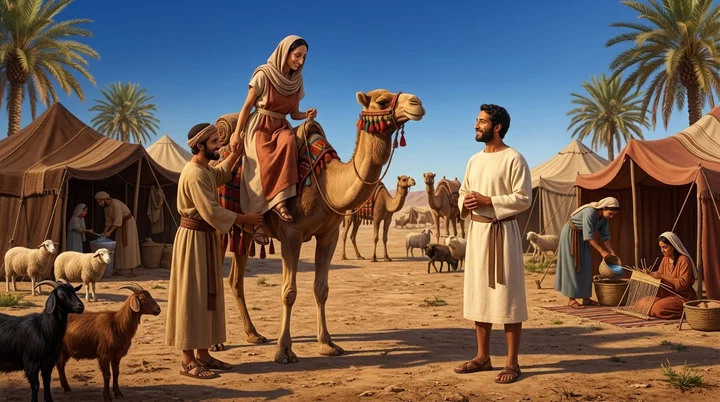
Cross-references
- Genesis 24:67
And Isaac brought her into his mother Sarah’s tent, and took Rebekah, and she became his wife; and he loved her: and Isaac was comforted after his mother’s death.
Completes the account of Isaac and Rebekah’s marriage.
- Genesis 24:3-4
And I will make thee swear by the LORD, the God of heaven, and the God of the earth, that thou shalt not take a wife unto my son of the daughters of the Canaanites, among whom I dwell:
Abraham directs the choice of a wife for Isaac.
Commentary
Each commentary is drawn from primary sources: the writings of Ellen G. White and Adventist pioneers and periodicals. Each commentary is separate. Its own words are not a quotation; follow the references to read the source passages.
Ellen G. White
5 sources
Genesis 24:62 belongs to the account of Isaac's marriage to Rebekah, centering on Abraham's arrangements carried out through his father's servant.SG3 112.3CE 228.1–230.1SG3 112.1–2ST Apr 10, 18791SP 104.3 The verse locates Isaac as dwelling in the south country, giving the setting in which he awaited the outcome of that mission.CE 228.1–230.1 That whole marriage account stands as a tender picture of domestic happiness.CE 228.1–230.1
The account shows that Abraham's training and education had produced in Isaac a life of noble, willing obedience.SG3 112.3ST Apr 10, 1879 At forty years old, Isaac submitted his choice of a wife to his father's direction.SG3 112.1–21SP 104.3 He trusted God to guide his father's servant in choosing a wife for him.SG3 112.1–2 He treated the choice of a wife as a matter for prayer.1SP 104.3 His conduct in this is an example for children who profess to fear God.SG3 112.1–21SP 104.3
The account teaches parents to guide their children's affections and to help them choose suitable marriage partners.SG3 112.3ST Apr 10, 1879 It teaches children to respect parental authority.SG3 112.3
Sources
Pioneers and periodicals
8 sources
Genesis 24:62 falls within the account of God's providential dealings with Abraham and his family, the family chosen as the line through which the promised Seed would come, including the sending of his trusted servant to obtain a wife for Isaac, and the whole account is to be read with the Promised Seed in mind.ST Dec 20, 1910ST The chapter shows Abraham's concern to secure a wife for Isaac from the godly line, so that the promised line would be preserved rather than joined with the ungodly.ST Aug 3, 1915 The account of Isaac in Genesis 24 continues the family through which the Seed was to come, with the promises extending from Abraham to Isaac and from Isaac to Jacob.ST Jan 14, 1913 It is the account in which God Himself selects a wife for Isaac through prayerful human agencies, parental counsel and prayer, and heavenly companionship, and Isaac shares the faith of Abraham, Eliezer and others by trusting the Lord's guidance rather than chance, with prayer preceding and thanksgiving following every important act, with self kept out of sight and God and others put first.ST Sep 15, 1898
The account shows Isaac's willing obedience and deference to his father's wishes and judgment in the matter of his marriage, reflecting a father's training that led him to love a life of obedience.ST Apr 10, 1879ST Jul 9, 1874 That deference testifies that honor to parents as enforced in the fifth commandment was not a new idea at Sinai but already controlled God's chosen servants among the patriarchs.ST Jul 9, 1874 The verse belongs to the simple yet romantic marriage of Isaac and Rebekah, which shows that marriage is a holy thing coming down from sinless Eden, ordained in the beginning when God took substance from near the heart of man and made woman to be a companion in holy service.ST Apr 5, 1905 Marriage is honorable in all, with a prudent wife from the Lord who does her husband good and not evil, and this marriage joins that of Boaz and Ruth in exalting marriage.ST Apr 5, 1905 It stands as a symbol of the union between Christ and the individual soul, Christ and His church, and Christ and His everlasting kingdom, when Christ takes His bride, the children all come home, and Bride and Bridegroom rejoice together.ST Apr 5, 1905
The account teaches parents to guide their children's affections and help them choose suitable marriage partners, to command, instruct and pray for their children, and teaches children to honor that guidance.ST Apr 10, 1879ST Sep 15, 1898
Sources