Genesis 24:65
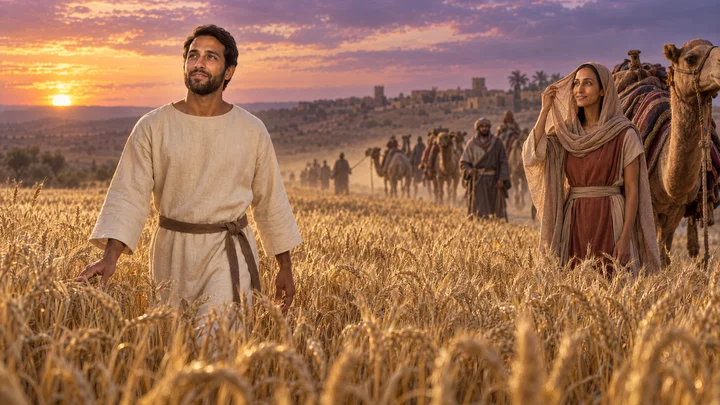
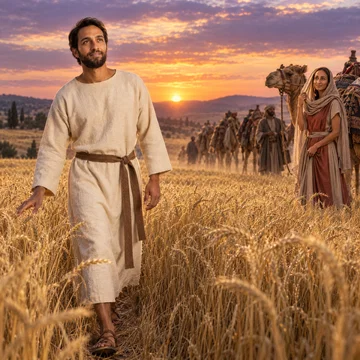
For she had said unto the servant, What man is this that walketh in the field to meet us? And the servant had said, It is my master: therefore she took a vail, and covered herself.
Translations
For she had said to the servant, What man is this that walks in the field to meet us? And the servant had said, It is my master: therefore she took a veil, and covered herself.
King James Version, KJV Cambridge Paragraph Bible
For she had said unto the servant, What man is this that walketh in the field to meet us? And the servant had said, It is my master: therefore she took a vail, and covered herself.
For she had said to the servant, What man is this that walketh in the field to meet us? And the servant had said, It is my master: therefore she took a vail and covered herself.
Revised Version, American Standard Version
And she said unto the servant, What man is this that walketh in the field to meet us? And the servant said, It is my master: and she took her veil, and covered herself.
and she saith unto the servant, 'Who [is] this man who is walking in the field to meet us?' and the servant saith, 'It [is] my lord;' and she taketh the veil, and covereth herself.
And she had said to the servant, Who is the man that is walking in the fields to meet us? And the servant said, That is my master! Then she took the veil, and covered herself.
and said unto the servant, Who is this man that is walking in the field to meet us? And the servant said, That, is my lord. So she took the veil and covered herself.
Berean Standard Bible, Majority Standard Bible
and asked the servant, “ Who is that man in the field coming to meet us?”“ It is my master,” the servant answered. So she took her veil and covered herself.
She said to the servant, “ Who is the man who is walking in the field to meet us?”The servant said, “ It is my master.”She took her veil, and covered herself.
And said to the servant, Who is that man coming to us through the field? And the servant said, It is my master: then she took her veil, covering her face with it.
(For shee had sayde to the seruant, Who is yonder man, that commeth in the fielde to meete vs? and the seruant had said, It is my master) So she tooke a vaile, and couered her.
Douay-Rheims (Challoner revision)
And said to the servant: Who is that man who cometh towards us along the field? And he said to her: That man is my master. But she quickly took her cloak, and covered herself.
Pictures
Cross-references
- Genesis 24:3-4
And I will make thee swear by the LORD, the God of heaven, and the God of the earth, that thou shalt not take a wife unto my son of the daughters of the Canaanites, among whom I dwell:
Abraham directs the servant to find Isaac a wife from his kindred, not the Canaanites.
Commentary
Each commentary is drawn from primary sources: the writings of Ellen G. White and Adventist pioneers and periodicals. Each commentary is separate. Its own words are not a quotation; follow the references to read the source passages.
Ellen G. White
6 sources
Genesis 24:65 belongs to the account of Rebekah's journey to marry Isaac, describing their first meeting when, on learning that the man walking in the field to meet them was her future husband, she took a veil and covered herself.PP 171.3CE 228.1–230.1 Abraham sought a wife for Isaac from his kindred in Mesopotamia so that Isaac could remain in Canaan and preserve the worship of the true God.PP 171.3 In doing so Abraham trusted God to guide the choice of a wife for his son.PP 171.3
The marriage was arranged under his father's judgment and entrusted to his God-fearing servant.SG3 112.1–2ST Apr 10, 1879CE 228.1–230.1 The servant entrusted with the arrangement was experienced.ST Apr 10, 1879CE 228.1–230.1 Isaac was forty at the time of this marriage arrangement.SG3 112.1–2 He accepted his father's arrangement through the servant in obedience and in trust in God's direction.SG3 112.1–2ST Apr 10, 18791SP 104.3
The account of Isaac's marriage is a tender picture of domestic happiness.CE 228.1–230.1 It stands as a record meant to show parents' responsibility to guide their children's affections toward suitable marriage companions and to teach them to respect parental authority.SG3 112.3ST Apr 10, 1879 It is held up as an example for children to follow in later generations, especially those who profess to fear God.SG3 112.1–21SP 104.3
Sources
Pioneers and periodicals
8 sources
Rebekah asked the servant who the man walking in the field to meet them was, and when told he was Isaac, her future husband, she covered herself with a veil. This meeting immediately preceded their marriage, and Isaac's welcome of Rebekah brought him comfort after his mother's death. It closed Rebekah's long journey of faith, undertaken with a heart full of trust while wondering what her new home and life and love would be.ST Feb 17, 1914 Meanwhile Isaac waited in the fields in the glow of the evening in joyful anticipation and longing, praying with Abraham's faith for the safe arrival of the precious caravan coming across the desert.ST Feb 17, 1914 When Isaac lifted his eyes and saw the approaching camels his heart thrilled, and when Rebekah saw him she alighted from her camel and veiled her face.ST Feb 17, 1914
Her act of covering herself with a veil upon learning the approaching man was her master is an emblem of a maiden's modesty before a man.ST Aug 12, 1913ST Feb 17, 1914 The veil covered her beauty and jewels, hiding them from view at a distance, but making them more admired when they appeared.RH Jan 30, 1866 Isaac's marriage illustrates his reliance on his father's judgment and the obedient character formed by his upbringing, with the detail of Rebekah's veil left without further explanation. The verse belongs to the closing step of God's progressive dealings with Abraham, the father of the faithful, when Abraham fully trusted God and sent his tried servant to obtain a wife for Isaac.ST Dec 20, 1910 The bringing of Rebekah to Isaac carried forward the Promised Seed through the divinely chosen line.ST Dec 20, 1910
God Himself selected Rebekah as wife for Isaac through prayer, faithful agencies, and divine guidance and accompaniment.ST Sep 15, 1898 Every important act was preceded by prayer and followed by thanksgiving, self was kept out of sight in selfless service to the master, and mere chance had no place for a servant of God.ST Sep 15, 1898 Isaac's marriage was guided by his father and entrusted to an experienced, God-fearing servant, and Isaac's acceptance of this arrangement is an example of obedience and trust in God's direction.ST Apr 10, 1879 The account teaches parents' responsibility to guide their children's affections toward suitable marriage companions.ST Apr 10, 1879 It teaches parents, children, and all who pray for God's work faith, obedience, and trust in the Lord's leading.ST Apr 10, 1879ST Sep 15, 1898
Isaac's deference to his father's wishes in his marriage shows honor to parents as required by the fifth commandment.ST Jul 9, 1874 That commandment was not new at Sinai but was already known and controlled God's chosen servants, and the ten commandments were the subsisting law by which God governed the human race for twenty-five hundred years before Sinai.ST Jul 9, 1874 The verse shows the simple yet romantic marriage of Isaac and Rebekah.ST Apr 5, 1905 Marriage is among the holy things come down from sinless Eden, ordained in the beginning, honorable in all, and exalted by their example.ST Apr 5, 1905 Their marriage is symbolic of the union between Christ and the individual soul, between Christ and His church, and between Christ and His everlasting kingdom, when He takes His bride, the children all come home, and Bride and Bridegroom rejoice together.ST Apr 5, 1905
Sources