Genesis 4:22
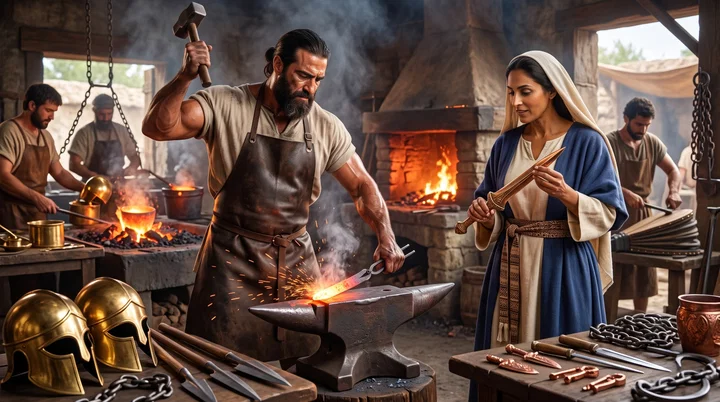
And Zillah, she also bare Tubal-cain, an instructer of every artificer in brass and iron: and the sister of Tubal-cain was Naamah.
Translations
American King James Version, Webster Bible
And Zillah, she also bore Tubalcain, an instructor of every artificer in brass and iron: and the sister of Tubalcain was Naamah.
And Zillah, she also bare Tubal-cain, an instructer of every artificer in brass and iron: and the sister of Tubal-cain was Naamah.
And Zillah, she also bare Tubal-cain, an instructor of every artificer in brass and iron: and the sister of Tubal-cain was Naamah.
Revised Version, American Standard Version
And Zillah, she also bare Tubal-cain, the forger of every cutting instrument of brass and iron: and the sister of Tubal-cain was Naamah.
And Zillah she also bare Tubal-Cain, an instructor of every artificer in brass and iron; and a sister of Tubal-Cain [is] Naamah.
And Zillah, she also bore Tubal-Cain, the forger of every kind of tool of brass and iron. And the sister of Tubal-Cain was Naamah.
And, as for Zillah, she also, bare Tubal-Cain, a sharpener of every cutting instrument of bronze and iron,—and, the sister of Tubal-Cain, was Naamah.
Berean Standard Bible, Majority Standard Bible
And Zillah gave birth to Tubal-cain, a forger of every implement of bronze and iron. And the sister of Tubal-cain was Naamah.
Zillah also gave birth to Tubal Cain, the forger of every cutting instrument of bronze and iron. Tubal Cain’s sister was Naamah.
And Zillah gave birth to Tubal-cain, who is the father of every maker of cutting instruments of brass and iron: and the sister of Tubal-cain was Naamah.
And Zillah also bare Tubal-kain, who wrought cunningly euery craft of brasse and of yron: and the sister of Tubal-kain was Naamah.
Douay-Rheims (Challoner revision)
Sella also brought forth Tubalcain, who was a hammerer and artificer in every work of brass and iron. And the sister of Tubalcain was Noema.
Pictures
Cross-references
- Genesis 4:17
And Cain knew his wife; and she conceived, and bare Enoch: and he builded a city, and called the name of the city, after the name of his son, Enoch.
Both trace developments in Cain’s line, including city-building and mechanical work.
- Genesis 4:16
And Cain went out from the presence of the LORD, and dwelt in the land of Nod, on the east of Eden.
Locates Tubal-cain's family in Nod, apart from God's presence.
- Genesis 5:28-31
And Lamech lived an hundred eighty and two years, and begat a son:
gives the other Lamech against Cainite Lamech
Commentary
Each commentary is drawn from primary sources: the writings of Ellen G. White and Adventist pioneers and periodicals. Each commentary is separate. Its own words are not a quotation; follow the references to read the source passages.
Ellen G. White
6 sources
The fourth chapter of Genesis tells the whole story of the first family after the fall and is to be read carefully, showing Cain as a tiller of the ground and Abel as a keeper of sheep, with tilling the soil as God's appointed healthful employment of man's physical powers.Lt 10, 1909, par. 4–9 The mention of Tubal-cain marks one step in the dark history of Cain and his descendants after Cain withdrew from his father's household and went out from the presence of the Lord, casting away the promise of the restored Eden to seek possessions and enjoyment in the earth under the curse of sin.PP 78.1–2PP 81.1 His descendants became distinguished in mere earthly and material progress and city-building civilization, standing at the head of that great class who worship the god of this world, but they were regardless of God and in opposition to His purposes for man.ST Nov 2, 1915PP 81.1
The verse shows the beginning of metalworking skill that grew into inventions of art and human skill greater than those known today, using the great gifts God had given men with gold and silver in abundance, as the long-lived race constantly sought to exceed one another in devices.7MR 367.1 That setting is contrasted with those who remained faithful to God and lived among fields and hills, where labor, study, and meditation helped them learn of God and teach their children.ST Nov 2, 1915 Enoch separated from Cain's descendants because of their increasing wickedness.ST Feb 20, 1879
Cain had merited death for his crimes, yet his life was spared to give opportunity for repentance.PP 78.1–2 Led on by Satan, he lived only to harden his heart, to encourage rebellion against divine authority, and to become the head and tempter of a line of bold, abandoned sinners whose example and influence exerted demoralizing power.PP 78.1–2 The Lord was forgotten, violence filled the earth until it became corrupt and filled with violence so as to call for its destruction, and men devised how to contend with heaven and gain possession of Eden.PP 78.1–27MR 367.1 Fifteen centuries after the sentence on Cain the fruition of his influence and example appeared in the crime and pollution that flooded the earth, until those greater arts were destroyed in the Flood.PP 78.1–27MR 367.1
Sparing the first murderer presented before the whole universe a lesson bearing on the great controversy, illustrating what would have resulted from permitting the sinner to live on forever in rebellion against God, since the forbearance of God only made the wicked more bold and defiant.PP 78.1–2 This makes manifest that the sentence of death pronounced on the fallen race for transgression of God's law was both just and merciful, for the longer men lived in sin the more abandoned they became.PP 78.1–2 The divine sentence cutting short a career of unbridled iniquity and freeing the world from the influence of those hardened in rebellion was a blessing rather than a curse.PP 78.1–2
Sources
Pioneers and periodicals
33 sources
The verse records a son of the Cainite Lamech who became the first teacher of metalworkers in copper and iron, and names his sister Naamah.RH Dec 23, 1915RH Dec 25, 1913RH Dec 6, 1870ST Oct 16, 1879 Lamech himself was the first polygamist in the record and a murderer like Cain, boasting of killing and claiming seventy-sevenfold vengeance.RH Apr 2, 1908RH Mar 1, 1870RH Dec 25, 1913 His family belongs to Cain's line, which stands distinct from and unlike Seth's godly line that preserved worship through men such as Enoch and Noah.RH Dec 23, 1915ST Oct 16, 1879ST Jul 27, 1915 Their skill in crafts and city-building shows the first generations possessed intellect and a splendid civilization rather than beginning as primitive savages.RH Dec 25, 1913RH Dec 6, 1870ST Jun 25, 1902RH Sep 15, 1904 Yet that progress did not keep them from forgetting God and living for this world, for civilization is not sanctification and without the regenerating grace of Christ it becomes corrupt.RH Dec 25, 1913ST Jun 24, 1889
Setting in Early Genesis
Genesis 4:22 belongs to the six-generation record of Cain's family given after the murder of Abel, reaching nearly to the time of the Flood.RH Dec 23, 1915ST Oct 16, 1879ST Sep 5, 1895 It names Tubal-cain as a son of the Cainite Lamech and Naamah as his sister, in the line running Cain-Enoch-Irad-Mehujael-Methusael-Lamech.RH Dec 23, 1915RH Mar 1, 1870RH Dec 23, 1915 After Cain went out from God's presence manifested at the gate of Paradise to live in the land of Nod east of Eden, his posterity grew up at a distance in separation from God in wickedness.RH Dec 23, 1915ST Oct 16, 1879 Cain himself did not repent of his sin but murmured at his punishment and desired separation, and his works were evil while Abel's were righteous.ST Oct 16, 1879
That Cainite line is distinct from and unlike Seth's godly family that leads to Noah.RH Dec 23, 1915ST Oct 16, 1879RH Dec 25, 1913 The worship of God was perpetuated and maintained through Seth's family by such men as Enoch and Noah, and because of the wickedness of Cain's family Eve had no hope in it but her hopes centered in Seth given to take Abel's place.ST Oct 16, 1879 The two lines stand side by side with closely mirroring names — Cain and Cainan, Enoch and Enoch, Irad and Jared, Mehujael and Mahalaleel, Methusael and Methuselah, Lamech and Lamech — showing outward likeness with inward unlikeness in character and standing before God.RH Dec 23, 1915 The Enoch who lived in Nod is not the Enoch who walked with God, and the Lamech who took two wives and killed a man is not the Lamech who fathered Noah, and while ages are given for Seth's line no ages are counted for this Cainite line, as if their mislived years were not worth counting.RH Dec 23, 1915 Enough of Cain's line is recorded to show its wholly irreligious and ungodly character in contrast with the godly line.ST Oct 16, 1879ST Jul 27, 1915
Lamech was the first polygamist so far as the record shows, taking two wives and setting himself against the Creator's plan.RH Apr 2, 1908RH Mar 1, 1870 He was the seventh from Adam and contemporary with Enoch.RH Mar 1, 1870 He was not only the descendant of a murderer but a murderer himself like Cain, boasting that he had slain a man for wounding him and a young man for bruising him, and claiming seventy and sevenfold vengeance if Cain should be avenged sevenfold.RH Apr 2, 1908 Genesis 4:1-26 is the only existing record about Cain and his descendants, and it gives only a brief account with few details, not explaining Tubal-cain or Naamah individually.ST Apr 5, 1905RH Jul 23, 1914 It does not say where Cain obtained his wife or how long after creation he married, but the long lifespans of the early people allow time for the human family to grow, with many years elapsing after the killing of Abel before Cain married one who was at least his sister, a daughter of Adam or Seth, and after he reached Nod he and his wife had sons and daughters there over great spaces of time covered in few verses to show how wickedness continued and what it resulted in.RH Jul 23, 1914ST Sep 5, 1895ST Mar 8, 1910
The placing of the birth of Seth and of other sons and daughters after the Cainite genealogy does not prove that Tubal-cain was born before Seth was born, for events in the Bible are not always in chronological order.ST Sep 5, 1895ST Feb 3, 1904 The verse stands in the antediluvian world that God highly favored with length of life twelve-fold the present age of man, with Adam's presence for almost one thousand years after conversing with God in Paradise, with Enoch's three-hundred-year holy walk and his translation that he should not see death as a powerful testimony for truth and righteousness, and with the striving of God's Spirit with mankind.RH Dec 17, 1861 Despite these favors human perversity triumphed over gracious restraint, wickedness became great in the earth with every imagination of the thoughts of the heart only evil continually, even the sons of God joined the general apostasy, until a single family was all that remained of the worshipers of the Most High.RH Dec 17, 1861 Enoch separated from Cain's descendants because of their increasing wickedness, and Cain's entire family without a single exception finally perished in the Flood.ST Feb 20, 1879ST Oct 16, 1879
The chapter gives the first mention of sacrificing, where Cain brought an offering of the fruit of the ground and Abel brought of the firstlings of his flock and of the fat thereof.ST Jul 1, 1889 Abel was accepted and obtained witness that he was righteous because he offered by faith and did well, while Cain did not do well and his cheaper substitute that cost less than the required sacrifice was not respected and sin lay at the door.RH Jun 25, 1901ST Jul 1, 1889 God's principle is that doing what is required precedes receiving its benefit, and Cain's crime brought punishment in this life when the ground would no longer yield its strength to him and he would be a fugitive and wanderer.RH Jun 25, 1901 The verse is part of the first ten chapters of Genesis whose historic character is affirmed against evolutionary claims that undermine confidence in those chapters.RH Aug 23, 1906 Its narrative about the beginnings of the race is consistent and harmonious, so that studying it gives valuable knowledge that prepares one to answer every questioner.ST Dec 22, 1898
Crafts and Early Civilization
Tubal-cain was the first artificer, an instructor or teacher of every artificer in brass and iron, who introduced metalworking as part of the mechanical lines of work taken up after departing from God's plan of pastoral living.RH Dec 25, 1913RH Mar 26, 1861RH Sep 25, 1913 Early men labored as miners and metalworkers, smelting iron and copper and shaping them into useful implements.RH Dec 6, 1870 They were skilled in metalwork in brass and iron at that early date just as they were skilled in music.RH Dec 6, 1870ST Dec 29, 1909
That skill is evidence that the first generations possessed practical skill, intellect, and knowledge of arts and crafts, with skilled craftspeople and a civilized society and splendid civilization with city-building.RH Dec 25, 1913RH Dec 6, 1870ST Jun 25, 1902 They did not begin as primitive savages gradually developing civilization.RH Dec 6, 1870RH Sep 15, 1904
His name and work were taken from the Hebrew religion and changed to suit carnal notions into the heathen god Vulcan, who rules over fire and looks after workers in iron and metals.RH Mar 26, 1861 He is pictured covered with sweat blowing forge fires, and also as lame and deformed holding a raised hammer while turning a thunderbolt on his anvil with pincers.RH Mar 26, 1861 He is the ancient prototype of the modern cannon maker, whose hand work and brain work over an antediluvian lifetime is surpassed by fifty years of modern labor and invention.ST May 6, 1889 His work is recalled as blows increasing day and night, portraying growing violence and the mobilization of the world for conflict.RH Sep 25, 1913
Naamah was the daughter of Cain and sister of Tubal-cain, and the first person who added ornament to female apparel.RH Sep 25, 1860 She is therefore the originator of fashionable adornment, and the outward adorning demanded by foolish and immodest fashions springs from her impure Cainite source.RH Sep 25, 1860 Since an impure fountain cannot send forth pure water, this origin condemns indulgence in such adornment.RH Sep 25, 1860
Corruption, Doctrine, and Warning
Polygamy is first found in the record of the descendants of Cain the murderer, to which this verse belongs, showing that it originated in that corrupt line and not with God.ST Apr 11, 1911 It was a sin that displeased God and helped bring the Flood upon the earth.ST Apr 11, 1911 Lamech's family stands as a counterfeit family institution opposed to God's plan for marriage and the perpetuity of the race, and as an attack upon His law, especially the seventh commandment.RH Apr 2, 1908 That disruption of God's purpose for marriage goes hand in hand with murder, for Lamech, a descendant of Cain the murderer, was himself a murderer who instituted polygamy in opposition to God's purpose for the family.RH Apr 2, 1908 Where that plan is followed the imagination works to debase and ruin morals, producing overflowing wickedness of thought and act and evils such as the murder of infant girls.RH Apr 2, 1908 Cain and Lamech in Genesis 4:8-24 show that people before Moses were accountable for personal sins, their guilt demonstrating that God's law and knowledge of it existed from Adam onward.ST Sep 2, 1875
The progress in arts and sciences and in building of cities among Cain's descendants could produce a splendid civilization, with Tubal-cain as the first artificer, yet it did not keep them from forgetting God and living for this world.RH Dec 25, 1913 The descendants of Cain originated the arts, sciences and amenities of life, with Tubal-cain's work in brass and iron as part of that increase of civilization and knowledge.ST Jun 24, 1889 That increase is not an increase of Christianity, for civilization is not sanctification and cannot produce it.ST Jun 24, 1889 The same line that produced civilization was polygamist and boastful, egotistical and murderous, so except there be sanctification civilization will merely become corrupt.ST Jun 24, 1889 The only means of converting the world, nations, or men is through the grace and regenerating power of the Lord Jesus Christ, for all must be born again.ST Jun 24, 1889 Against this city-building civilization of Cain's descendants stands the life of those who remained faithful to God and lived among fields and hills, where labor, study, and meditation helped them learn of God and teach their children.ST Nov 2, 1915
Sources