Jeremiah 10:3
For the customs of the people are vain: for one cutteth a tree out of the forest, the work of the hands of the workman, with the axe.
Translations
For the customs of the people are vain: for one cuts a tree out of the forest, the work of the hands of the workman, with the ax.
For the customs of the people are vain: for one cutteth a tree out of the forest, the work of the hands of the workman, with the axe.
For the customs of the people are vain:
For one cutteth a tree out of the forest,
The work of the hands of the workman, with the axe.For the customs of the people are vain: for one cutteth a tree out of the forest, the work of the hands of the workman, with the ax.
For the customs of the peoples are vanity: for one cutteth a tree out of the forest, the work of the hands of the workman with the axe.
For the customs of the peoples are vanity; for one cutteth a tree out of the forest, the work of the hands of the workman with the axe.
For the statutes of the peoples are vanity, For a tree from a forest hath one cut, Work of the hands of an artificer, with an axe,
For the statutes of the peoples are vanity; for [ it is] a tree cut out of the forest, worked with a chisel by the hands of the artizan;
For as for the prescribed customs of the peoples, vanity, they are,—For a tree out of the forest, one cutteth down, Work for the hands of a skilled workman with the axe:
Berean Standard Bible, Majority Standard Bible
For the customs of the peoples are worthless;
they cut down a tree from the forest;
it is shaped with a chisel
by the hands of a craftsman.For the customs of the peoples are vanity;
for one cuts a tree out of the forest,
the work of the hands of the workman with the ax.For that which is feared by the people is foolish: it is the work of the hands of the workman; for a tree is cut down by him out of the woods with his axe.
For the customes of the people are vaine: for one cutteth a tree out of the forest (which is the worke of the handes of the carpenter) with the axe,
Douay-Rheims (Challoner revision)
For the laws of the people are vain: for the works of the hand of the workman hath cut a tree out of the forest with an axe.
Pictures
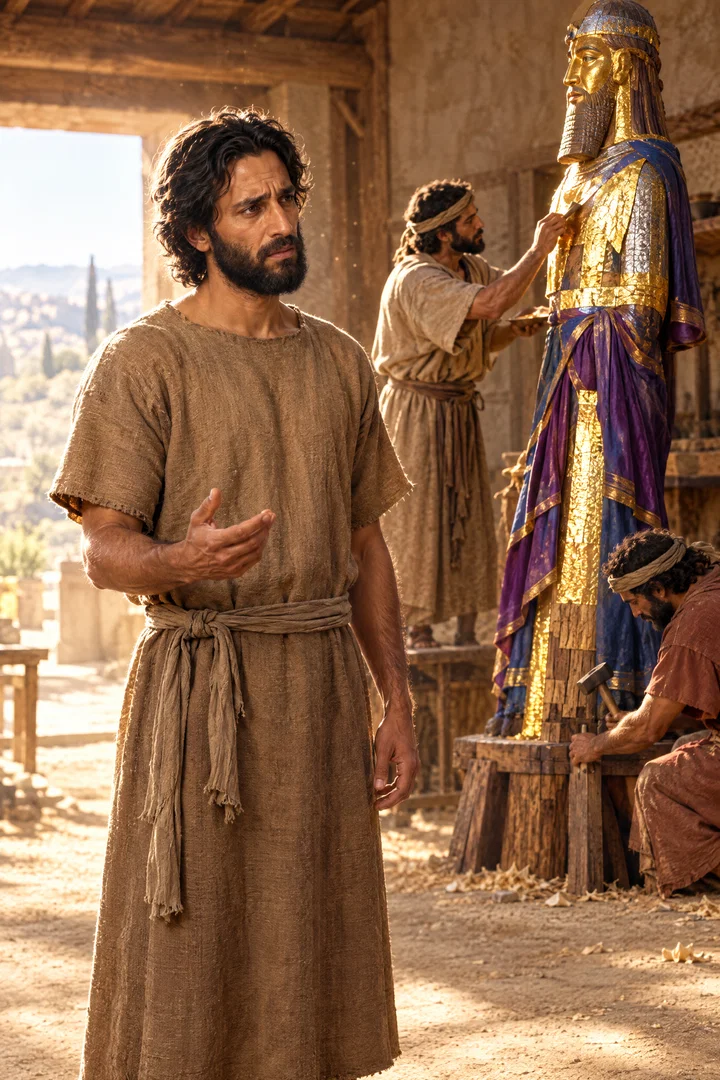
Cross-references
- Acts 17:24
God that made the world and all things therein, seeing that he is Lord of heaven and earth, dwelleth not in temples made with hands;
Paul identifies the true God to the Athenians as Maker of the world.
- Jeremiah 10:11-12
Thus shall ye say unto them, The gods that have not made the heavens and the earth, even they shall perish from the earth, and from under these heavens.
Contrasts powerless handmade gods with the God who made the earth.
- Isaiah 2:8
Their land also is full of idols; they worship the work of their own hands, that which their own fingers have made:
Both passages describe people worshiping things made by their own hands.
- Isaiah 42:8
I am the LORD: that is my name: and my glory will I not give to another, neither my praise to graven images.
Both reject giving God’s glory to graven images.
- Acts 14:15
And saying, Sirs, why do ye these things? We also are men of like passions with you, and preach unto you that ye should turn from these vanities unto the living God, which made heaven, and earth, and the sea, and all things that are therein:
Both contrast vain idols with the living God who made heaven and earth.
- Psalms 115:4
Their idols are silver and gold, the work of men’s hands.
Both distinguish the true God from idols made by human hands.
- Leviticus 18:3
After the doings of the land of Egypt, wherein ye dwelt, shall ye not do: and after the doings of the land of Canaan, whither I bring you, shall ye not do: neither shall ye walk in their ordinances.
It warns Israel not to follow the practices of other nations.
Commentary
Each commentary is drawn from primary sources: the writings of Ellen G. White and Adventist pioneers and periodicals. Each commentary is separate. Its own words are not a quotation; follow the references to read the source passages.
Ellen G. White
1 source
The verse stands as part of a divine warning not to learn the way of the heathen and not to be dismayed or afraid at their signs.FE 171.2–172.1 The customs of the peoples are declared vain and empty in themselves.FE 171.2–172.1 That emptiness lies in this, that their gods are cut as a tree out of the forest and shaped by the hands of a workman with the axe, made by human hands from wood.FE 171.2–172.1 Against these handmade idols stands the living God, who created the world and who sustains it.FE 171.2–172.1
Sources
Pioneers and periodicals
26 sources
The verse describes cutting a tree from the forest and shaping it with the axe by a craftsman's hands into an object of worship, showing that idols are products of human hands and not creators.ST Feb 13, 1901ST Jun 17, 1875ST May 27, 1880 Such customs are empty and vain, for it is foolish and inconsistent to treat what man has made as a god when it is powerless to protect or to harm.ST Feb 13, 1901RH Mar 17, 1903ST Dec 30, 1903ST Feb 13, 1901ST Apr 2, 1902 It sets these lifeless human works against Jehovah, the true and living God, the Creator of heaven and earth and Former of all things, while gods that did not make heaven and earth shall perish.RH Sep 10, 1872ST May 28, 1885 Creation is the invariable test by which Scripture distinguishes the true God from false gods, and the seventh-day Sabbath is His memorial, sign and seal because He made all things in six days and rested the seventh day.ST Oct 30, 1884ST Aug 2, 1877RH Apr 29, 1875 That the customs of the people are vain means popular acceptance, long-standing custom, numbers, or inheritance does not make a practice right, so calling Sunday the Christian Sabbath without divine command cannot replace obedience to God's command, while the righteous custom of Christ was to keep His Father's commandments and enter the synagogue on the Sabbath day.ST Dec 3, 1885ST Oct 23, 1893ST Nov 5, 1885ST Apr 7, 1881ST Apr 10, 1879
Words and Setting
Jeremiah 10 stands as a denunciation of Israel's idolatry, declaring the idolatrous customs of the people to be vain.ST Jul 22, 1913 It belongs to chapters 2-11, associated with prophecies written down by Baruch after Jehoiakim burned the first scroll, a book marked by symbolic language, appeals, warnings, and assurances of God's kindness and everlasting love.RH Jul 27, 1916
The verse pictures a person cutting a tree out of the forest and a craftsman shaping it by hand into an object of worship.ST Feb 13, 1901 The idols of the nations are thus made by human craftsmen from cut trees, products of human hands and not creators.ST Jun 17, 1875 The customs of the nations are empty in that people cut a tree from the forest and shape it with hands and tools and by human labor as part of idolatrous worship directed away from the Creator toward human-made objects.ST May 27, 1880RH Mar 7, 1854
To treat something made by human hands as a god is absurd.ST Feb 13, 1901 Such fashioning of gods out of a cut tree and then worshiping them is vain and absurd, a foolish and inconsistent superstition, and the reason and sense given by the Creator ought to enable every person to see that absurdity and the clear force of its exposure.ST Feb 13, 1901
Pagan image-making by cutting a tree from the forest with a workman's axe is empty and powerless.RH Mar 17, 1903 Heathen customs of cutting a tree from the forest and shaping it by human labor with an axe to make an idol produce gods powerless to protect or harm.ST Dec 30, 1903 Idols made from wood by human hands are so powerless that a wooden idol cannot get itself out of bed.ST Apr 2, 1902
The word rendered with expresses a tool or instrument, so the tree is cut with an axe and not beneath one.ST Oct 29, 1912 It illustrates that the Hebrew preposition beth, when used with a tool or instrument, means with.ST Oct 29, 1912
Creator and Sabbath Sign
Jeremiah 10 sets lifeless works of human hands against Jehovah, the true and living God, the Creator of heaven and earth and Former of all things.RH Sep 10, 1872ST May 28, 1885RH Mar 11, 1875RH Jan 8, 1875 The vain custom described is men cutting a tree from the forest and fashioning it by human hands into an object of worship, which shows idols are only human handiwork.RH Sep 10, 1872ST May 28, 1885RH Mar 11, 1875 Against these lifeless works stands the true God whose distinguishing character is power to create, while the gods that have not made heaven and earth shall perish and the Portion of Jacob is the Former of all things.RH Sep 10, 1872RH Mar 11, 1875 That contrast makes the Sabbath the sign or memorial of that exercise of creative power by which the Creator is known.RH Sep 10, 1872ST May 28, 1885RH Jan 8, 1875
Creation reveals Jehovah's power and Godhead and is the invariable test by which Scripture distinguishes the true God from false gods.ST Aug 2, 1877RH Apr 29, 1875 The worthless idols cut from the forest and shaped by workmanlike skill are set over against the living God who made heaven and earth, exposing the worthlessness of idol gods beside the Creator.ST Aug 2, 1877RH Apr 29, 1875 The customs of the nations are vain precisely because they honor what human hands have made instead of Him who made all things.ST Aug 2, 1877
The Sabbath is the memorial of that creation and rest, the sign whereby the true God the Creator is known.ST Oct 30, 1884RH Feb 14, 1871RH Jan 8, 1875 It memorializes God's creation and rest and serves as proof of His Creator title as Maker of all things in contrast to idols.ST Oct 30, 1884RH Feb 14, 1871 That title is the reason His Sabbath is His sign, because He made all things in six days and rested the seventh day.RH Feb 14, 1871RH Jan 8, 1875 To change it to another day destroys that sign of His authority as Creator.
That fact of creation lies at the foundation of the Sabbath institution by which God is known as Creator and distinguished from all other gods.ST Aug 2, 1877RH Mar 11, 1875RH Apr 29, 1875 Only the fourth commandment presents God as Creator of heaven and earth with His title, dominion, and right to reign, and therefore only it can distinguish Him from idol gods.ST Aug 2, 1877RH Apr 29, 1875 For that reason Jeremiah 10 proves the seventh-day Sabbath is His sign and seal between Him and His people that they may know He is the Lord, the only thing in the Bible so called.ST Aug 2, 1877RH Apr 29, 1875 It is the only part of the law that shows who the Lawgiver is, distinguishes Him from other gods, and gives His title of royalty, the extent of His dominion, and His right to reign.ST Aug 2, 1877RH Apr 29, 1875
Human Custom Tested
The customs of the people are vain, and popular acceptance or long-standing custom gives no proof that a course is right, for right is not settled by numbers, by inheritance, or by what the multitude follows, and this warning applies in every age.ST Dec 3, 1885ST Oct 23, 1893ST Nov 5, 1885ST Jan 29, 1885 A custom is not made right by a pious purpose or by the religious beliefs of those who follow it, but customs not grounded in God's word are vain unless they conform to the Bible and God's law.ST Apr 5, 1883ST Apr 7, 1881 A custom that changes or weakens God's law has no authority.ST Apr 5, 1883ST Apr 7, 1881
The same rule exposes Sunday observance, for majority Christian observance cannot show it correct and inherited custom cannot replace obedience to God.ST Nov 5, 1885ST Apr 7, 1881ST Apr 10, 1879ST Jan 29, 1885 Calling Sunday the Christian Sabbath gives it no authority, since it has no divine command and opposes God's command to keep the seventh-day Sabbath.ST Apr 7, 1881ST Apr 10, 1879 As customary falsehood cannot make lying right, so adopting Sunday and other heathen practices on the strength of majority custom cannot make them right, and even a religious majority within God's church can be wrong, for obedience to God matters more than professing to serve Him.ST Nov 5, 1885ST Jan 29, 1885
Against the vain custom of the world stands the righteous custom of Christ, who kept His Father's commandments and whose custom was to go into the synagogue on the Sabbath day, and all who abide in Him must walk as He walked and follow His steps.ST Oct 23, 1893 Trusting in one's own way and in the multitude brings wickedness, iniquity and lies.ST Oct 23, 1893 In Noah's day the multitude opposed the truth and Noah was in a hopeless minority, yet the flood came because the word of the Lord had said so, and when Christ came to His own they received Him not and rulers and Pharisees rejected Him, though He was the Son of God.ST Oct 23, 1893
The cutting of a tree from the forest to make an idol by a workman's axe belongs to God's warning to Israel not to learn the way of the nations nor fear their signs and idols, but to fear Jehovah, the great King of the nations who has none like Him.RH Mar 17, 1903 That warning applies now, because the same heathen principles entice people away from the true God even when image-making is mental instead of material, and the remedy is the same call to fear God and give Him glory.RH Mar 17, 1903 The same vanity appears in heathen idolatry still practiced, such as Chinese gods brought into temples in San Francisco in the heart of a Christian nation, fashioning gods with human hands out of a cut tree and then worshiping them, a foolish and inconsistent superstition whose absurdity the reason and sense given by the Creator ought to enable every person to see, so that worshipers ought promptly to abandon it when its foolishness strikes them.ST Feb 13, 1901 Mere words are not so powerful on the unenlightened mind as actions flowing from a powerful life, so the living Word seen in real life is needed with the spoken Word, for grasping dealing, unkind actions, and crooked betrayal of confidence by professing Christians hides the inconsistency of idolatry from the heathen and causes small results from mission work, calling for volunteers who represent God in real life and not in profession merely.ST Feb 13, 1901
Sources