Job 18:16
His roots shall be dried up beneath, and above shall his branch be cut off.
Translations
American King James Version, King James Version, Webster Bible, Revised Version
His roots shall be dried up beneath, and above shall his branch be cut off.
KJV Cambridge Paragraph Bible, American Standard Version
His roots shall be dried up beneath,
And above shall his branch be cut off.From beneath his roots are dried up, And from above cut off is his crop.
His roots shall be dried up beneath, and above shall his branch be cut off;
Beneath, let his roots be dried up, and, above, be cut off his branch;
Berean Standard Bible, Majority Standard Bible
The roots beneath him dry up,
and the branches above him wither away.His roots will be dried up beneath.
His branch will be cut off above.Under the earth his roots are dry, and over it his branch is cut off.
His rootes shalbe dryed vp beneath, and aboue shall his branche be cut downe.
Douay-Rheims (Challoner revision)
Let his roots be dried up beneath, and his harvest destroyed above.
Pictures
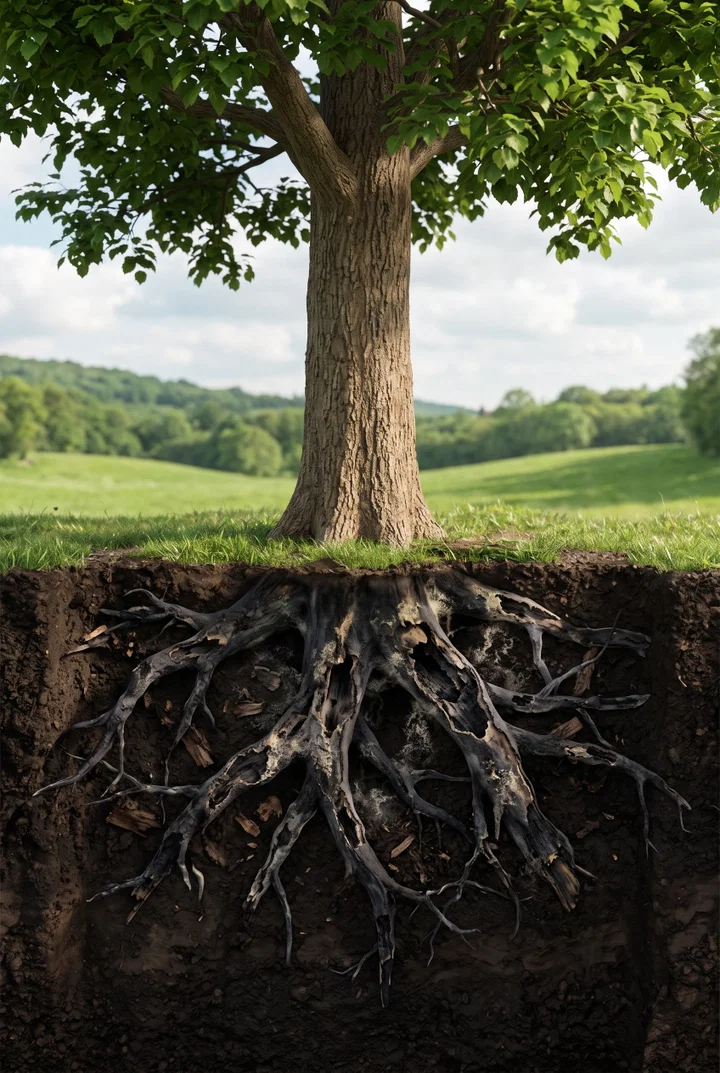
Cross-references
- Malachi 4:1
For, behold, the day cometh, that shall burn as an oven; and all the proud, yea, and all that do wickedly, shall be stubble: and the day that cometh shall burn them up, saith the LORD of hosts, that it shall leave them neither root nor branch.
The wicked are left with neither root nor branch.
- Isaiah 5:24
Therefore as the fire devoureth the stubble, and the flame consumeth the chaff, so their root shall be as rottenness, and their blossom shall go up as dust: because they have cast away the law of the LORD of hosts, and despised the word of the Holy One of Israel.
both picture root rotted and blossom gone as dust
- Psalms 37:2
For they shall soon be cut down like the grass, and wither as the green herb.
The wicked wither like grass.
- John 15:6
If a man abide not in me, he is cast forth as a branch, and is withered; and men gather them, and cast them into the fire, and they are burned.
both picture the wicked as dry branches burned
- Job 18:5
Yea, the light of the wicked shall be put out, and the spark of his fire shall not shine.
both describe the wicked put out and cut off
Commentary
Each commentary is drawn from primary sources: the writings of Ellen G. White and Adventist pioneers and periodicals. Each commentary is separate. Its own words are not a quotation; follow the references to read the source passages.
Pioneers and periodicals
7 sources
Job 18:16 belongs to Bildad's second speech, which describes the final doom of the wicked.RH Jan 6, 1916 It stands within the constant accusations, implied and otherwise, that Job's friends bring against Job in Job 8 through Job 27, which Job answers with his own replies.ST Jun 23, 1909 More specifically it is one of the declamations of Job's misguided friends found in Job 4, 5, 8, 11, 15, 18, 20, 22, and 25.ST Sep 21, 1904
The verse states the friends' general claim that evil is ultimately punished, but as applied to Job it was misapplied, since suffering does not prove that a person is under God's displeasure.ST Mar 27, 1893 Though put on record by inspiration, the misguided friends did not speak the truth about God or about Job.ST Sep 21, 1904 Their words are therefore not correct and reliable and are not rightly dividing the Word unless sustained by inspired declarations given elsewhere in the Bible, and where they contradict the teachings of Scripture they are not verity and truth but must be compared with other portions of the Bible to see if they are sustained.ST Sep 21, 1904
When so sustained, the verse describes the final doom of the wicked as complete destruction.RH Jan 6, 1916ST Apr 15, 1875 Its roots dried up beneath and its branch cut off above picture a plant killed from the roots below and stripped of growth above, with nothing left to live.ST Apr 15, 1875ST May 2, 1878 The end of the wicked is to be dried up underneath and cut off above like a dead plant.ST Apr 10, 1879
The sinner's fate is thus utter destruction, compared to perishable materials that are used up and gone.ST May 2, 1878 The wicked do not live on forever in fire but are burned up entirely and cease to exist.ST Apr 10, 1879 The verse is one of many comparisons to the most perishable materials — chaff, stubble, tares, dry branches, fat, thorns, wood, hay — that prove total consumption in the fire that melts the earth.ST Apr 10, 1879
Sources